

Routing loops cause packets to circulate between routers instead of being delivered. In some cases, these routers duplicate each looping packet over and over again, amplifying the resulting load exponentially. This unnecessary traffic can congest links, overwhelm routers, slow routing convergence, enable Distributed Denial-of-Service (DDoS) attacks, and ultimately reduce the stability and reliability of the Internet.
In a recent measurement study, we found that, despite being easy to fix, routing loops and amplification of looping packets are fairly common. This suggests that the network operator community is not prioritizing these issues.
In this blog post, we want to draw attention to the impact of routing loops and amplification of looping packets so that these misconfigurations are hopefully solved in the future.
Providers often hand out large chunks of so-called provider-aggregatable (PA) address space to their customers. Those customers often use only a small fraction of the assigned IPv6 address space, which can lead to routing loops if not properly configured. A serious bug in the firmware from common router vendors that is triggered by routing loops can lead to significant amplification. Unlike IPv4, this problem is more prevalent in IPv6 since the IPv6 address space is sparsely populated.
Routing loops are unnecessary and should be fixed! You can check whether your network is affected on the IPv6 Subnet-Router Anycast (SRA) Dataset.
What causes routing loops?
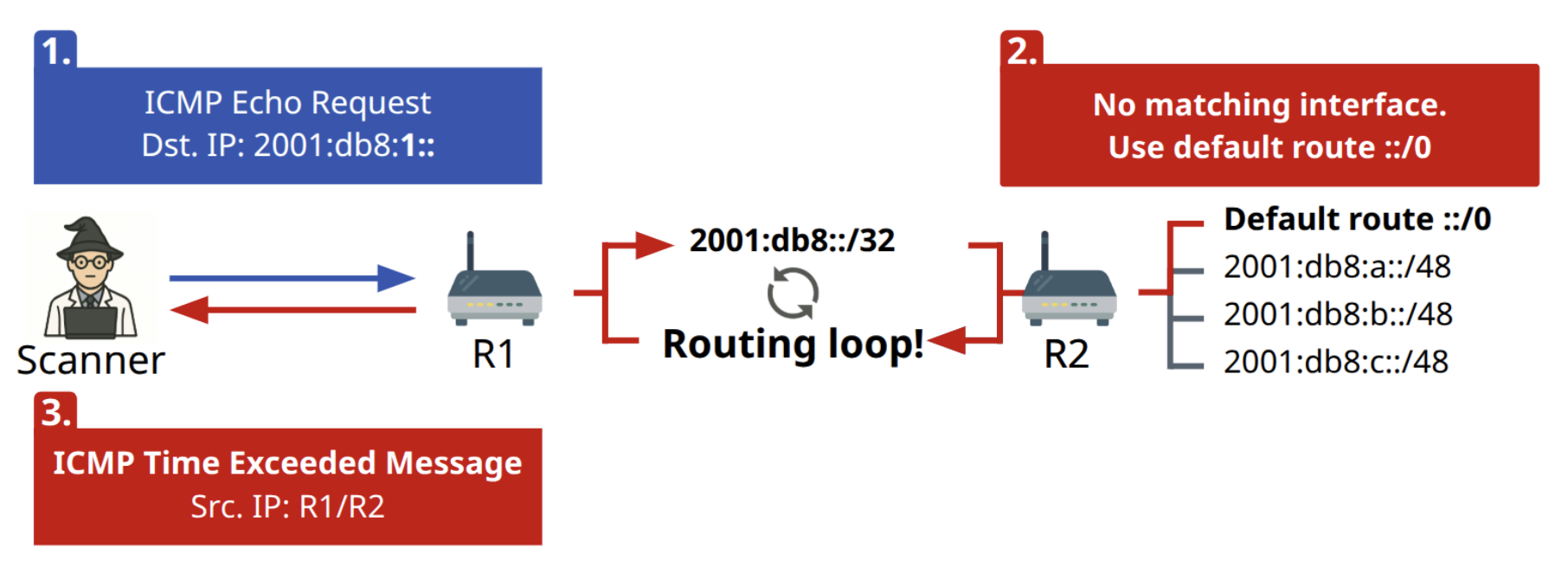
Internet routing loops often occur when the following two configurations collide.
- A provider maintains a downstream route to its customer. The customer, however, uses only some more specific prefixes of the covering route maintained by the provider. This covering downstream route makes both the used and unused address space reachable via the upstream of the customer.
- The customer also maintains a default route to the provider, packets to the unused address space are then sent back to the provider since the customer does not have any more specific route than the default route. Packets to the unused address space are sent back and forth between customer and provider until the hop limit is exceeded.
How to prevent routing loops?
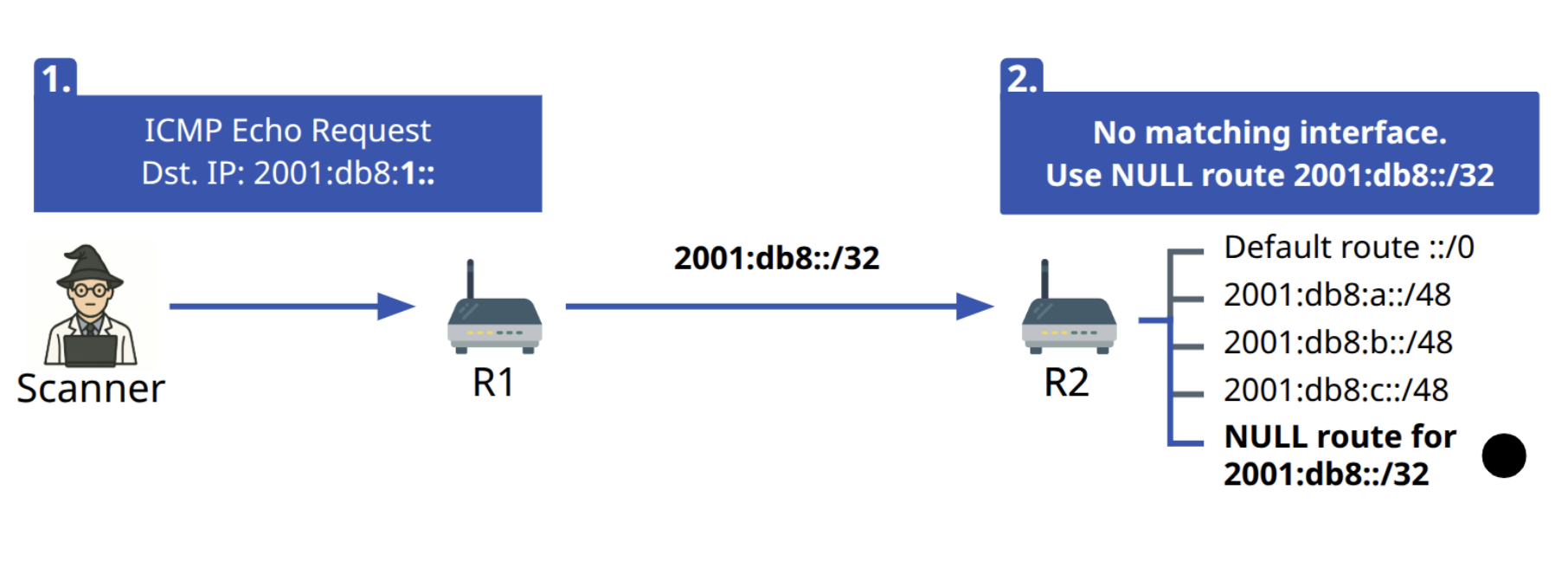
To prevent routing loops triggered by downstream peers of the customer, the customer router needs to drop packets destined to the unused address space.
In many router implementations, this is achieved by using null routes.
For example, a customer who has been assigned the prefix 2001:db8::/32 but only uses the parts 2001:db8::/34 and 2001:db8:8000::/34 must exclude traffic to 2001:db8:4000::/34 and 2001:db8:c000::/34 from further forwarding.
Instead of configuring each null routed prefix separately, many router configurations allow configuring a null route using a single line. On some Cisco and Juniper routers, null routes can be configured as follows:
Cisco IOS
ipv6 route 2001:db8::/32 Null0Juniper Junos OS.
set aggregate route 2001:db8::/32These configurations instruct the router to drop traffic to 2001:db8::/32 if no more specific route is available.
Amplification bug in the firmware from common router vendors
During our active scans, we discovered a serious bug in the firmware of common router vendors that is triggered by routing loops and can lead to significant amplification. A single ICMPv6 echo request can result in more than 250,000 replies from the same router.
We confirmed our observations with network operators and router vendors. Routing loops, in conjunction with the amplification bug, can be exploited for denial-of-service attacks, posing a significant risk to network security.
Global deployment of routing loops
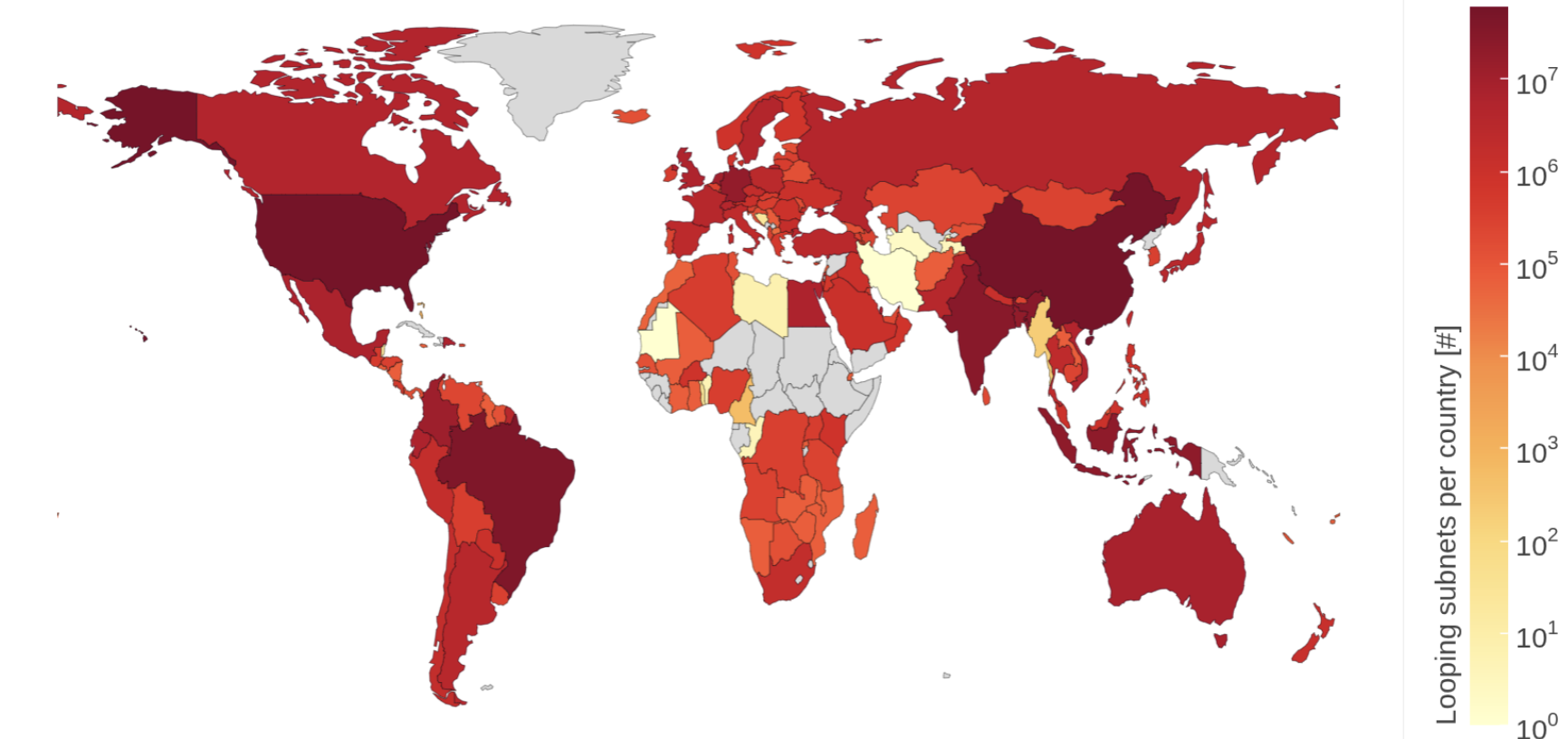
We observed routing loops triggered by 419M /64 subnets. These subnets affect 7.1M IPv6 router addresses, distributed in over 163 economies.
Most IPv6 routers involved in loops only have one misconfigured /64 subnet. But a tiny number of routers are responsible for an enormous number — over a million each — of broken /64 networks, making them disproportionately responsible for routing loops on the IPv6 Internet.
Global deployment of the amplification bug
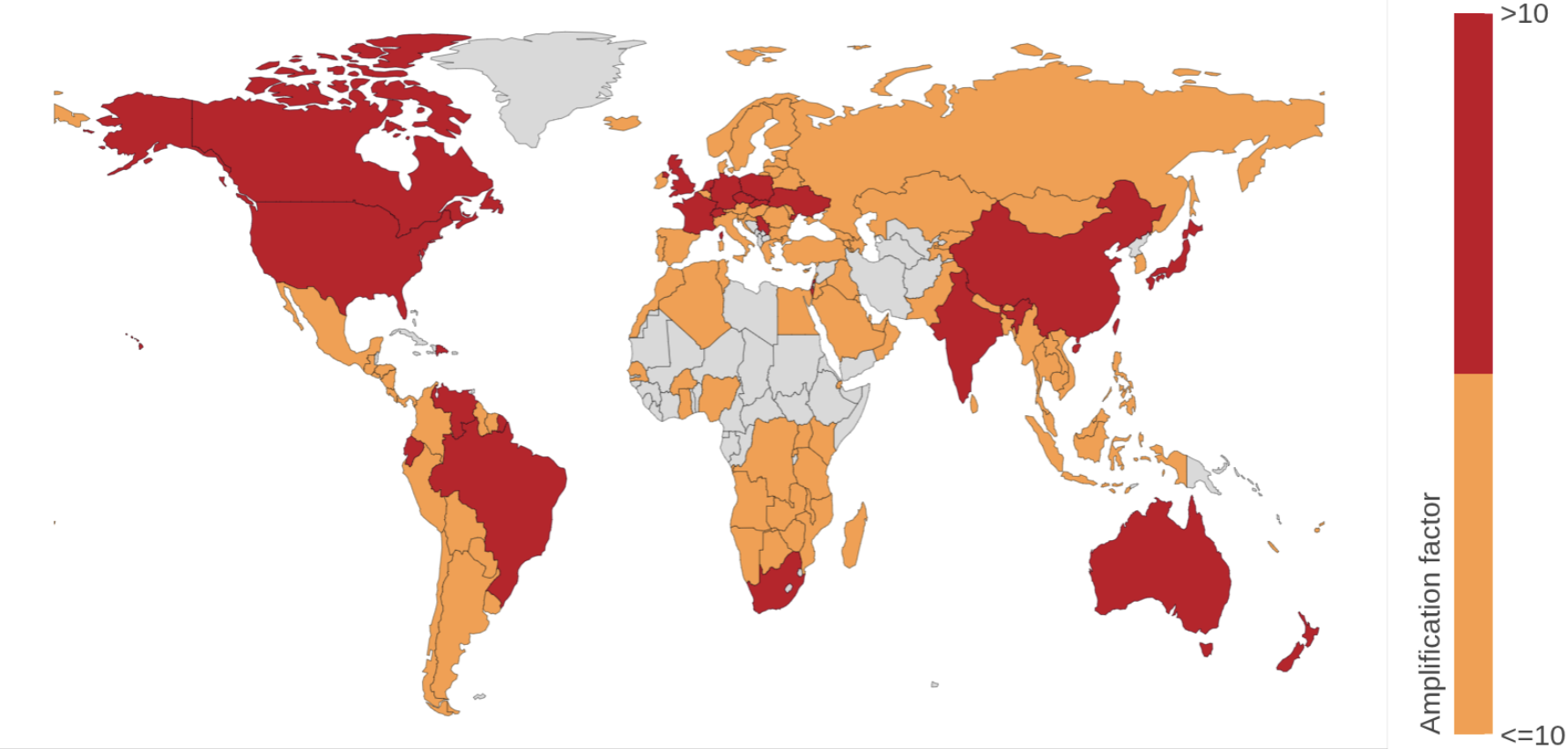
Of the 7.1M IPv6 router addresses affected by routing loops, 34k are also affected by amplification. These IPv6 router addresses are highly concentrated in Brazil (28%), India (19%), and China (16%).
While 87% of the amplification factors are below ten, a few routers amplify single ICMP Echo requests exponentially, significantly increasing the threat potential of these devices. These routers are primarily located in Brazil (80%) and China (17%). The highest amplification factors can be observed in Germany and Japan.
Two mitigation steps for network operators
- Check if your networks are affected. We publish our measurement results and provide a form to check if your network is affected by routing loops.
- To prevent routing loops, it is advised to set NULL routes for all unused subnets of the assigned address space if you deploy default routes.
More details are available in our publication ‘Scanning the IPv6 Internet Using Subnet-Router Anycast Probing’ presented at ACM CoNEXT 2025 and published in the Proceedings of the ACM on Networking Vol. 3, No. CoNEXT4, 2025.
Maynard Koch is a PhD student and research associate at the Chair of Distributed and Networked Systems at TU Dresden, supervised by Prof. Dr Matthias Wählisch. Before joining TU Dresden, he graduated with a BSc and MSc in Computer Science from Freie Universität Berlin. His research focuses on Internet measurements to improve network security. He is particularly interested in DNS and scalable IPv6 scanning.
The views expressed by the authors of this blog are their own and do not necessarily reflect the views of APNIC. Please note a Code of Conduct applies to this blog.