

Timor-Leste occupies the eastern half of the island of Timor, together with the Oecusse enclave and the islands of Atauro and Jaco, and is home to a population of around 1.44 million people. The economy has historically relied heavily on petroleum revenues and public spending. However, economic diversification and the development of a stronger domestic private sector have become increasingly important.
As Timor-Leste enters this new economic chapter, digital development has an important role to play. It can support access to online services, businesses, and e-commerce, while creating new opportunities in the digital economy. This has become increasingly important following Timor-Leste’s accession to the World Trade Organization (WTO) in 2024 and ASEAN in 2025. Regional integration increasingly encompasses digital trade, payments, cybersecurity, and cross-border data exchange.
Initiatives such as Timor Digital 2032, alongside the digitalization of government and trade services, are intended to support this development and strengthen the economy’s participation in the regional digital economy.
Internet adoption in Timor-Leste has grown considerably since 2021, when Internet penetration stood at 35%. Estimates for 2026 indicate that 62% of the population uses the Internet, largely through mobile connectivity, with 1.2 million mobile Internet subscriptions.
Timor-Leste’s underlying connectivity is also undergoing significant change. Low Earth Orbit (LEO) satellite services are extending access to remote communities, while the Timor-Leste South Submarine Cable System (TLSSC), which launched commercial operations in July 2026, provides the economy with its first international submarine fibre connection.
Together, these developments are creating a stronger foundation for faster and more resilient Internet access. However, affordability, last-mile connectivity, and digital literacy remain challenges.
Connectivity overview
Timor-Leste liberalized its telecommunications sector in 2012, introducing greater competition and supporting the expansion of mobile services across the economy. Today, three major telecommunications operators, Timor Telecom, Telkomcel, and Telemor, provide services alongside 19 ISPs.
The telecommunications operators provide the underlying network infrastructure, while ISPs deliver Internet access services to end users. However, the ISP market remains highly concentrated in Dili, where population density and commercial demand make fixed and wireless infrastructure more viable.
Outside the capital, the economics of deploying conventional ISP infrastructure are considerably more challenging. Lower population density and the cost of extending backhaul and access networks make it difficult for smaller providers to achieve a sufficient return on investment. This has created a distinct urban-rural divide in the way Internet services are delivered.
Satellite connectivity is helping extend coverage to more remote communities. Starlink has emerged as a key connectivity option, with some local ISPs reselling satellite-based services rather than investing in their own access infrastructure.
In 2026, the Ministry of Transport and Communications (MTC), with deployment support from Vorakai Lda, used Starlink to connect 450 remote villages. This has enabled connectivity to reach communities that would otherwise be difficult to serve with terrestrial networks. It also highlights the continuing challenge of developing sustainable domestic infrastructure beyond Dili.
Together, mobile networks, satellite services, and submarine cables are creating a more diverse connectivity environment. Timor-Leste is moving away from its historical dependence on satellite and microwave links for international connectivity. Submarine fibre is providing new international capacity, while LEO satellite services complement terrestrial networks in geographically isolated areas.
Internet infrastructure
Submarine cables
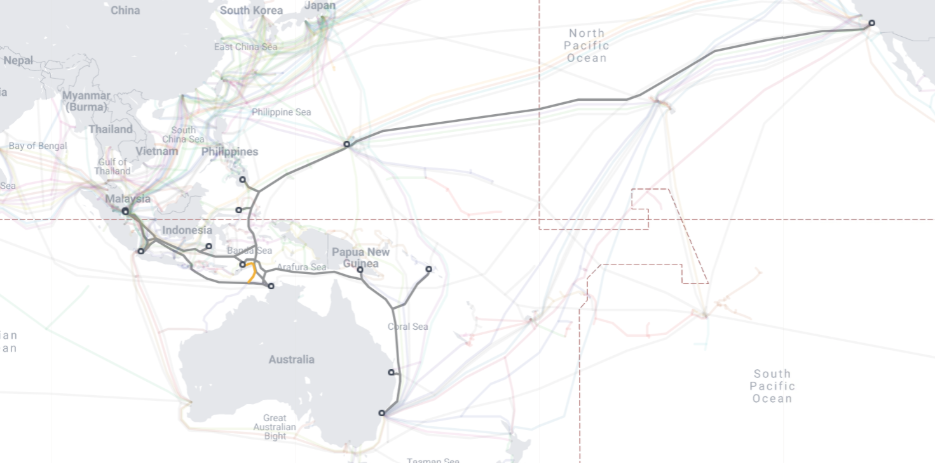
The TLSSC represents a significant development in Timor-Leste’s international Internet infrastructure. The system, owned by state-owned Cabos de Timor-Leste (CTL), launched commercial operations in July 2026, providing the economy with its first international submarine cable connection and reducing reliance on comparatively expensive and capacity-constrained satellite and radio links.
Further submarine cable developments could substantially increase international capacity and route diversity.
Inligo Networks’ planned Asia Connect Cable System (ACC-1) includes a landing in Dili and is designed to connect Timor-Leste directly with Australia, Indonesia, and Singapore, with onward connectivity to the Philippines, Guam, and the United States.
Timor-Leste could gain another international route through Hawaiki Nui 1, being developed by BW Digital. The planned 240Tbps system will connect Australia, Indonesia, and Singapore, with optional branches to Timor-Leste, Papua New Guinea, and the Solomon Islands. BW Digital lists the project as under development, with completion planned for 2027-2028.
When realized, these systems would provide greater route and provider diversity. They would reduce reliance on a single international cable path while strengthening Timor-Leste’s connections with South East Asia, Australia, and the wider Pacific.
IXPs and local interconnections
Timor-Leste’s domestic Internet infrastructure is developing alongside improvements in international connectivity.
The Autoridade Nacional de Comunicações (ANC), the National Communications Authority, is establishing the Timor-Leste Internet Exchange Point (TL-IXP). This will allow ISPs and other networks to exchange traffic locally rather than routing it through international connections. Plans include route servers, DNS root mirrors, monitoring infrastructure, and routing security measures such as RPKI validation.
Local content infrastructure is already beginning to develop. Internet Society measurements indicate that 66% of Timor-Leste’s 1,000 most-visited websites can be reached through an in-economy server or cache. Meta CDN infrastructure is also present in Dili, bringing frequently accessed services such as Facebook, Instagram, and WhatsApp closer to users.
Timor-Leste is also taking early steps towards developing domestic data centre infrastructure. TIC Timor IP, the Agência da Tecnologia Informação e Comunicação under the MTC, has been assigned responsibility for developing a national data centre.
The establishment of the TL-IXP could strengthen this ecosystem by making it easier for networks and content providers to interconnect locally. Combined with additional caching and CDN deployment, greater local traffic exchange can reduce latency and international transit requirements while improving service performance and resilience.
RPKI
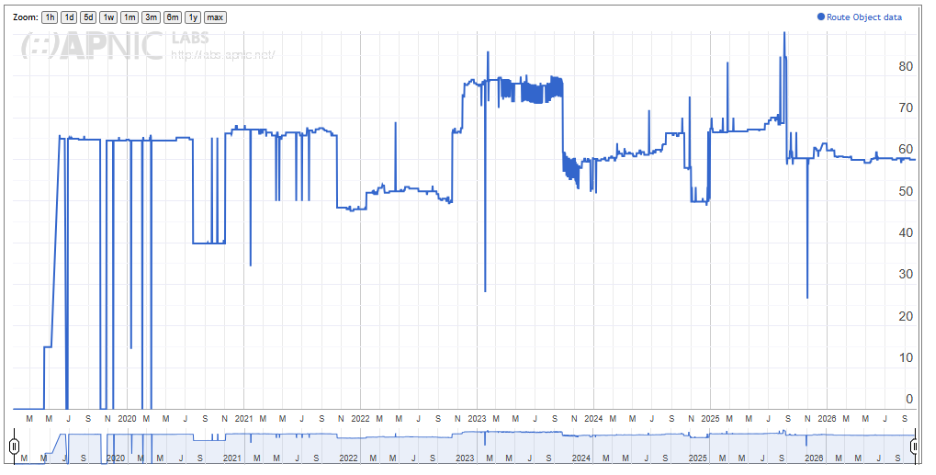
Timor-Leste has made progress in strengthening routing security through Resource Public Key Infrastructure (RPKI), particularly through the creation of Route Origin Authorizations (ROAs). APNIC Labs measurements indicate that approximately 60% of announced address space is covered by valid ROAs (Figure 2).
ROAs allow network operators to declare which Autonomous Systems are authorized to originate specific IP address prefixes. Route Origin Validation (ROV) uses this information to identify and reject invalid route announcements.
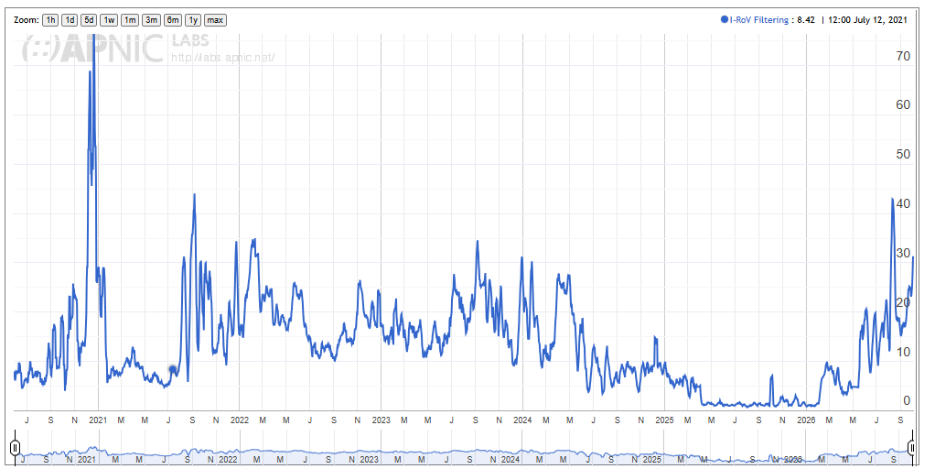
Over the seven days ending 10 July 2026, APNIC Labs measured invalid-route filtering in Timor-Leste at 34.42% (Figure 3), compared with 14.46% across South East Asia and 26.69% globally.
While the measurements indicate encouraging progress, continued ROA creation and broader implementation of ROV among network operators will be important as Timor-Leste’s Internet ecosystem grows and becomes more interconnected.
IPv6
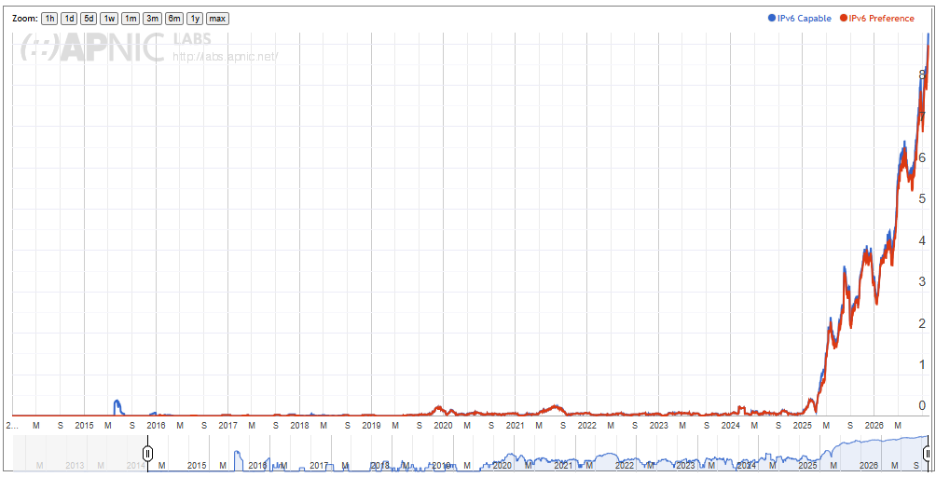
As of October 2026, Timor-Leste’s IPv6 capability rate stands at approximately 9%, indicating limited progress compared with neighbouring economies and well below the South East Asia average of 36.5%.
Growth in IPv6 capability since early 2025, shown in Figure 4, has been driven by the introduction of Starlink into the market. Most operators, however, have yet to adopt the technology.
Wider adoption of both RPKI and IPv6 is constrained by limited technical knowledge and engineering capacity, low awareness of their operational benefits, and the need to build greater strategic awareness and prioritization across government, regulatory, and private-sector organizations.
Continued training and stronger engagement between technical practitioners and decision-makers will be important to accelerate deployment.
Internet security
As Timor-Leste’s digital economy grows, cybersecurity is becoming increasingly important. While expanded connectivity creates new opportunities, it also increases exposure to cyber threats and risks to critical infrastructure.
In response, the government strengthened its cybersecurity governance arrangements. In August 2026, it established the Interministerial Committee on Cybersecurity and the Digitalization of State Services (CICDE).
The CICDE replaced the earlier Interministerial Cybersecurity Working Group (GICS) and provides a higher-level mechanism to coordinate cybersecurity policy, digital transformation, and the protection of critical digital infrastructure across government.
Timor-Leste is also strengthening its legislative and institutional cybersecurity framework through greater coordination across government and engagement with international partners. Through the work of the GICS and its successor, the CICDE, the government has advanced a legislative package covering cybersecurity, cybercrime, digital services, critical infrastructure protection, and national incident-response capabilities.
International cooperation, particularly with Australia, has supported this process through cybersecurity assessments, cyber-resilience planning, and discussions on protecting critical infrastructure and managing risks associated with Timor-Leste’s growing digital infrastructure, including the TLSSC.
The development of a national Computer Security Incident Response Team (CSIRT/CERT) is also progressing. A CSIRT is responsible for coordinating cyber-incident response, information sharing, and technical support during cybersecurity events.
In 2024, the International Telecommunication Union (ITU) conducted a national CIRT maturity assessment and delivered training on incident handling, digital forensics, malware analysis, cyber-crisis management, and operational procedures.
These activities represent important steps towards establishing a formal national capability for coordinating cyber-incident response and information sharing.
At the operational level, initiatives such as the planned TL-IXP and the Timor-Leste Network Operators Group (TLNOG) are helping promote routing security, RPKI deployment, and cybersecurity best practices across the local technical community.
As Timor-Leste deepens its integration with ASEAN and expands its digital infrastructure, strengthening cyber resilience and local technical expertise will remain important priorities.
Internet community
Organisations focused on technical operations, digital inclusion, and community development support Timor-Leste’s Internet community.
Technical community
TLNOG was established in August 2024 and formally registered in July 2025. It provides a forum for network engineers, operators, and technical professionals to share knowledge and strengthen local Internet operations. Its first community event, TLNOG 1, was held in Dili on 22 August 2024, establishing a dedicated platform for collaboration among Timor-Leste’s growing technical community. Building on this foundation, TLNOG 2, held 19 – 21 November 2025, placed greater emphasis on network security and operational skills.
Digital inclusion and skills development
Community organisations also support digital participation. Hadomi Timor Foundation (FHT) works on digital rights, literacy, inclusion, and cybersecurity.
Fundasaun Desenvolvimento Software Livre (FDSL) promotes open-source software and digital skills through training and community activities.
redEsperansa.tl, supported through an APNIC Foundation ISIF Asia grant, has focused on last-mile connectivity, locally hosted educational services, and community capacity building, particularly for schools and underserved communities.
Regional engagement
Regional initiatives are strengthening links with the wider Internet community. EmpowerTech 2025: Timor-Leste, run by APNIC Foundation, brought together the technical community and industry experts to address key challenges and promote inclusion, building on the Foundation’s Switch! initiative.
Despite this progress, participation remains constrained by the community’s small size, its concentration in Dili, language barriers, and limited opportunities for regular technical exchange and specialized training.
Strengthening these networks will help develop local expertise and connect Timor-Leste’s Internet community with regional peers.
The views expressed by the authors of this blog are their own and do not necessarily reflect the views of APNIC. Please note a Code of Conduct applies to this blog.