

India has built one of the world’s largest Internet ecosystems through affordable mobile broadband, major digital infrastructure investment, and global leadership in IPv6 adoption. As India prepares to host APNIC 62, this Economy Report examines how the focus is shifting from rapid growth to ensuring connectivity remains resilient, secure, and inclusive for more than 1.4 billion people.
India is one of the world’s largest digital economies, with a rapidly growing Internet user base that continues to drive economic and social transformation. While its scale, diversity, and geography create significant opportunities, they also present challenges in ensuring reliable and equitable access to digital services across the economy.
Digital transformation has become a central pillar of development under the Digital India Program. Investments in broadband networks, mobile connectivity, digital identity, and interoperable digital platforms have expanded access to services, strengthened digital inclusion, and improved public service delivery. As a result, digital technologies are increasingly embedded across sectors including finance, healthcare, education, agriculture, commerce, and government, with the digital economy now accounting for approximately 12 to 14% of Gross Domestic Product (GDP).
Despite this progress, disparities in broadband quality, affordability, and digital literacy persist, particularly in rural and remote areas. Addressing these gaps remains a key priority as India works to ensure the benefits of digital transformation are shared more widely across society.
Connectivity
India’s connectivity landscape has grown rapidly over the past decade, driven by widespread mobile broadband adoption, affordable data pricing, and ongoing investment in telecommunications infrastructure. As of 2025, the ITU Data Hub reports around 70% of the population were Internet users, a significant increase from 20.1% at the end of 2018, reflecting continued growth in digital access.
Mobile broadband remains the primary means of Internet access, supported by extensive 4G coverage and the expansion of 5G networks. India is now one of the world’s largest mobile data markets, underpinned by competitive pricing and broad smartphone adoption. At the same time, fixed broadband infrastructure continues to expand through private sector investment and initiatives such as BharatNet, which aims to improve connectivity in rural and underserved communities.
While affordability has driven Internet growth in India, Internet Society Pulse data shows mobile broadband remains among the region’s most affordable. However, challenges persist in digital literacy, infrastructure quality, and access in remote and underserved communities. Continued investment in broadband infrastructure, spectrum deployment, and digital skills will be important to support India’s growing digital economy and improve connectivity outcomes nationwide.
Internet Infrastructure
IXPs
India has one of the largest Internet interconnection ecosystems in the Asia Pacific region. As of July 2026, India has 31 operational Internet Exchange Points (IXPs) and 85% of the economy’s 2,957 active networks connected through an IXP, significantly higher than the Asia Pacific regional average of five IXPs and 51% network participation. This extensive peering environment enables domestic traffic to be exchanged locally, improving performance, reducing latency, lowering transit costs, and enhancing network resilience.
The ecosystem includes both commercial and community-driven exchanges, with major interconnection hubs located in Mumbai, Delhi, Chennai, Bengaluru, and Hyderabad. The National Internet Exchange of India (NIXI), established in 2003 as a not-for-profit body under the Companies Act, remains the flagship domestic exchange operating eight Internet Exchange nodes and more than 20 Network Operations Centres (NOCs) across the economy.
Alongside NIXI, commercial operators such as DE-CIX, AMS-IX, and Extreme IX play a significant role in strengthening India’s interconnection landscape. Together, these exchanges enable ISPs to exchange and route domestic traffic within India rather than relying on international transit routes, resulting in lower latency and reduced bandwidth costs for participants.
Despite the maturity of the ecosystem, the exchanges are concentrated in only seven of India’s 169 population centres of over 300,000 people, highlighting opportunities for further geographic expansion.
Data centres and CDNs
India has emerged as one of Asia Pacific’s leading digital infrastructure markets, supported by 245 operational data centres and a highly developed content delivery ecosystem. Major data centre clusters are concentrated in Mumbai, Chennai, Hyderabad, Bengaluru, and Delhi NCR, with Mumbai serving as the primary hub due to its proximity to international submarine cable landing stations and dense concentration of cloud, enterprise, and interconnection infrastructure. Strong demand from cloud computing, digital platforms, AI workloads, financial technology services, and government digital initiatives continues to drive investment and capacity growth.
Further strengthening the sector’s attractiveness, the Union Budget 2026 – 2027 introduced a tax holiday until 2047 for eligible foreign companies providing cloud services globally using India-based data centres. This measure is intended to provide long-term investment certainty and attract hyperscale cloud investment, reinforcing India’s position as a regional hub for digital infrastructure and cloud services.
Complementing this infrastructure, major Content Delivery Network (CDN) providers including Akamai, Cloudflare, Google, Amazon CloudFront, Meta, and Netflix maintain extensive caching infrastructure across the economy. As a result, 86% of India’s 1,000 most-visited websites can be accessed through servers or caches located within India, significantly above the regional average. This high level of content localization keeps a large proportion of Internet traffic within India, improving user experience while reducing reliance on international transit links.
These developments contribute to improved service performance, lower latency, and greater resilience for high-demand digital services such as streaming, cloud computing, and online platforms.
Submarine cables
India’s Internet ecosystem depends on an extensive but geographically concentrated submarine cable network. As cloud adoption, AI computing demands, and digital services continue to grow, submarine cable infrastructure has become a strategic national priority overseen by the Telecom Regulatory Authority of India (TRAI).
India is connected to the global Internet through around 20 submarine cable systems. While connectivity remains concentrated around Mumbai and Chennai, new cable landings at Machilipatnam and Digha are helping diversify infrastructure and reduce concentration risk.
Despite this expansion, Mumbai remains India’s primary submarine cable hub, hosting 15 systems, including 2Africa, AAE-1, IMEWE, and SEA-ME-WE 4, with IEX and Raman expected to enter service in 2026. Chennai is the second-largest landing hub, hosting nine active systems and several planned projects, including SEA-ME-WE-6 (2027) and I-2SEA (Q4 2029). This concentration creates resilience risks, prompting calls for greater geographic diversification through emerging east coast landing stations such as Machilipatnam and Digha.
India’s submarine cable ecosystem faces both ageing infrastructure and broader industry challenges. Around 11 cable systems are more than 20 years old and nearing the end of their typical operational lifespan, increasing the need for renewal and capacity upgrades. At the same time, geopolitical tensions and supply chain disruptions have delayed major projects, including the Gulf segments of 2Africa Pearls and Google’s Blue-Raman, as well as expansion phases of SEA-ME-WE 6. Development is further constrained by the lack of a domestic cable repair vessel, leaving India reliant on regional consortiums for repairs, while the absence of local wet-plant manufacturing increases dependence on a small group of global suppliers.
However, telecommunications providers and hyperscalers are investing heavily in new international connectivity. Bharti Airtel has landed 2Africa Pearls and is building a new landing station in Visakhapatnam, while Reliance Jio is advancing the IAX and India-Europe-Xpress (IEX) systems. Google and Meta are also playing a growing role. Google’s Blue-Raman cable and its US 15 billion America-India Connect initiative are centred on a new Visakhapatnam subsea gateway and additional routes linking India to Singapore, South Africa, Australia, and the United States. Meta’s Project Waterworth is reportedly evaluating infrastructure along the same corridor to better connect Hyderabad’s growing AI data centre ecosystem.
The eastward shift gained further momentum in July 2026 when Lightstorm, Microsoft, Singtel, and Tata Communications signed contracts to build I-2SEA, a 3,600km AI-focused cable linking India’s east coast Hyderabad and Chennai’s data-centre clusters to Singapore and Kuala Lumpur, with dual landings at Machilipatnam and South Chennai.
Together with India’s expanding IXP and data centre footprint, these investments are gradually reducing the economy’s historic dependence on west coast landing hubs and strengthening the resilience of its international connectivity infrastructure.
RPKI and IPv6 deployment
RPKI
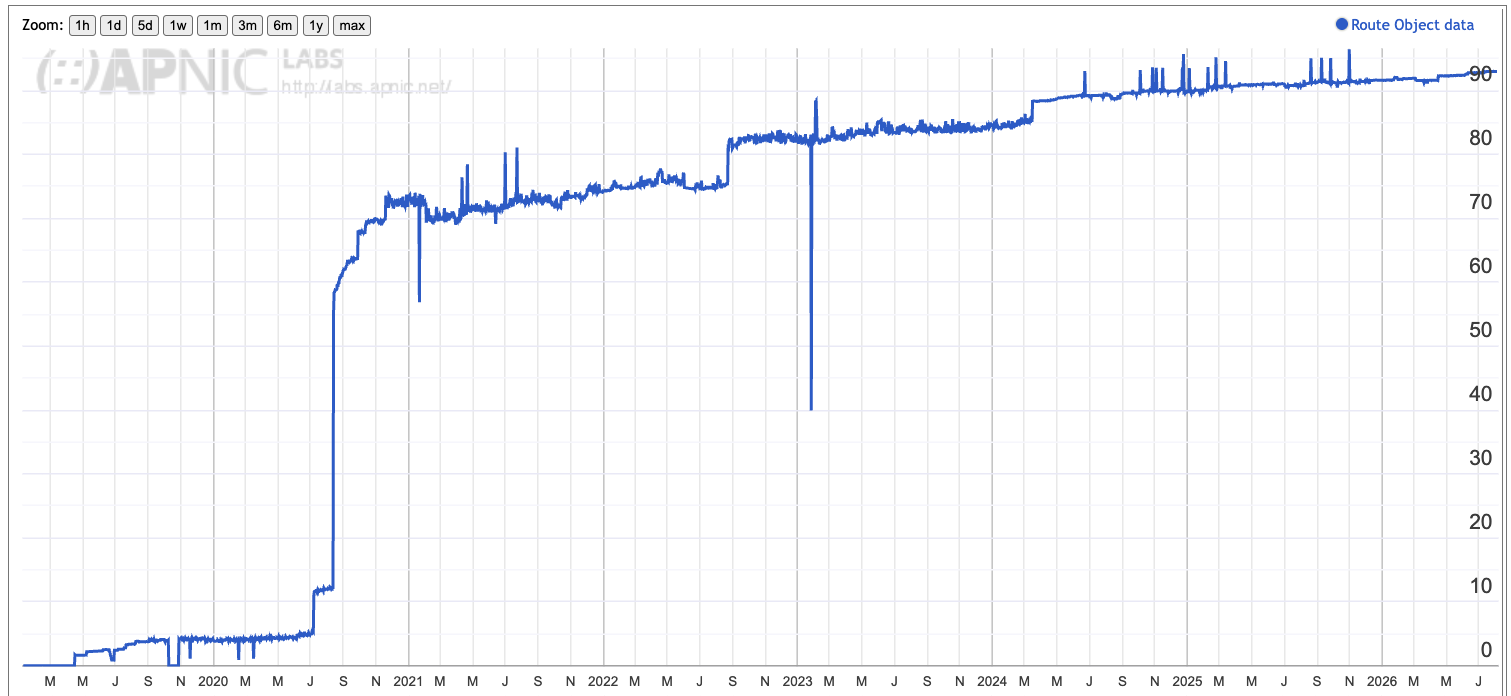
India has made substantial progress in strengthening Internet routing security through the adoption of the Resource Public Key Infrastructure (RPKI), particularly in the creation of Route Origin Authorizations (ROAs) by network operators. According to APNIC data presented at the India ISP Conclave 2025, India’s ROA coverage grew from 72.11% in January 2024 to 82.95% in January 2025, one of the largest year-on-year gains of any economy in the region.
As of late July 2026, APNIC Labs shows this has continued to climb, with 88.04% of IPv4 route objects and 97.91% of IPv6 route objects now covered by a valid ROA, leaving only 11.65% of IPv4 and 1.78% of IPv6 announcements with no ROA coverage at all.
However, the deployment of Route Origin Validation (ROV) remains comparatively limited, at just 0.99% of networks filtering out invalid prefixes and announcements as of 29 July 2026, well below both the South Asia regional average of 3.14% and the global average of 26.92%.
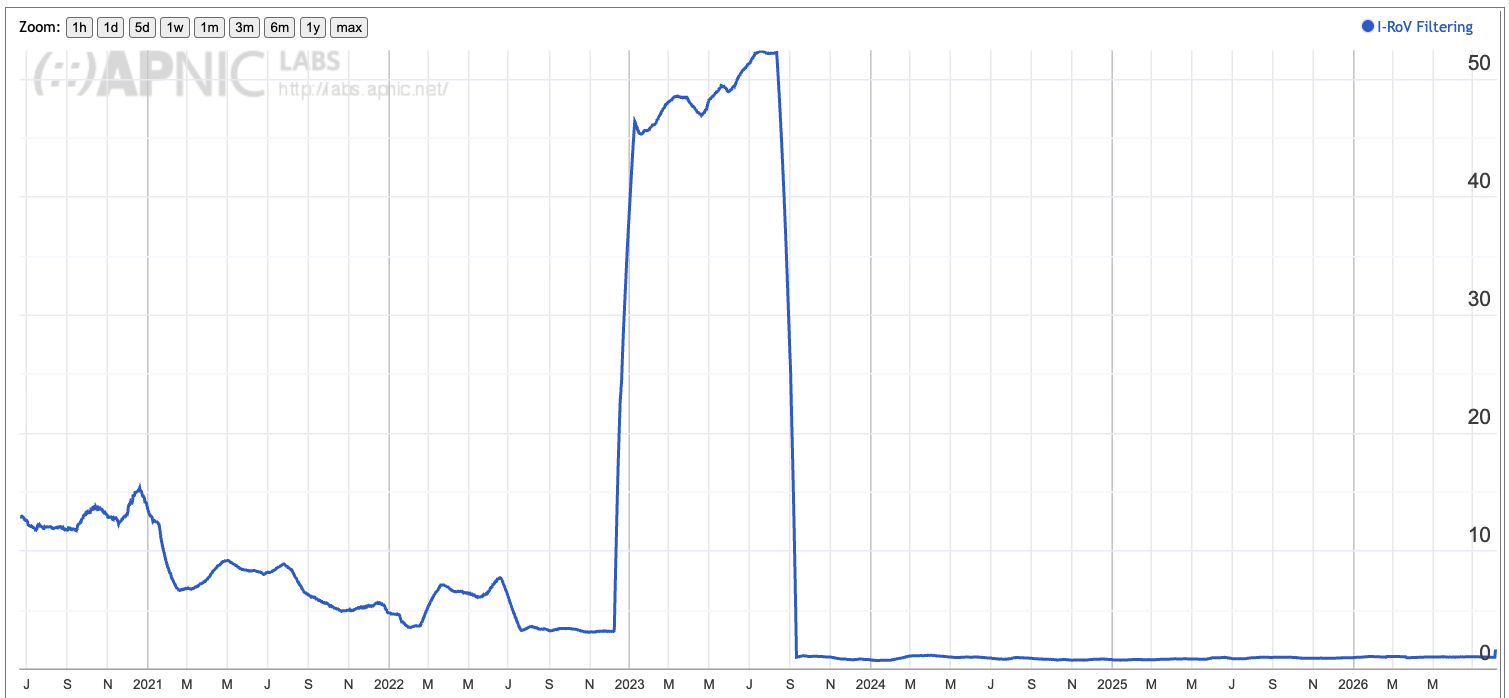
While most Indian networks now publish ROAs, relatively few enforce ROV by filtering invalid route announcements. The gap between signing and enforcement remains wide and appears to have grown as global ROV adoption outpaces India’s.
Despite these challenges, awareness of routing security has increased significantly in recent years through the efforts of the Internet Service Providers Association of India (ISPAI), Network Operator Groups, and collaboration with APNIC and the wider technical community. Continued growth in IPv6 deployment, expansion of IXP participation, and increasing focus on critical infrastructure protection are expected to drive further RPKI adoption across Indian networks. As more operators implement both ROA creation and ROV, India’s Internet ecosystem will become more resilient against route leaks, prefix hijacking, and other Border Gateway Protocol (BGP) routing incidents.
IPv6
According to APNIC Labs measurements, India is one of the world’s leading adopters of IPv6. Adoption grew from just 1.19% in December 2015 to 16.64% by January 2017, accelerating rapidly following the launch of Reliance Jio’s nationwide network. IPv6 capability surpassed 56% in 2018, 63% in 2020, and 77% in 2022, before peaking at 82.11% in January 2024.
While adoption has since eased slightly, IPv6 capability remained high at around 79%, meaning nearly four in five Internet users in India can access online services via IPv6. With well over 600 million IPv6 users, India has one of the world’s largest IPv6-enabled populations and ranks among the global leaders in IPv6 adoption.
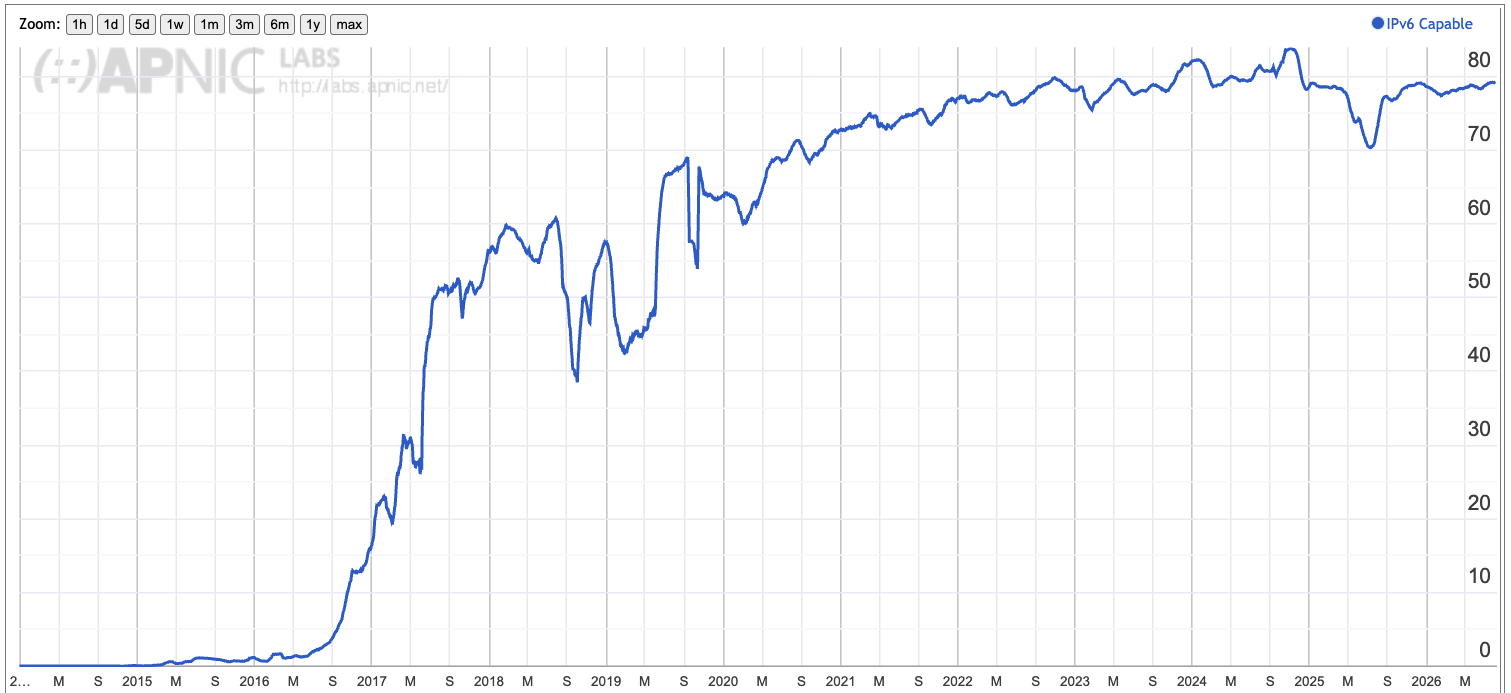
Much of India’s IPv6 growth can be traced to Reliance Jio. Launched in September 2016 as India’s first ‘all-IP’, LTE-only mobile network, Jio deployed IPv6 from the outset rather than retrofitting it later. As the operator rapidly scaled, its rollout closely tracked India’s national IPv6 adoption curve, demonstrating how a single large-scale mobile deployment can accelerate IPv6 adoption across an entire economy.
However, India’s IPv6 rollout is entering a more mature phase. While capability peaked at 82.11% in early 2024 and has since eased slightly to 78.59% in early 2026, the change is within normal statistical variation and suggests much of the growth driven by mobile networks has already been realized. Further gains are likely to depend on greater adoption across fixed-line and enterprise networks, as India’s high IPv6 capability remains concentrated in the mobile sector rather than uniformly distributed across the broader Internet ecosystem.
Resource allocation data points in the same direction. At APRICOT 2026, the Indian Registry for Internet Names and Numbers (IRINN), India’s National Internet Registry (NIR), reported that its membership had grown to 4,649 organizations by January 2026, a 64% increase over six years. Over the same period, IPv4 allocations remained largely flat while IPv6 allocations continued to rise, reflecting the shift toward IPv6 deployment. Sustaining further growth will depend on broader adoption across fixed-line and enterprise networks, while dual-stack IPv4 and IPv6 operation is likely to remain the norm for the foreseeable future.
Cybersecurity
India places strong emphasis on cybersecurity as a critical enabler of its digital economy, security, and public trust. As digital infrastructure and public services continue to expand, the Government of India has invested significantly in strengthening national cyber resilience through dedicated institutions, policies, and operational capabilities.
At the centre of these efforts is the Indian Computer Emergency Response Team (CERT-In), the national cyber incident response authority under the Ministry of Electronics and Information Technology (MeitY). Established in 2004 and formally designated under the Information Technology Act, CERT-In is responsible for monitoring cyber threats, coordinating incident response, issuing security advisories, conducting cyber exercises, providing digital forensics support, and promoting cybersecurity awareness across government, critical infrastructure, industry, and the wider internet community.
CERT-In also plays an active international role through its participation in the Forum of Incident Response and Security Teams (FIRST) and the Asia Pacific Computer Emergency Response Team (APCERT), supporting information sharing, capacity building, and coordinated cyber incident response across the Asia Pacific.
In 2025, CERT-In reportedly handled more than 2.9 million cyber incidents and issued over 1,500 security alerts. It also expanded its focus to emerging areas including AI security, software supply chain assurance, space and satellite cybersecurity, and cyber workforce development. These efforts further strengthen CERT-In’s position as a leading cybersecurity authority in the Asia Pacific region.
The National Critical Information Infrastructure Protection Centre (NCIIPC) complements CERT-In as India’s national agency for protecting Critical Information Infrastructure (CII). Established under Section 70A of the Information Technology Act, NCIIPC works to secure critical sectors including energy, banking and finance, telecommunications, transport, government, strategic enterprises, and health. Through threat intelligence sharing, incident response coordination, vulnerability disclosure, malware reporting, and stakeholder engagement programs, NCIIPC plays a key role in strengthening the resilience and security of India’s most critical digital infrastructure.
Internet community
India has one of the largest and most diverse Internet communities in the Asia Pacific region, bringing together network operators, ISPs, academia, government agencies, industry, and civil society to support the continued development of the economy’s Internet ecosystem. This collaborative community has played an important role in strengthening Internet infrastructure, promoting operational best practices, and supporting the adoption of new technologies across one of the world’s fastest-growing digital markets.
Several organizations play a central role in supporting the development of India’s Internet ecosystem. NIXI helps improve network performance and efficiency by facilitating the exchange of domestic Internet traffic through its IXPs. NIXI also manages the .IN ccTLD and oversees IRINN, which administers Internet number resources and supports initiatives such as IPv6 deployment and technical capacity building.
ISPAI represents ISPs and digital connectivity stakeholders, providing an important industry voice on regulatory, policy, and technology matters. Through engagement with government and industry partners, ISPAI contributes to the development of policies that support broadband expansion, innovation, and a competitive Internet ecosystem.
India is also an active contributor to regional and global Internet governance, supported by a strong multistakeholder community that includes government, industry, academia, the technical community, and civil society. The economy hosted the third United Nations Internet Governance Forum (IGF) in Hyderabad in 2008 and has continued to strengthen multistakeholder engagement since then.
In 2021, India established the India Internet Governance Forum (IIGF) with support from MeitY. Through its annual events, including the most recent edition, IIGF 2025 in New Delhi, the forum provides a platform for dialogue on digital inclusion, cybersecurity, emerging technologies, and Internet policy.
India’s Internet governance ecosystem is further strengthened by a range of capacity-building initiatives that help develop future leaders and expand multistakeholder participation. The India School on Internet Governance (inSIG), established in 2016, provides training and engagement opportunities for participants from government, industry, academia, civil society, and the technical community, helping to build awareness and expertise in Internet governance issues across India. The Youth IGF India initiative complements these efforts by supporting the next generation of Internet governance leaders. Through training programs, fellowships, annual events, and community engagement activities with support from APNIC, these initiatives have helped build Internet governance capacity, cultivate emerging leaders, and strengthen multistakeholder participation across India’s Internet ecosystem.
India has further strengthened its position within the global Internet governance ecosystem by hosting several ICANN Public Meetings, including ICANN 85 Community Forum in Mumbai in March 2026, hosted by NIXI, as well as ICANN 57 in Hyderabad (2016) and ICANN 31 in New Delhi (2008). These events highlight India’s growing influence as a centre for Internet governance, policy development, and technical collaboration in the Asia Pacific region.
These events highlight India’s growing influence as a centre for Internet governance, policy development, and technical collaboration in the Asia Pacific region.
India has also emerged as an important venue for global discussions on artificial intelligence policy and governance. In February 2026, New Delhi hosted the India AI Impact Summit 2026, the first summit in the series to be held in a Global South economy. The event brought together representatives from nearly 100 economies, including heads of state, government officials, international organizations, researchers, and technology leaders, to discuss the opportunities, challenges, and governance implications of artificial intelligence. The summit further demonstrated India’s growing role as a global convenor on emerging technology and digital policy issues.
The Indian Network Operators Group (INNOG) serves as an important platform for technical collaboration and knowledge sharing among network engineers and operators. Through conferences, workshops, and technical discussions, INNOG promotes best practices in routing, IPv6 deployment, network automation, DNS, peering, and Internet security, helping to build expertise across India’s growing Internet infrastructure community.
Additionally, India has been a prominent venue for the South Asian Network Operators Group (SANOG), one of the region’s leading forums for network operators and Internet infrastructure professionals. India has hosted 12 SANOG conferences dating back to 2004, including events in Mumbai, Gurgaon, Bangalore, and most recently, SANOG 41 in Mumbai in 2024.
The Government of India established the National Knowledge Network (NKN) in 2010 to create a high-speed nationwide research and education network connecting universities, research institutions, laboratories, and government organizations. Implemented by the National Informatics Centre (NIC), NKN supports collaborative research, advanced education, and knowledge sharing through a high-bandwidth, low-latency digital infrastructure
Through the combined efforts of government agencies, community organizations, technical operators, policy stakeholders, and event hosts, India has established itself as a leading centre for Internet development, governance, and technical collaboration in the Asia Pacific region.
The road ahead
India’s Internet ecosystem has transformed rapidly over the past decade, driven by affordable mobile broadband, government-led digitalization, infrastructure investment, and widespread IPv6 adoption. Together, these developments have connected hundreds of millions of people and established India as a global digital powerhouse.
The next phase of growth will be defined less by scale and more by resilience, distribution, and maturity. Priorities include improving connectivity in underserved areas, diversifying submarine cable infrastructure, expanding ROV and IPv6 adoption beyond mobile networks, and continuing investment in data centres, cloud platforms, AI infrastructure, and cybersecurity.
As India prepares to host APNIC 62, it stands at an important inflection point. The foundations of a world-class Internet ecosystem are firmly in place, but sustaining growth will depend on ensuring that connectivity remains inclusive, secure, and resilient. How India addresses these challenges will not only shape the future of its own digital economy but will also influence Internet development across the wider Asia Pacific region.
The views expressed by the authors of this blog are their own and do not necessarily reflect the views of APNIC. Please note a Code of Conduct applies to this blog.
Maybe NCIIPC of NTRO should have been included as CERT-In is
Thanks for letting us know, Priyanka. We have updated the post.
It will be good to include reference to AIORI, (https://portal.aiori.in/) which advances both network measurement and community measurement—building technical visibility of Internet performance and resilience while developing the people and institutions that can use this evidence.