
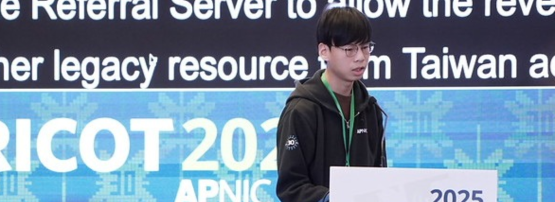
Five years ago, I never imagined that my curiosity about how the Internet works would lead me to become part of the APNIC community.
During the COVID-19 pandemic in 2020, I was learning about networking, routing protocols, and how the Internet operates behind the scenes. My interest in how IP addresses and Autonomous System Numbers (ASNs) were allocated led me to APNIC. I had also always been curious about public policy, and Internet number resource management seemed like an interesting connection between technology and governance
I began attending APNIC meetings online, was selected for the APNIC Fellowship Program in 2022, and attended my first in-person APNIC conference at APNIC 54 in Singapore.
Since then, I’ve attended APNIC 56 in Kyoto, APNIC 59 in Petaling Jaya, APNIC 60 in Da Nang, APNIC 61 in Jakarta, and APNIC 62 in Mumbai.
Along the way, I’ve gone from listening to Policy Special Interest Group (SIG) discussions to proposing a policy myself, joining the pilot APNIC Policy Fellowship Program, and helping others learn about Internet policy.
Looking back, these are five things I’ve learned.
1. The Internet is not just about technology: Policy matters too
When I first started studying networking, I was mostly interested in technical topics such as Border Gateway Protocol (BGP), IPv6, and routing protocols. I thought that understanding how the Internet works was mainly about understanding the technologies behind it.
Talking with Fellows from different economies, APNIC staff, network operators, and people involved in Internet governance at APNIC 54 in Singapore helped me realize that operating the Internet involves much more than making technical decisions.
The Internet is a network of independently operated networks. Different organizations have different needs, and there isn’t one central authority making every decision. This is where policy becomes important.
A policy that works well for a large network operator may create challenges for a smaller organization. Similarly, a technically reasonable proposal may not always be practical for everyone in the region. Technical knowledge alone isn’t enough to understand these issues.
Technology gives us the tools to build the Internet, while policy helps us agree on how shared Internet resources should be managed.
2. You don’t need to be an expert to join the conversation
As a newcomer, I was surrounded by people who had been working in networking and Internet governance for many years. Sometimes, I wondered whether I knew enough to participate in the discussions. The APNIC Fellowship Program helped me become more comfortable.
People were happy to explain technical issues, share experiences, and listen to different opinions. I realized I could ask questions without feeling that I shouldn’t be there and that participating doesn’t always mean standing in front of a room and giving a presentation.
Sometimes, it means asking a question or sharing a different perspective. This is especially true for Internet policy.
APNIC’s Policy Development Process is open to anyone interested in Internet number resource management. Not every discussion is easy to follow, but everyone has to start somewhere.
You don’t need to know everything before participating. You just need to be willing to engage with others and learn.
3. Good policy is about consensus, not winning an argument
After attending several conferences and following Policy SIG discussions, I decided to take a step further and propose a policy to the community at APNIC 59 in Petaling Jaya, Malaysia. It was a very different experience.
When you’re the one proposing a change, you have to answer questions like:
- What problem are you trying to solve? Why is the existing policy insufficient?
- Who would be affected by the proposed change?
- What might the consequences be?
My experience in the pilot APNIC Policy Fellowship in 2025 helped me understand the process beyond what happens during an Open Policy Meeting. Policy development involves preparation, discussion on mailing lists, reviewing feedback, considering operational impact, and sometimes revising or reconsidering a proposal.
A successful policy discussion isn’t necessarily one where your proposal is accepted. It’s one where the community has properly considered the problem and its possible solutions.
4. Even small changes to policy have real consequences
One thing I’ve found particularly interesting is how seemingly small policy proposals can lead to important discussions. Before becoming involved in the Policy SIG, I often focused on the technical question: Would a proposed change work? Now, I find myself asking more questions.
- Who benefits from this change?
- Who might face additional operational work?
- Does it solve a real problem?
- And is a policy change actually the right way to address it?
For example, the Open Policy Meeting (OPM) at APNIC 62 considered a proposal to change the nibble-boundary alignment of IPv6 allocations.
From a technical perspective, nibble boundaries can make reverse Domain Name System (DNS) delegation and address management easier. But turning that operational consideration into policy requires examining allocation practices and the effects on different resource holders.
If people who understand the operational challenges don’t participate, important perspectives may be missing from the discussion.
A few lines in a policy document can affect thousands of networks. That’s why the details deserve careful discussion.
5. Being part of a community means giving something back
When I first attended APNIC 54 as a fellow, I was mainly thinking about what I could learn about networking and Internet governance, and who I could meet.
Over the years, my perspective has gradually changed. At APNIC 61 in Jakarta, I had the opportunity to take part in the Policy 101 session at APRICOT 2026, alongside other Policy Fellows.
The session focused on how Internet number resource policies relate to real network operations and how community members can participate in policy development.
I benefited from people explaining the policy process to me when I was new. Now, I had an opportunity to help make that process more approachable to others. Looking back, I’ve realized that being part of the APNIC community is about more than how many conferences you’ve attended or how many presentations you’ve given.
Share what you’ve learned, listen to others, and help make the community better for the people who come after you.
Five years later, I’m still learning
My advice to anyone thinking about joining the APNIC community is simple:
- Don’t wait until you feel like an expert.
- You don’t need to start by proposing a policy. Sometimes, a simple question can help move a discussion forward.
- Read a policy proposal. Join a Policy SIG session. Ask a question. Talk to someone during a coffee break.
Five years ago, I joined APNIC because I wanted to understand how the Internet works.
Today, I want to understand how we can work together to make it better.
Tsung-Yi is an Internet governance and networking enthusiast from Taiwan. His interests include programmable switches, routing protocols, software-defined networking (SDN), and Internet number resource policy development.
He is particularly interested in connecting technical and policy perspectives and encouraging more newcomers to participate in the Internet community. If you meet him at a conference, feel free to say hello!
The views expressed by the authors of this blog are their own and do not necessarily reflect the views of APNIC. Please note a Code of Conduct applies to this blog.