

As cloud computing and artificial intelligence (AI) reshape digital infrastructure, the Internet community faces a dual challenge. Networks must become faster, smarter, and more autonomous to support increasingly demanding workloads. At the same time, the people and organizations responsible for securing those networks must work together more effectively than ever before.
At the APNIC 62 Opening Ceremony and Keynotes session, Amajit Gupta, Group CEO and Managing Director of Lightstorm, focused on the evolution of autonomous networks. At the same time, Yukako Uchida, Manager of the Global Coordination Division at JPCERT/CC, highlighted the role of trust and human relationships in cybersecurity collaboration.
Together, their presentations showed that the next phase of Internet development will depend on both technological innovation and stronger communities.
Networks in the age of AI
Opening the keynote session, Amajit argued that September 2026 may one day be viewed as a pivotal moment in the evolution of network infrastructure. Drawing parallels with previous technological shifts, he pointed to the emergence of the Internet in the 1990s and the rise of cloud computing in the mid-2000s as developments that fundamentally changed how networks operate. Today, he suggested, AI represents a similarly significant turning point.
According to Amajit, the industry’s biggest challenge is no longer compute capacity or bandwidth. Instead, latency has become the critical resource.
“The scarce resource is not bandwidth or compute. It is latency,” he said.
As AI workloads spread across clouds, data centres, and edge environments, networks have only fractions of a second to reroute traffic, respond to degradation, and maintain performance. Traditional operating models, built around manual intervention and human decision-making, struggle to meet these requirements.
Amajit argued that while compute capacity can be expanded through investment, latency cannot be recovered once it is lost. For AI-driven services, financial transactions, industrial systems, and other time-critical applications, every millisecond matters.
Using India’s digital payments ecosystem as an example, he highlighted the economic consequences of network delays and suggested that AI will only amplify the cost of latency across applications and services.
AI is exposing network limitations
Amajit suggested that AI is not simply creating demand for more bandwidth. Rather, it is exposing long-standing structural limitations in network design and operations. He cited research showing that enterprises are already encountering networking challenges as they deploy AI workloads at scale. Among survey respondents, workload distribution emerged as the most significant issue, followed by WAN-edge latency, traffic prioritization, and congestion management.
These findings suggest that application performance increasingly depends on networks making decisions in real time (Figure 1).
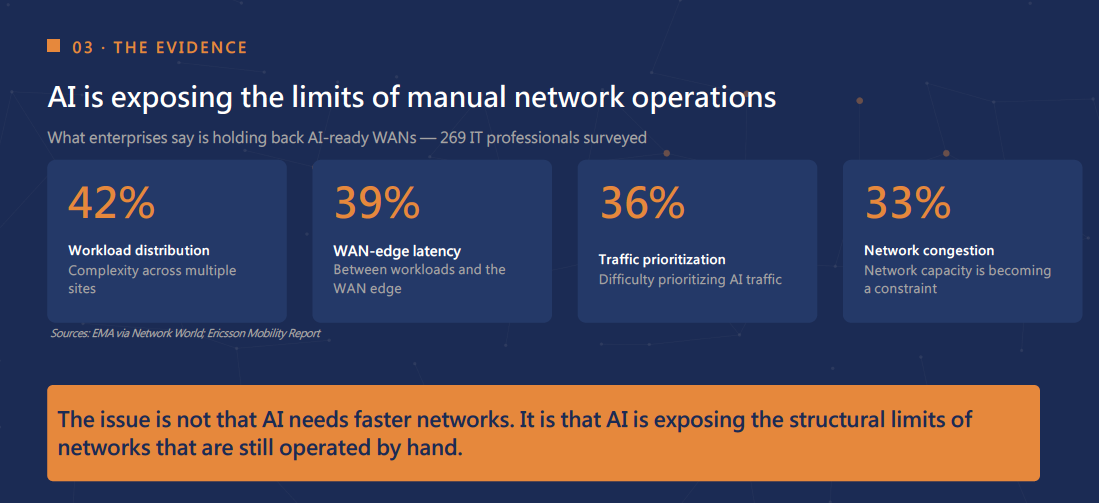
“The issue really is not that AI needs faster networks. AI is likely to expose the structural limitations of networks, which largely today are still operated by hand,” he said.
For Amajit, AI is accelerating the need for a new operating model, one capable of responding dynamically to changing demand and infrastructure conditions.
From networks to utility grids
To address these limitations, Amajit argued that networks should operate more like electricity grids. Power networks continuously balance supply and demand, monitor infrastructure health, and automatically reroute resources to maintain reliability. Internet infrastructure, he argued, should evolve in a similar direction.
Rather than simply providing connectivity, future networks will need to function as intelligent utility platforms that can respond dynamically to changing conditions and application requirements. This vision forms the basis of what Amajit described as the ‘autonomous grid’. In practical terms, it is a highly automated, software-driven environment that can detect conditions, make decisions, and respond in real time with minimal human intervention.
He identified four foundational capabilities required to make autonomous networking a reality:
- Real-time telemetry
- Intent-based orchestration
- Programmable path control
- Resilient, self-correcting architectures
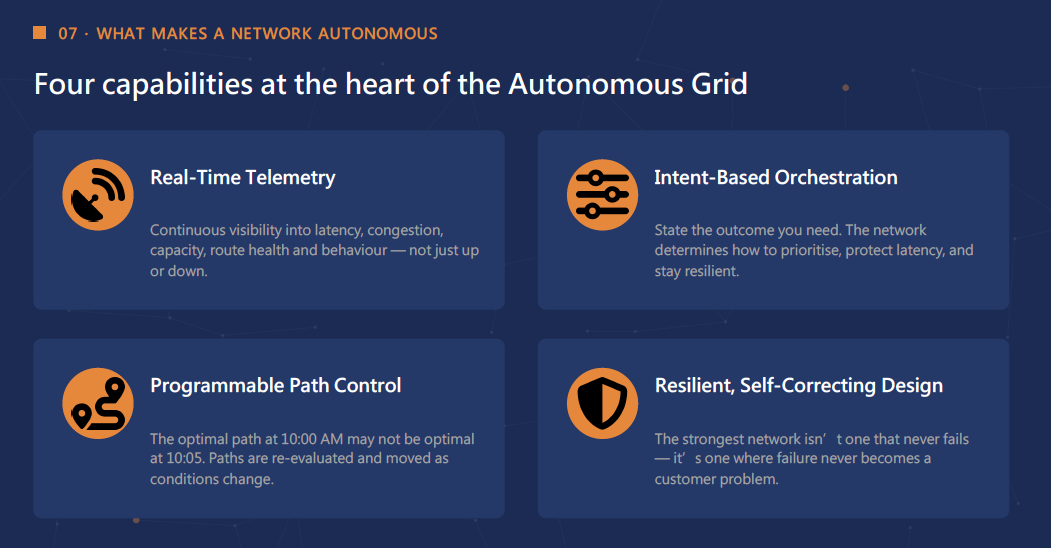
While straightforward to describe, he acknowledged that implementing these capabilities is considerably more difficult in practice, particularly for operators managing existing infrastructure, legacy processes, and established operating cultures.
Beyond automation
Despite years of industry discussion about network automation, Amajit acknowledged that success has been uneven. The ambition has always been clear, he noted, but implementation remains challenging. Effective automation requires not only technology, but also changes to organizational structures, operating processes, and workforce skills.
Many operators still rely on engineers to identify problems, implement changes, and verify outcomes. Every intervention introduces time, cost, and complexity. The autonomous grid model seeks to transform this into a closed-loop process in which networks detect conditions, make decisions, and execute responses automatically while operating within human-defined guardrails.
Importantly, Amajit rejected the notion that automation diminishes the role of people. Instead, he argued that automation removes repetitive operational tasks and allows engineers to focus on higher-value activities such as architecture, resilience planning, governance, and oversight.
He also highlighted the business benefits of automation, including lower operating costs, faster response times, reduced troubleshooting workloads, and improved customer outcomes. In this sense, autonomous networking is not simply a technical objective, but also an operational and financial one.
Building a regional digital utility
Looking further ahead, Amajit proposed a broader vision of Internet infrastructure across the Asia Pacific region. The autonomous capabilities he described are also essential for operating infrastructure at regional scale. Drawing again on the analogy of electricity grids, he suggested that carriers, submarine cable operators, cloud providers, and data centres should increasingly operate as part of a more integrated ecosystem, connected through common frameworks for resilience, security, interoperability, and service assurance.
As AI and cloud services continue to scale across national borders, Amajit argued that the region must move beyond isolated interconnections towards a more coherent and resilient digital utility model.
He concluded with a simple observation:
“The best network is actually the one that you never have to manage.”
Trust as infrastructure
While Amajit focused on the evolution of network infrastructure, Yukako explored another essential component of a resilient Internet: Trust.
Drawing on more than a decade of experience building international relationships for Japan’s national Computer Emergency Response Team (CERT), JPCERT/CC, she highlighted the human foundations of effective cybersecurity.
CERTs play a critical role in identifying, analysing, and coordinating responses to cybersecurity incidents. Their work routinely involves collaboration across organizations, industries, and national borders.
Whether sharing sensitive information, coordinating responses to attacks, or requesting assistance from external organizations, cybersecurity practitioners must have confidence that their counterparts will use information responsibly, act on it appropriately, and provide reliable information in return.
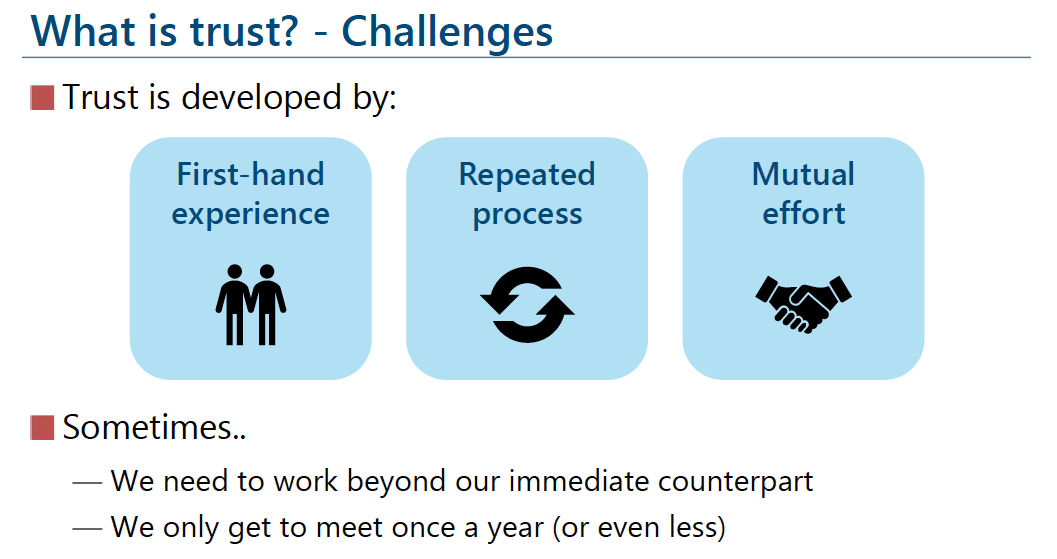
For Yukako, trust is not created through formal agreements or technical systems. Instead, it is built through first-hand experience, repeated interactions, and personal relationships.
Trust at global scale
While trust is often discussed as an abstract concept, Yukako demonstrated that it has become a core operational requirement for cybersecurity.
In 2025 alone, JPCERT/CC coordinated approximately 20,000 cybersecurity incidents, many involving organizations in multiple jurisdictions. Over the past two decades, it received incident reports from organizations in more than 100 economies and provided notifications to stakeholders in more than 160 economies.
These figures illustrate the highly interconnected nature of modern incident response. Addressing cyber threats increasingly requires organizations to exchange information across national borders, coordinate actions between different sectors, and build confidence that shared information will be handled appropriately.
For Yukako, the ability to respond effectively to incidents depends not only on technical capabilities, but also on the quality of relationships that exist before an incident occurs.
The value of community
Much of Yukako’s keynote focused on the role communities play in creating and strengthening trust.
Organizations such as APCERT and FIRST provide opportunities for security professionals to meet, share experiences, participate in exercises, and develop relationships that later prove invaluable during real-world incidents.
These relationships often begin with something simple:
- A conversation between sessions
- A discussion over coffee
- A question asked during a conference presentation
Over time, these interactions form a trusted network that supports information sharing and incident coordination.
Reflecting on her own career, Yukako described spending years travelling, attending meetings, engaging with communities, and maintaining relationships.
“Trust is built by your own firsthand experience,” she said.
Yukako emphasized that trust cannot be delegated and cannot be created instantly. It develops gradually through repeated interactions and mutual confidence between individuals and organizations.
The trust that develops between individuals often becomes the foundation for broader organizational cooperation, particularly during complex incidents that require rapid information sharing and coordinated action.
Diversity strengthens collaboration
Yukako also reflected on the diversity of the global Internet community and the importance of understanding differences in communication styles, workplace norms, and cultural expectations.
Through examples from her own experiences, she highlighted how seemingly small differences in behaviour can influence collaboration. Approaches to asking questions, participating in discussions, managing time, and conducting business interactions vary significantly across cultures.
Recognizing and respecting these differences helps build stronger relationships and more effective collaboration. For a community that operates across national, linguistic, and cultural boundaries, this adaptability is essential. Yukako encouraged participants to make the most of opportunities provided by events such as APNIC 62.
“Everything you do, every engagement you make during this week is the first step in building trust relationship in this community,” she said.
She reminded attendees that conferences are about more than presentations and technical sessions. They are opportunities to build relationships that may later prove critical when responding to incidents or tackling shared challenges.
Two sides of the same future
Although their topics differed, the two APNIC 62 keynote presentations addressed closely connected challenges. Amajit described a future in which networks become increasingly autonomous, intelligent, and capable of operating at machine speed to support AI-driven applications and digital economies. Yukako highlighted the relationships that enable organizations to cooperate during cybersecurity incidents, share information across borders, and respond collectively to emerging threats.
Both argued that existing approaches will not scale indefinitely. Networks must become more adaptive and automated, while Internet communities must continue investing in the trust and relationships that make collaboration possible.
One keynote focused on infrastructure that can increasingly make decisions for itself. The other focused on the people who must continue working together when those systems fail, come under attack, or require coordination across organizations and economies.
For APNIC 62 attendees, the message was clear: The future Internet will depend on both intelligent infrastructure and trusted communities. Advances in automation may help networks operate at unprecedented scale, but the resilience of the Internet will continue to rest on the relationships that connect the people behind it.
Watch the keynotes from APNIC 62:
The views expressed by the authors of this blog are their own and do not necessarily reflect the views of APNIC. Please note a Code of Conduct applies to this blog.