
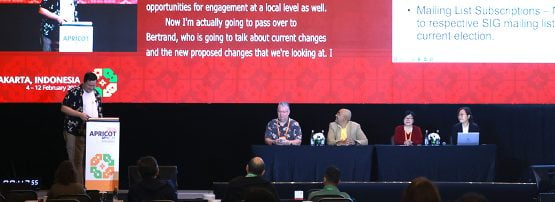
APNIC Special Interest Groups (SIGs) are open forums where the participants discuss topics that matter to the Asia Pacific Internet operations community, including policy development, National Internet Registry (NIR) matters, broader Internet cooperation, and routing security. There are currently four active SIGs: Policy, NIR, Cooperation, and Routing Security. Each SIG is chaired by community members.
Each SIG meets in person twice a year at APNIC meetings, with discussion continuing on its mailing list throughout the year. SIGs are one of the clearest examples of APNIC’s bottom-up, community-driven model. Anyone can join the discussion, and SIG Chairs are chosen by the community they serve. SIGs are an important part of the APNIC community, so the rules that govern how SIGs operate are relevant to not only the current SIG Chairs but also to all those who participate in and are affected by the SIG process.
The APNIC SIG Guidelines set out how a Special Interest Group works: How it is formed, how a Chair or Co-Chair is elected, what happens when a SIG is no longer needed, and how the system remains fair and open to the community. The APNIC SIG Guidelines were originally published in 2016 and, apart from a very limited update in 2023, have only been reviewed once, in 2021. This current review provides an opportunity to ensure the Guidelines remain fit for purpose and continue to reflect the needs of the APNIC community.
During the Joint SIGs session at APNIC 60, a discussion about updating the nomination rules for Chair and Co-Chair positions led to a broader question — instead of updating small parts of the Guidelines one at a time, should the whole document be reviewed together?
The community agreed, and shortly afterwards, Christopher Hawker invited the community to take part in a full review. Following the Joint SIGs session at APNIC 61, the SIG Guidelines Review Working Group was established with the support of the SIG Chairs and the endorsement in principle of the APNIC Executive Council. The Working Group comprises Joy Chan (Taiwan), Terry Sweetser (Australia), Om Prakash Sharma (Nepal), and me. I serve as Chair, with Joy as Co-Chair. The Working Group held its first meeting on 3 June 2026.
A principles-first approach
Reviewing a governance document line by line is not always easy. It is easy to focus on wording and minor details while losing sight of the central question — is this the right way to run a SIG? To avoid this, the Working Group chose to share the principles behind the proposed changes first before drafting the final text.
This means the draft recommendations shared with the community are not the final Guidelines text. Each recommendation explains a problem with the current Guidelines and the principle the Working Group believes should guide the solution. The community is being asked to provide feedback on these principles first. Once this feedback is collected, the Working Group will move to detailed drafting.
What is being proposed
The draft recommendations cover 12 issues in total, touching on almost every part of how a SIG operates. For each issue, the Working Group has identified a problem with the current Guidelines and proposed a principle to guide the solution. Some of the main themes are:
Term limits
Currently, there is no limit on how many terms a Chair or Co-Chair can serve. The Working Group proposes a limit of four terms (eight years) in total across all SIGs. As a transitional measure, Chairs who have already served the maximum number of terms would be allowed to stand for one additional term at APNIC 64, so SIGs are not left without continuity during the change.
Making the rules clearer
Several issues are not really about changing what SIGs should do, but about making the existing rules easier to understand. For example, the current process for forming a new SIG does not clearly distinguish between mandatory and optional steps. The rules on who can stand for election also contain some gaps. The Working Group wants to address this by clearly stating what is required and what is not.
Fair process for dissolution and removal
Two important recommendations deal with what happens when a SIG is dissolved or when a Chair or Co-Chair is removed.
At present, both processes rely on criteria that are not clearly defined, and they provide limited procedural protections.
The Working Group wants to introduce clear criteria, appropriate notice, an opportunity to respond, and published reasons for any decision.
Rules for Working Groups
The Guidelines currently do not explain how a Working Group should be formed, who it reports to, or how its leaders are chosen. The Working Group is proposing to add this missing information.
Chair duties that fit all SIGs
Some duties currently listed for SIG Chairs apply only to the Policy SIG. The Working Group suggests moving these duties to the relevant SIG charter so the Guidelines list only responsibilities that are common to all SIGs.
The complete list of all 12 issues and the recommended principles has been shared with the community through the SIG Guidelines Review mailing list.
Why I got involved
I got my start in SIG leadership when I became Co-Chair of the NIR SIG at APNIC 54 in Singapore. That role allowed me to learn how NIRs work and how a SIG operates from the inside. It also allowed me to work closely with some brilliant people in the community, including Joy Chan, Oanh Nguyen, Sunny Chendi, Nicole Chan, and many others.
During that time, I Co-Chaired the NIR SIG session at APNIC 55, where I presented on the uniqueness of NIRs. I later Co-Chaired the NIR SIG session at APNIC 56.
Being part of SIGs has taught me a lot. I learned about Internet governance, how to plan and run multistakeholder events, and how to work effectively with people across the region who bring different priorities to the table. I also learned how network best practices, such as MANRS, work in the real world, not just on paper.
If you are on the fence about getting involved, my advice is simple — it is worth it. Every member of the Internet community should think about joining a SIG and contributing. You learn a great deal, and you get to work alongside genuinely great people along the way.
The SIG Guidelines exist to keep APNIC’s bottom-up process open and fair. It is only right that the process for updating them is open as well. If you have ever wondered why SIG elections work the way they do, or what happens when a SIG mailing list goes quiet, now is the time to help shape the answer.
How to share your feedback
The Working Group’s first draft was due by the end of June, with final recommendations to be published ahead of APNIC 62. This review depends on hearing from people who participate in SIGs. Feedback can be shared in the following ways:
- Join the SIG Guidelines Review mailing list, where the draft recommendations have been posted for discussion, and raise your views.
- Contact the Working Group directly with questions, comments, or suggestions.
- Attend the Joint SIGs session at APNIC 62 in Mumbai, either in person or online, where the Consensus Call Draft will be presented to the community.
All feedback from this round will be used to prepare the SIG Guidelines Consensus Call Draft.
Gaurav Kansal is Joint Director (IT) at the National Informatics Centre, Government of India. He spearheads the ‘Sarvagya — Bharat Public DNS (1.10.10.10)’. He is a member of the RSSAC Caucus, the ICANN Fellowship Selection Committee, and previously served as an NRO NC Member and NIR SIG Co-Chair at APNIC.
The views expressed by the authors of this blog are their own and do not necessarily reflect the views of APNIC. Please note a Code of Conduct applies to this blog.