

Low Earth Orbit (LEO) satellite constellations are rapidly becoming increasingly critical to bring 5G and future 6G connectivity to remote and infrastructure‑limited regions around the world. Yet while the radios and protocols largely reuse terrestrial 5G designs, one small but crucial component has been left behind: The control plane timers that quietly govern how registration, mobility, and session procedures behave under real-world conditions.
In our recent work, we proposed AstroTimer, a lightweight framework for sizing Non‑Access Stratum (NAS) timers specifically for LEO Satellite Networks (LSNs). The work shows that getting the timers right can meaningfully reduce registration latency, lower signalling load on core Network Functions (NFs), and conserve User Equipment (UE) energy, all without modifying 3rd Generation Partnership Project (3GPP) procedures or message flows.
Why do NAS timers matter in 5G and non‑terrestrial networks?
NAS is the functional layer that carries control‑plane signalling between the UE and the 5G Core (5GC), handling registration, mobility management, and session management. Almost every NAS procedure is guarded by timers on both the UE and NF side. For example, watchdog timers bound how long to wait for a response, backoff timers govern when to retry, and periodic timers trigger re‑registration or keepalive activity. In terrestrial networks, these timers are usually configured once and rarely revisited.
LSNs break these assumptions. Links and routes change rapidly due to satellite movement, paths can span tens of inter‑satellite hops, and control‑plane functions are often concentrated at a small number of gateways or on resource‑constrained onboard platforms. In this setting, reusing terrestrial, Geostationary Earth Orbit (GEO), or Medium Earth Orbit (MEO) timer values can lead to signalling storms, excessive retries, long registration delays, and wasted energy at the UE.
The gap in current 3GPP guidance
3GPP has made substantial progress on Non‑Terrestrial Networks (NTNs), including architectural support for LEO, MEO, and GEO deployments. However, the current specifications still do not provide LEO‑specific NAS timer values. Even for GEO/MEO, only a subset of timers is defined — many are explicitly left ‘up to the operator’ with little guidance on how to size them.
As a result, operators face practical design questions: Should NAS timers in LSNs just reuse the fixed values from terrestrial networks, or not? If they are fixed, how can they handle time‑varying multi‑hop paths and changing control‑plane load, without being large enough to hide failures or small enough to overload NFs? If they are not fixed, how should we adjust them dynamically instead?
Our measurements and simulations show that naively reusing fixed NAS timers in LSNs leads to overloaded NFs, high timer‑expiry rates, and poor registration success, especially under loss or at higher UE densities.
What AstroTimer does differently
AstroTimer starts from a simple but important question: Can we compute NAS timers directly from LEO‑specific conditions, such as path length, link variability, and NF load, using a closed‑form, low‑cost model? We developed a mathematical expression for each NAS timer that:
- Aggregates per‑hop propagation and processing delays along the UE-NF path, including inter‑satellite links and feeder links.
- Accounts for both steady‑state load and short‑lived bursts at each node, capturing queueing effects when arrival rates temporarily exceed processing rates.
- Separately models origin and responder processing (for example, UE and Access and Mobility Management Function (AMF)) and introduces tuning coefficients that balance faster failure detection against the risk of triggering unnecessary retries.
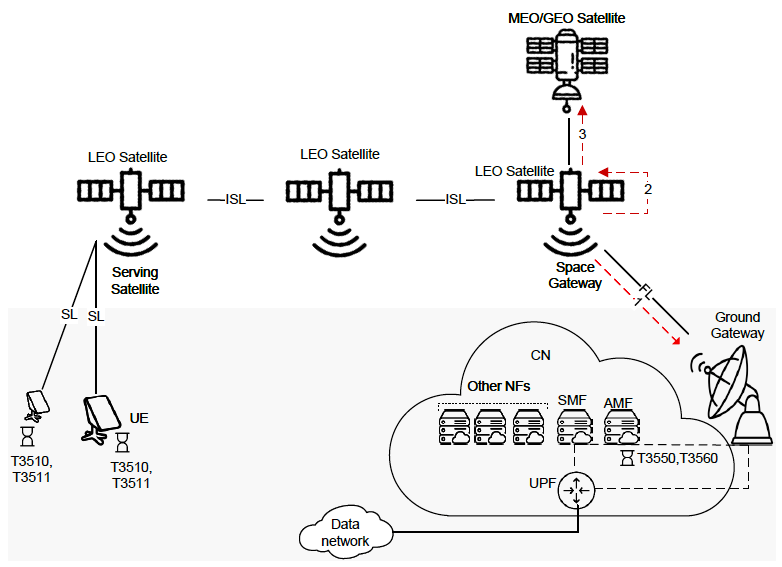
To explain the AstroTimer system model, consider Figure 1, which illustrates a typical LEO satellite network architecture based on a 3GPP reference design (Release 18), the industry standard for mobile network systems.
Each UE connects to a serving satellite through a Service Link (SL). The serving satellite may connect to other satellites via Inter-Satellite Links (ISLs) or to the ground gateway via a Feeder Link (FL). For simplicity, the cross-orbit ISL is shown only on the Space Gateway (SG). If the serving satellite lacks an FL, it forwards traffic to the SG through ISLs. The SG then connects to the ground gateway via the FL. The ground gateway forwards NAS traffic to the AMF and access stratum traffic to the User Plane Function (UPF), which connects to the data network. The Session Management Function (SMF) configures the UPF based on Quality of Service (QoS) requirements. NAS timers regulate NAS procedures.
Figure 1 also shows the NAS timers used during registration and where they run. For example, T3510 runs on the UE and limits the registration completion time. Registration is the first procedure a UE executes after powering on.
The UE starts registration by sending a NAS registration request to the AMF and starting T3510. The AMF authenticates the UE with the help of other NFs, sends a NAS authentication request, and starts T3550 to limit the UE response time. After successful authentication, the AMF processes any additional service requests from the UE. If registration succeeds, the AMF starts T3560 and sends a NAS registration accept message. The UE then sends a NAS registration complete message, which the AMF must receive before T3560 expires.
Despite incorporating these details, the timer has low computational complexity in the number of hops since each hop contributes only constant‑time calculations. This makes AstroTimer practical to implement in an operator environment or network management system where paths and loads may be updated frequently.
We applied this model to key NAS timers in the 5G registration procedure, including watchdog timers such as T3510, T3550, and T3560, and the backoff timer T3511. AstroTimer is designed to be topology‑agnostic and deployment‑independent, supporting gateways anchored on the ground, on-orbit NF deployments, off-orbit NF hosting in higher orbits, and hybrid combinations.
Performance of AstroTimer versus 3GPP defaults
To understand the operational impact, we built a Python‑based NAS emulator that executes full 5G registration call flows and evaluated AstroTimer under LEO scenarios.
We replayed full registration call flows for 3,000 – 5,000 UEs, swept packet‑loss from 0% to 50%, and compared 3GPP’s MEO/GEO‑style reference timers against AstroTimer‑derived values.
Under light load and no loss, both behaved similarly, because queues stayed short and timers almost never expired. The differences emerge as soon as links get lossy and the AMF is heavily loaded. The summary of the performance highlights is listed below:
Faster, more robust registration: AstroTimer cuts time‑to‑register by shrinking backoff when the network is healthy and lengthening watchdog timers when the AMF is close to saturation, so UEs don’t give up too early or hammer an overloaded core. With AstroTimer, all UEs in the stressed scenarios eventually register successfully, while with 3GPP‑style timers, more than 96% of UEs can fail to register when the AMF is under heavy load.
Controlled timer expiries instead of storms: AstroTimer intentionally allows only a modest fraction (around 20%) of timers to expire to detect problems and trigger adaptive retries. With 3GPP defaults, up to about 99% of timers can expire under high load, causing repeated failures and compounding control‑plane pressure.
Lower UE energy consumption: Because UEs spend less time stuck in the active state and use smarter backoff intervals, AstroTimer significantly reduces energy use per device, especially at higher loss rates. This translates directly into better battery life for remote and power‑constrained terminals.
These gains come without changing any NAS procedures or message formats, only the timer values are tuned, making AstroTimer a drop‑in way to get faster registration, fewer failures, and lower energy use in LEO‑based non‑terrestrial 5G and future 6G deployments.
For operators experimenting with or planning LSN-integrated 5G deployments, AstroTimer offers a practical, standards-compatible path to improved reliability, scalability, and user experience. By rethinking something as fundamental and as easily overlooked as control plane timers, we hope AstroTimer can help operators build more robust and efficient NTNs.
This work is going to be presented at the 2026 IEEE International Conference on Communications (ICC).
Dr Peng Hu is an Associate Professor at the University of Manitoba in the Department of Electrical and Computer Engineering, and the Director of the Advanced Network and Embedded Systems Lab (AEL). Dr Hu leads interdisciplinary research in satellite networks, space-air-ground integrated systems, and applied AI in the New Space Era.
The views expressed by the authors of this blog are their own and do not necessarily reflect the views of APNIC. Please note a Code of Conduct applies to this blog.