

A recent PING episode noted that, for the Border Gateway Protocol (BGP) at least, ‘the shape of the curve’ appears to have changed. That’s not quite right. The curve itself hasn’t changed; rather, our position on it has. So what is this curve, and why are we encountering this shift now?
The ‘curve’ here is the technology adoption curve, and it’s not just one thing. It can describe who you are in the lifecycle of a new technology, and it can describe the size of the market and how that market is evolving. The PING episode touched on market size and the rate of change, but let’s start with who you are.
Who are you in the technology adoption curve? Early bird or laggard?
For this view of the technology adoption curve, it’s all about you. It’s about when you enter the market, when you first encounter a new idea. And, broadly speaking, there are two sides to be on — early or late.
Many people will recognize this as the ‘technology adoption life cycle’, but that label is a bit misleading here. This view isn’t really cyclical, and its shape is the familiar bell curve. So, for clarity, here’s a version often referred to as the ‘Rogers bell curve’:
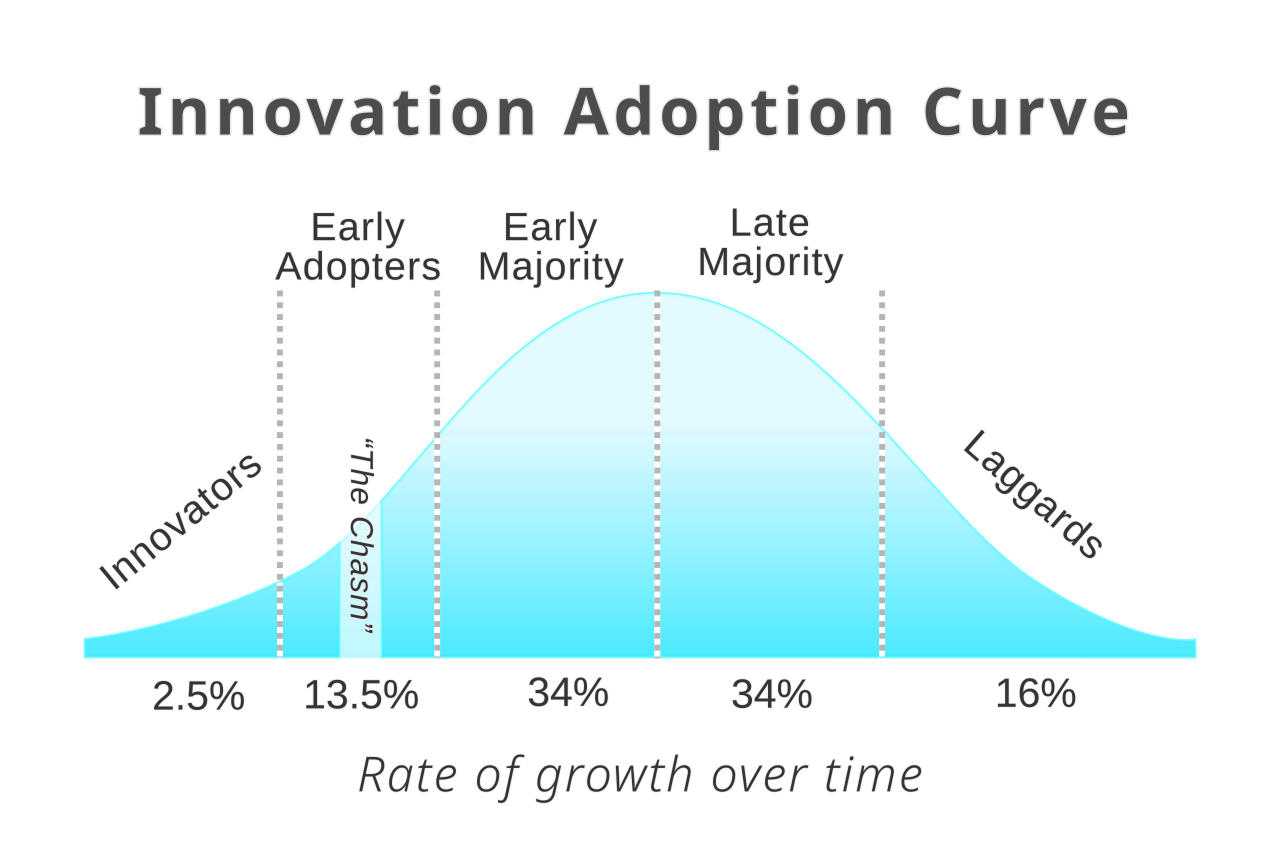
It’s a surprisingly old idea; older than most of the technologies we now take for granted, like colour TV, mobile phones, or personal computers. Even in the days of black‑and‑white television, or earlier with radios and pianos, this pattern was already well understood: Some people are irresistibly drawn to what’s new, some notice the trend and follow not long after, most arrive soon behind them, and a few — the ‘laggards’ — trail along at the end.
For the Internet, we’re well past the ‘late majority’ stage in most developed economies
Worldwide Internet adoption is now around 6 billion people. With a global population of about 8.3 billion, that still leaves more than 2 billion people offline, roughly a quarter of humanity. The difficulty is that these are often the most economically marginalized communities — people who are harder and more expensive to connect, whether because of geography, infrastructure, or circumstance, or who live outside the reach of a technology-driven urban lifestyle, on its fringes or in deeply rural settings.
They deserve better. Closing this gap is a core goal for organizations like the ITU and the Internet Society, both of which see extending Internet access as fundamental. In the Asia Pacific region, the APNIC Foundation has played a significant role in tackling this challenge and improving connectivity for underserved communities.
Emerging technologies may shift the balance. Systems like Starlink, with much lower on-the-ground infrastructure requirements, offer a way to deliver widespread coverage. For rural areas in particular, where limited power as well as physical isolation can be barriers, satellite connectivity, paired with solar, wind, and battery solutions, could prove decisive.
For everyone else who is economically engaged (roughly three‑quarters of the world), the Internet is now simply a fact of life. If you aren’t online, you’re a laggard. And if you’re reading this, by definition, you aren’t.
The other curve: The technology sigmoid curve
The other way to look at this is the one discussed on PING, in relation to the growth rate of BGP. For most of its life, after an initial early phase, BGP growth has been faster than linear — effectively exponential. Planning for routing deployments meant assuming ever-increasing demands on memory and CPU. No capital investment could be relied on to comfortably see out its working life, often falling short before it was even fully depreciated. As a result, BGP engineers became accustomed to frequent upgrade cycles.
Geoff Huston’s most recent review of BGP suggests a shift. While we tend to think device growth continues unabated, the impact on routing is now far less aggressive than it once was. This is a classic manifestation of the technology sigmoid curve. Figure 2 shows a set of past examples that helps illustrate the pattern:
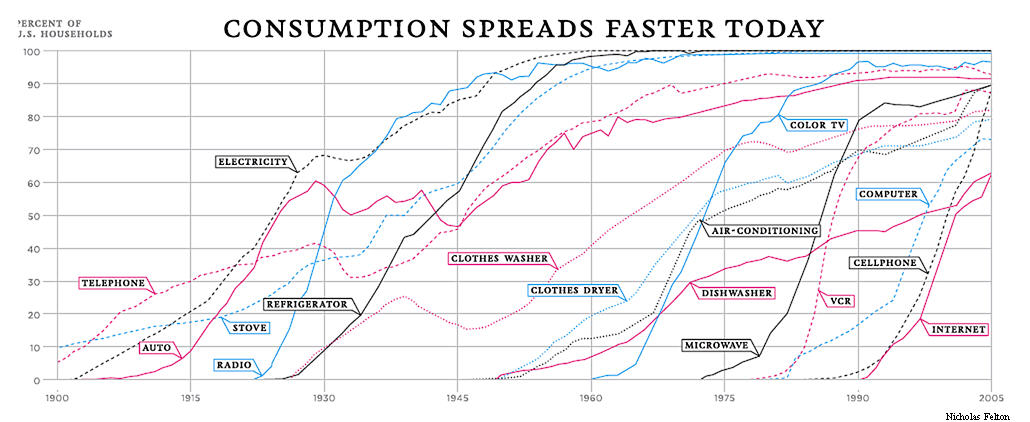
In this view of how new technology is adopted, two patterns emerge. The first is the overall shape of the lifecycle. It follows the classic sigmoid, sometimes called the logistic curve, so named because it traces the familiar ‘S’ shape (Figure 3).
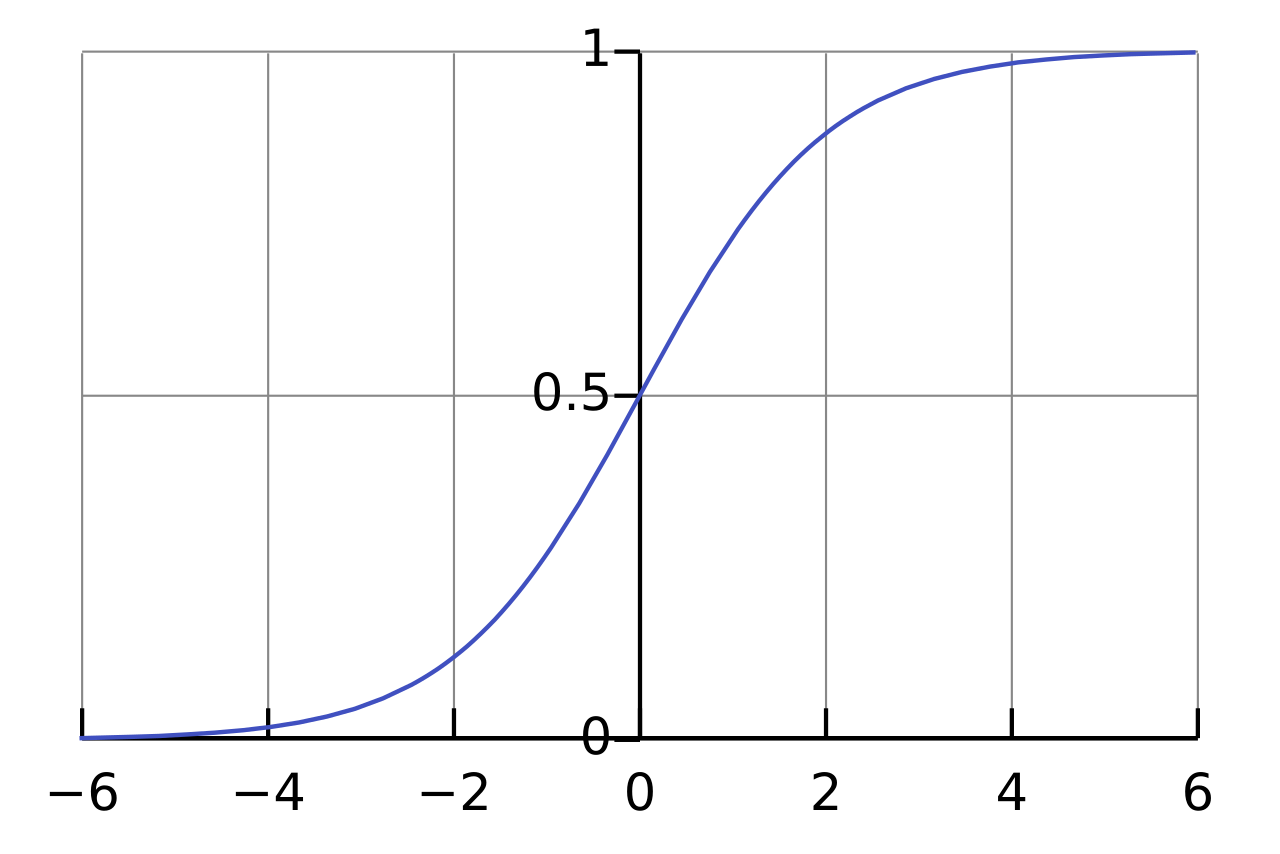
In this view, the early adopters sit on the left, the middle phase is the period of exponential growth, and the right-hand side, those ‘laggards’, marks where adoption begins to taper off. This is where the diagram shows market saturation taking hold — there’s a peak, a point beyond which further growth becomes less economically viable. That can happen because there are no new consumers left to reach, so activity shifts to replacement, or because the cost of connecting the remaining users outweighs any likely return.
For much of the Internet, we’re probably already in this phase. We have broadband, we have our phones, we have computers and tablets. We replace them, certainly, but that doesn’t drive large increases in overall numbers, nor does it happen at anything like the pace we saw when the Internet was still new and expanding rapidly.
The second factor at play is that the slope of the curve has been accelerating over the past century. Where technology adoption was once slow and measured, innovation now bursts into the market and moves rapidly towards saturation.
For BGP, we grew used to assuming we were in a phase of explosive, sustained growth. Now, though, BGP appears to be spanning most of the economically active world; the Internet is already present in most places that can readily support it, and the pace of the ‘new’ Internet (new networks, new ISPs, new additions to the routing surface) has slowed markedly.
Part of this, as Geoff explores in the PING episode and his posts, reflects broader economic conditions. COVID-19 disrupted global growth, and economically, we haven’t returned to the trajectory that preceded it. But that’s only part of the story. More fundamentally, this shift reflects where we are on the curve, in the lifecycle of the technology itself.
The views expressed by the authors of this blog are their own and do not necessarily reflect the views of APNIC. Please note a Code of Conduct applies to this blog.