

Low Earth Orbit (LEO) satellite networks are becoming increasingly important for eliminating dead zones where terrestrial infrastructure is unavailable or uneconomical to deploy. However, owning a satellite constellation is unrealistic for most Mobile Network Operators (MNOs), given the scarcity of orbital and spectrum resources and the enormous cost of deployment and operation.
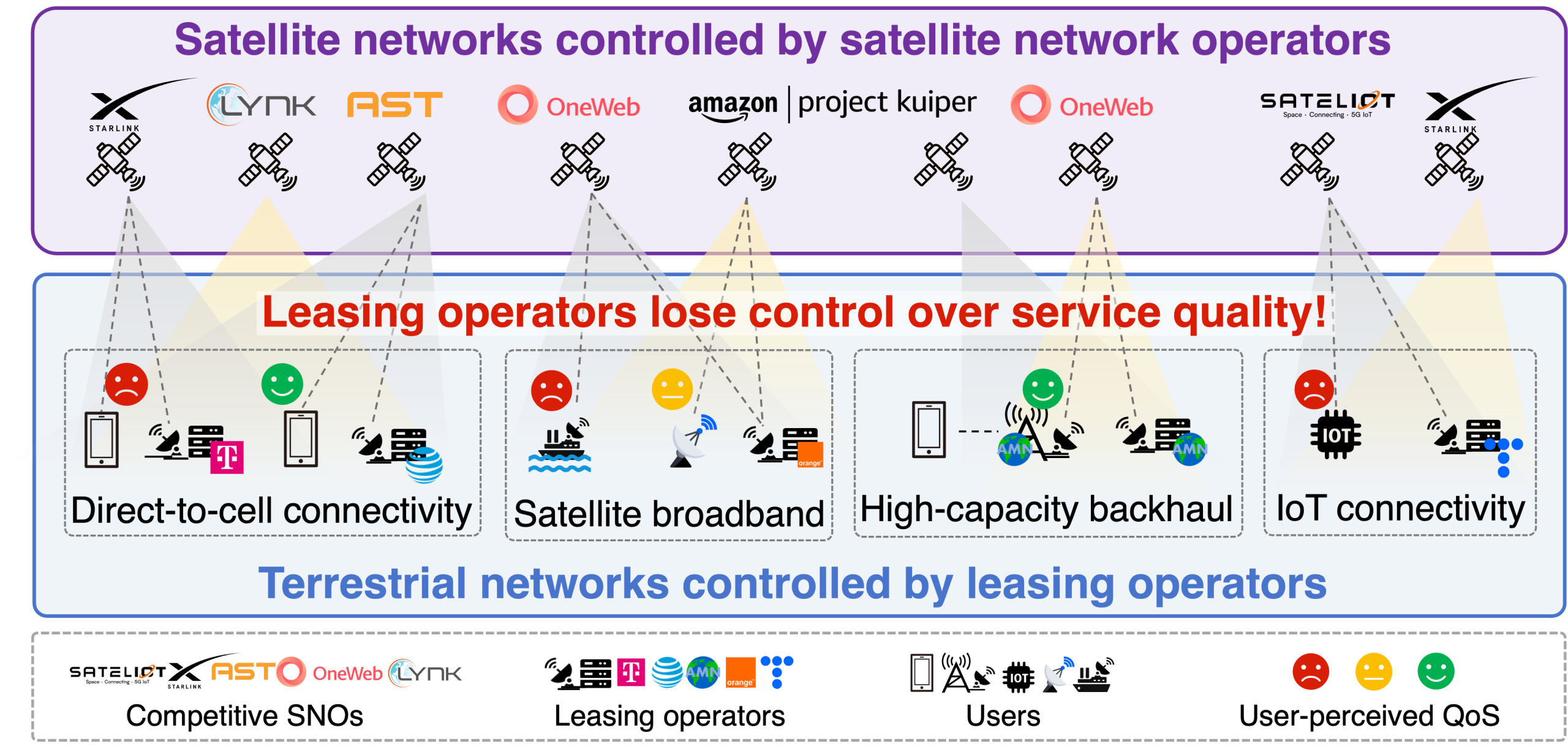
As a result, leasing satellite service from Satellite Network Operators (SNOs) is becoming an increasingly attractive path (Figure 1). Looking ahead, MNOs can cooperate with multiple SNOs to balance coverage and cost, while SNOs can serve multiple MNOs to improve the return on their constellations.
This creates a win-win situation. It gives MNOs a cost-effective way to expand coverage without building dense terrestrial infrastructure or owning a satellite constellation, while allowing SNOs to increase the return on expensive satellite constellations by serving more MNOs.
The risk of leasing satellites: Service quality beyond MNOs’ reach
However, once service is outsourced to third-party satellites, guaranteeing the promised service quality becomes much harder because leasing operators lack direct control over the satellites, as illustrated in Figure 1.
The challenge is not only technical. At its core, it is a problem of trust and incentives.
First, outsourcing creates a trust gap. MNOs lack control over SNO satellites. As a result, the promised service quality becomes harder to enforce. Second, there is a conflict of interest. MNOs want high-quality service to attract and retain users. The SNOs, however, may be tempted to reduce service quality to cut operational costs.
Existing approaches mainly fall into three categories:
- SLA-based mechanisms
- Client-side monitoring
- Trustless verification mechanisms
All three are insufficient in outsourced LEO satellite networks. Because LEO satellites move fast, link quality fluctuates rapidly. Even when an MNO observes service quality degradation, it is difficult to tell whether the degradation comes from unavoidable link dynamics or from SNOs’ intentional service degradation. As a result, it becomes difficult to determine whether the SNO is responsible for the degradation, making any after-the-fact penalties slow, difficult, and often ineffective.
Ripple: Don’t police the satellite, let the market police it
To address this challenge, researchers from Tsinghua University proposed Ripple. Instead of relying on stronger monitoring or after-the-fact penalties, Ripple aligns the incentives of MNOs and SNOs, so SNOs are naturally incentivized to deliver the best possible service quality. Its key idea is to directly bind SNOs’ revenue to their delivered service quality.
To achieve this, Ripple leverages pay-as-you-go accounting mechanisms, such as tokens, so that every traffic migration becomes a revenue migration. When an SNO underdelivers, users and leasing operators can shift away, and the SNO loses revenue. In this way, Ripple turns service quality from a performance indicator into a competitive market force.
Ripple does this through two coupled incentive mechanisms:
- User-side short-term incentives by Quality of Service (QoS)-aware handover: Ripple empowers users to measure runtime QoS metrics (like throughput, latency, and packet loss) and flexibly switch among competitive SNOs with pay-as-you-go tokens. This dynamic traffic migration acts as a financial vote, instantly redirecting revenue away from underperforming SNOs. This creates strong short-term incentives for SNOs to deliver the best possible service. To effectively adapt to rapidly changing and unpredictable satellite QoS, Ripple formulates user-side SNO selection as an adversarial multi-armed bandit (MAB) problem and develops a lightweight yet effective EXP3-based selection algorithm that balances exploration and exploitation. Over time, users can converge toward the best-performing SNO.
- Operator-side long-term incentives by partner re-selection: Ripple lets MNOs periodically re-evaluate SNOs based on historical performance (based on the aggregated pay-as-you-go token distribution), and update their cooperation partners accordingly. Unlike traditional rigid long-term contracts, this performance-adaptive, short-term agreement maintains continuous competitive pressure on SNOs, ensuring that short-term QoS improvements evolve into sustained, long-term quality guarantees.
By integrating these dual-layer incentive mechanisms, Ripple establishes a self-reinforcing competitive ecosystem that compels SNOs to deliver the best possible service.
We prototyped Ripple in the direct-to-cell scenario as a proof-of-concept on top of open-source 4G/5G protocol stacks (srsUE, srsRAN, and free5GC). Experiments show that Ripple enables QoS-aware SNO handover with minimal overhead, averaging just 1.4% CPU use, while enabling users to eventually converge to the best-performing SNO.
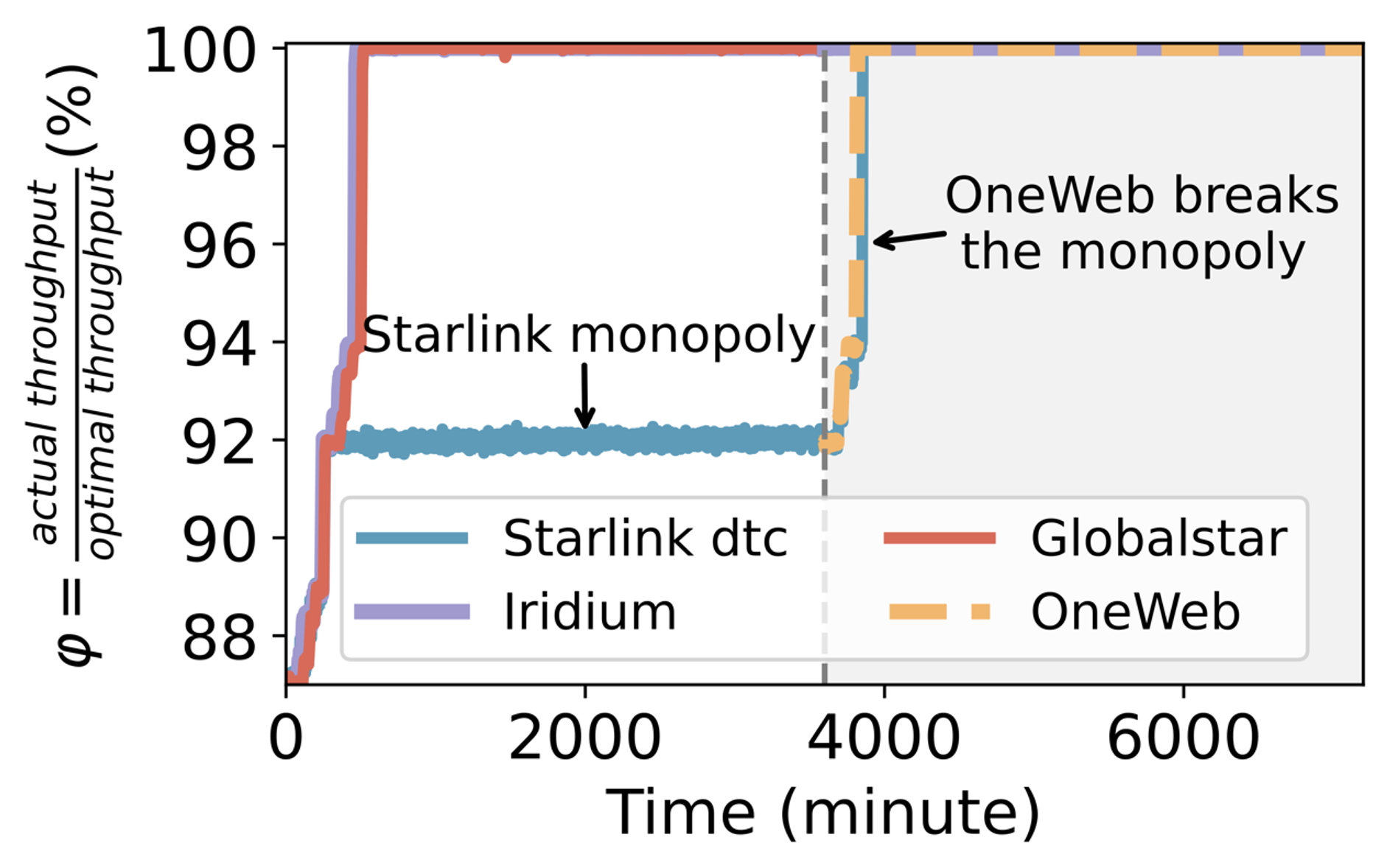
As shown in Figure 2, large-scale simulations driven by real LEO satellite traces indicate that Ripple can mitigate the dominance of a monopolistic SNO and encourage SNOs to compete on quality. Ripple gives users and MNOs a practical way to deal with service quality that cannot be guaranteed in outsourced satellite networks.
Users can switch SNOs based on observed QoS, while MNOs can update SNO partners based on historical performance. As a result, lower-quality service leads to short-term traffic loss and long-term business loss, while better service brings higher revenue. Improving service quality becomes the dominant strategy for SNOs. Results show that SNOs that consistently deliver better service can gain up to 27.7% higher revenue.
Looking forward, the design principles of Ripple may also extend beyond LEO satellite networks. In shared infrastructures, such as cloud networks and Mobile Virtual Network Operator (MVNO) networks, combining pay-as-you-go accounting with QoS-aware provider selection could create a more competitive market, where traffic and revenue naturally shift toward providers that deliver better service. This could help leasing operators gain more control over the service quality they receive and encourage infrastructure providers to improve service quality to win more traffic and business.
We will be presenting our Ripple paper at IEEE INFOCOM 2026.
Lixin Liu is a PhD candidate at the Institute of Network Science and Cyberspace, Tsinghua University. Her research mainly focuses on satellite networks.
The views expressed by the authors of this blog are their own and do not necessarily reflect the views of APNIC. Please note a Code of Conduct applies to this blog.