

This is not the first time I’ve looked at Domain Name Certificate revocation in these blog articles, first in 2020 and again in 2022 — it’s an evolving story. There have been several recent changes by the Certificate Authority and Browser Forum (CAB Forum) and the largest Certification Authority, Let’s Encrypt, which have a fundamental impact on the way in which we use (and trust) these certificates. I thought it would be useful to look at the topic of certificate revocation once more in the light of these changes.
Public Key Infrastructure (PKI) is a system designed to support the use of public/private keyed digital signatures through a system of structured transitive trust. The objective of a PKI is to enable trusted communications between parties who may have never directly met and may not necessarily even know each other at all.
A PKI normally uses X.509 public key certificates, which are digital objects that contain:
- A verifiable attestation that the certificate issuer has satisfied itself using application procedures documented in its Certificate Practice Statement
- An assertion that the holder of a given public/private key pair has met certain criteria as specified by the certificate issuer
The certificate issuer then publishes a certificate that associates a subject name (such as an individual’s details for identity certificates or a DNS name for a domain name certificate) with the holder’s public key. It then attaches a digital signature to this object, generated using the certificate issuer’s private key. This act is both verifiable by any party that has knowledge of the issuer’s public key and cannot be subsequently repudiated by the issuer.
X.509 public key certificates support several purposes, including authenticity, verifiability, and attribution. They can also help establish an encrypted session. For example, if an individual signs a digital document with their certified private key, anyone who refers to the associated public key identity certificate can validate (verifiability) that it was this particular individual who signed the document (attribution), and the document is unaltered (authenticity), as long as they are prepared to trust the integrity of the certificate issuance practices of the certificate issuer. If a client uses a server’s public key as part of the process of setting up a session key, the client and server can exchange encrypted messages that can only be deciphered by each other (encryption), such as in the use of keys by Transport Layer Security (TLS).
We see widespread use of domain name public key certificates in the web, where clients can access servers’ published content and online services using Transport Layer Security (TLS), as seen in the use of HTTPS URLs. The use of the web PKI allows a client to validate the authenticity of the remote server’s identity and encrypt the ensuing access session, ensuring that:
- The transaction cannot be eavesdropped on by third parties
- The contents of the transaction are not altered in any way
- The server cannot repudiate the transaction
Obviously, this level of trust is vital for the Internet, making TLS one of the foundational protocols for the Internet. If I had to nominate just a handful of critical, common Internet protocols, I’d say that TLS ranks alongside DNS and HTTP. This means that the web PKI system of domain name certification is also critically important to the Internet. I’d go further and argue that, across a range of Internet security mechanisms, including DNSSEC and RPKI, we rely heavily on these domain name certificates to provide the assurance that we are not being misled.
X.509 Public Key Certificates enable transitive trust (on the basis that if Alice trusts every action of Bob’s and Bob trusts Carol, then Alice can trust Carol). However, trust is never eternal, including the implicit trust described in a certificate.
An X.509 Public Key Certificate has two date fields, notBefore and notAfter, specifying the timespan during which the certificate can be used. It must be noted that RFC 5280 does include the specification of a ‘forever’ notAfter date value if eternal trust really is the intended outcome! But using this value would be an incredibly foolhardy action! The usual practice of certification management is to set the notBefore field to the date of certificate issuance, and the notAfter field to some period specified by a contract or agreement between the certificate issuer and the subject.
The subject is expected to apply for a new certificate before the expiration of the current certificate if they wish to continue to be certified beyond the notAfter date. Before Let’s Encrypt’s entry into the Secure Socket Layer (SSL) certification market, typical certification periods were one or two years. Let’s Encrypt is now a major player, and its certificates have a 90-day validity period, so the average validity period for these certificates has come down. There is a change coming in these Let’s Encrypt certificates next month, in May 2026, but we’ll discuss this further on in this article.
There are circumstances where the certificate should be marked as unusable immediately, which is before the notAfter expiration time. The private key may have been compromised, or the certificate was issued in error, or the subject is no longer undertaking the activity or service for which it was certified, and so on. The subject may want a new certificate issued before its current certificate expires, and retire the old certificate as soon as its replacement is brought into service. Or the certificate issuer may have been compromised. These things happen.
Revocation
How can a certificate be marked as unusable (or be revoked) before its scheduled expiration time?
The certificate issuer should remove the revoked certificate from its online publication point, so that the revoked certificate is no longer available for upload and use by relying parties.
But that’s not good enough. There are many reasons for certificate users to gather and locally store copies of such certificates. My web server, for example, uses a local copy of the server name’s certificate to support secure sessions. When a client starts a TLS session with this server, how is the client meant to know that the certificate being used to set up this secure session has been revoked? The client needs a way to check whether the certificate is still trustworthy.
Before looking at revocation mechanisms, I should note one rather esoteric point about revocation, namely its irrevocability.
Revoking a certificate causes the Certification Authority (CA) to create a metadata record about the unusable status of the certificate in a special list of revoked certificates. The list is called — imaginatively — a Certificate Revocation List (CRL), digitally signed by the CA to attest to its authenticity.
The CA does not issue an altered replacement certificate that records its revoked status within the certificate itself. The entry in the CRL is the only record that the certificate must not be used. A CA could, in theory, subsequently remove the listing of the revoked status of the certificate in the CRL. Because the certificate itself has not been altered in any way, it could restore the certificate to its publication point. In effect, the published certificate state after this removal of the revocation metadata would be the same as it was before the revocation action. The certificate has been unrevoked.
In practice, this would be a truly terrible idea, and CAs must never attempt this! The only permitted way to signal the reinstatement of trust is by issuing a new certificate for the same subject with a new serial number. It would be prudent for the subject to use a new public/private key pair in this case.
A conventional PKI response to manage revocation is for the CA to regularly publish a signed CRL. The list contains all of the certificate serial numbers of all unexpired revoked certificates it has issued, and the time of revocation. A CRL also contains the date of its own issuance and the anticipated date when the next CRL will be published. CRLs are signed with the private key of the CA. A standard profile for CRLs for use on the Internet is published in RFC 5280. An example CRL is shown below.
$ wget http://e8.c.lencr.org/111.crl
$ openssl crl -inform DER -text -noout -in 111.crl
Certificate Revocation List (CRL):
    Version 2 (0x1)
    Signature Algorithm: ecdsa-with-SHA384
    Issuer: C=US, O=Let's Encrypt, CN=E8
    Last Update: Apr 22 01:42:43 2026 GMT
    Next Update: May  1 01:42:42 2026 GMT
    CRL extensions:
        X509v3 Authority Key Identifier:
            8F:0D:13:A2:F6:2E:7E:D1:50:6C:33:18:38:5D:59:8E:23:72:91:CA
        X509v3 CRL Number:
            1776822163859760709
        X509v3 Issuing Distribution Point: critical
            Full Name:
              URI:http://e8.c.lencr.org/111.crl
            Only User Certificates

Revoked Certificates:
    Serial Number: 05F5F9651D5AA120AFFB590755A2C51979EE
        Revocation Date: Jan 21 01:06:17 2026 GMT
    Serial Number: 063914206A1E038705B852D44A5051E3396E
        Revocation Date: Jan 21 04:33:49 2026 GMT
    [repeated 1,560 times]

    Signature Algorithm: ecdsa-with-SHA384
    Signature Value:
        30:66:02:31:00:b7:59:6a:b2:61:fc:d5:57:92:1e:5c:08:86:
        11:77:7a:c0:91:07:3c:b3:32:62:6b:d4:d8:6b:7a:d9:33:9c:
        ea:a1:e9:5d:a5:75:e7:d0:cb:f4:a1:65:d5:47:94:21:0c:02:
        31:00:86:7b:d7:6b:14:19:7a:8d:ad:2e:ec:d8:e5:ce:83:ad:
        3e:7d:57:84:21:09:38:af:31:90:97:32:74:61:f5:b8:59:1a:
        89:68:ef:66:03:43:fd:12:71:b6:8d:e1:b8:14
The CRL is intended to list all unexpired revoked certificates issued by this CA in a given scope at the date specified by the Last Update field of the CRL. If the scope of the CRL is the entire set of certificates issued by this CA, then any unexpired certificate that is not listed in the CRL can be trusted (used as a valid certificate) until the next CRL issuance time.
End users (‘relying parties’) can consider a CRL itself to be valid if the current time is between the CRL time and the CRL’s nextUpdate time, and the CRL’s signature can be validated.
Having a certificate listed in a CRL effectively curtails a certificate’s validity, but the effect is not necessarily immediate across the broader domain of use. A relying party may hold a local copy of an issuer’s CRL until the CRL’s nextUpdate time, and therefore revocation may not be visible to relying parties until the next CRL is published.
While a CRL can curtail a certificate’s lifetime before its scheduled expiration date, the CRL may not necessarily be up to date, and may lag by as much as the CRL’s publication interval. In the case of the CRL above, there is a nine-day window where a relying party may be unaware that an issued certificate may have been revoked. In practice, a CRL improves the timeliness of certificate currency from years to a week or so. It’s still not immediate, but it’s an improvement.
How can a client check the revocation status of a certificate that is presented to it when starting a TLS session? The CRL procedure entails:
- Find the CRL publication URL in the certificate provided as part of the TLS handshake
- Retrieve the CRL
- Validate that the digital signature was generated by the CA’s private key, and create a validation chain to a TA
- Validate the currency of the CRL with the update date of the CRL
- Look for the certificate’s serial number in the CRL
If the certificate was revoked prior to the CRL issue date, then its serial number will be listed in this CRL. If it cannot be found in the CRL, then either the certificate has not been revoked, or, more accurately, it had not been revoked at the time of the CRL creation date.
More unexpired revoked certificates mean larger CRLs. Longer certificate lifetimes mean larger CRLs. For a large CA, the workload associated with CRLs can be significant. Delivering a complete list of all revoked certificates may be over-answering, particularly if all the querier wanted to know was the revocation status of a single certificate. In the CRL in the example above, the client is given a list of 1,562 revoked certificate serial numbers to check through.
The generation of CRLs is not a mandatory requirement for CAs. A CA may elect to regularly publish CRLs, or may elect to publish CRLs and update them with delta CRLs, or may not publish CRLs at all!
The question is: Do we use CRLs in this manner? No!
It takes too long to load the CRLs and perform the CRL checking actions, and nobody is willing to pay this time penalty. It’s also a totally inefficient design. Why retrieve the entire list of revoked certificates in a CRL when all you want to know is the status of a single certificate? For these reasons, CRLs were typically not used by end clients when setting up a TLS session.
Plan B: OCSP
Online Certificate Status Protocol (OCSP) is a refinement of the omnibus style of CRLs. In OCSP, a client generates a request that contains a certificate serial number and sends it to the CA that issued the certificate. The CA responds with a signed certificate status report indicating whether the certificate is good or whether the certificate has been revoked (Figure 1). The protocol is documented in RFC 6960.
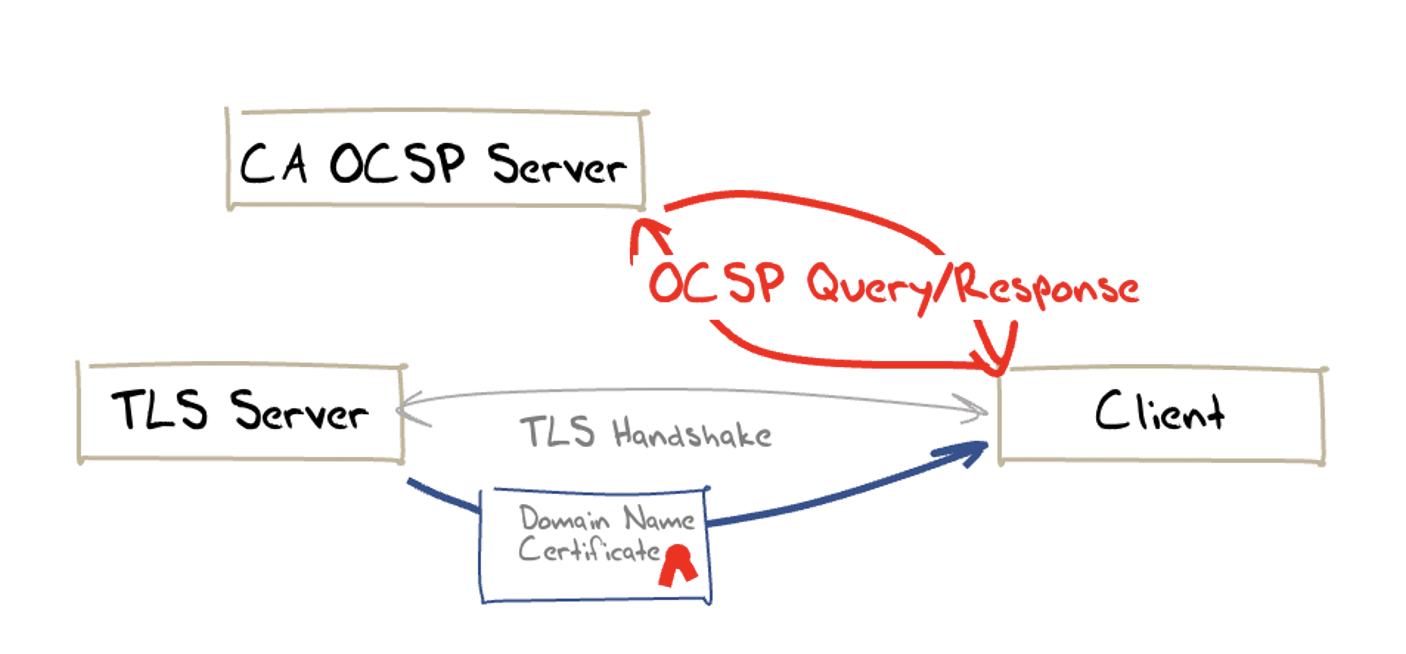
An OCSP request is an ASN.1 object, containing one or more certificate serial numbers of certificates that the client wants the CA to check.
An OCSP response is digitally signed by the CA that issued the certificate, or a CA-designated responder. The response includes the identity of the responder, the time of the response, responses for each certificate in the request, and optional extensions. The response codes used by OCSP indicate that the certificate is either:
good, which actually means no certificate with this serial number issued by this CA is revoked. As RFC 6960 explains: “This state does not necessarily mean that the certificate was ever issued or that the time at which the response was produced is within the certificate’s validity interval.”revoked, which indicates an unexpired revoked certificate, but may also indicate that this CA has not issued a certificate with this serial number.unknown, which indicates that the CA does not recognize this certificate serial number.
An example OCSP response for a revoked certificate:
$ openssl ocsp -issuer lets-encrypt-r3-cross-signed.pem.txt -serial
  0x04F6351FB48399440794386973D8BD9C4095 -url http://r3.o.lencr.org -text
OCSP Request Data:
    Version: 1 (0x0)
    Requestor List:
        Certificate ID:
          Hash Algorithm: sha1
          Issuer Name Hash: 48DAC9A0FB2BD32D4FF0DE68D2F567B735F9B3C4
          Issuer Key Hash: 142EB317B75856CBAE500940E61FAF9D8B14C2C6
          Serial Number: 04F6351FB48399440794386973D8BD9C4095
    Request Extensions:
        OCSP Nonce:
            0410E32D127F0CAE78737814324013BF904C
OCSP Response Data:
    OCSP Response Status: successful (0x0)
    Response Type: Basic OCSP Response
    Version: 1 (0x0)
    Responder Id: C = US, O = Let's Encrypt, CN = R3
    Produced At: Mar 13 16:22:00 2022 GMT
    Responses:
    Certificate ID:
      Hash Algorithm: sha1
      Issuer Name Hash: 48DAC9A0FB2BD32D4FF0DE68D2F567B735F9B3C4
      Issuer Key Hash: 142EB317B75856CBAE500940E61FAF9D8B14C2C6
      Serial Number: 04F6351FB48399440794386973D8BD9C4095
    Cert Status: revoked
    Revocation Time: Mar  8 16:22:24 2022 GMT
    This Update: Mar 13 16:00:00 2022 GMT
    Next Update: Mar 20 15:59:58 2022 GMT
    Revocation Time: Mar  8 16:22:24 2022 GMT
    Signature Algorithm: sha256WithRSAEncryption
         73:88:aa:a1:1d:ff:5f:5b:eb:30:9d:43:ca:76:b8:3e:70:9f:
         d7:d2:3f:6e:dd:dd:fb:69:0f:16:e4:b3:3c:f3:75:d3:6b:37:
         f4:fa:cc:10:15:8c:cf:59:e0:f4:2a:60:d9:4c:5e:b2:df:24:
         d9:a1:20:b2:7e:14:d8:d0:03:92:97:9e:be:b3:e5:4e:c9:6c:
         db:96:8c:ff:6c:c7:4f:cf:88:35:bb:52:90:4f:6e:b9:51:70:
         f1:51:93:9d:de:b0:91:44:69:12:47:15:b2:18:c3:0d:bd:d5:
         af:01:ff:c3:8d:c0:31:94:87:e0:0e:06:18:35:7a:a8:4a:dd:
         2a:e4:61:2a:6d:db:6e:9f:87:d4:9f:79:25:17:f5:7a:e3:4d:
         7b:44:95:56:d4:ff:b2:38:50:f6:58:7c:d3:97:0c:e6:ab:2c:
         f6:2b:9a:55:a8:63:c6:f4:b9:97:2b:21:a2:bf:38:0d:91:e6:
         af:64:22:b8:50:b4:e8:70:27:ee:60:0d:fd:96:6e:b2:54:f8:
         38:ed:14:31:ca:1e:3f:c3:7f:ae:f5:d3:ff:9b:75:bf:4d:12:
         e7:1b:9a:62:a8:d9:c0:a4:8f:48:33:b2:f5:ea:d0:e9:27:e3:
         4f:ed:c3:1a:80:3a:1b:94:27:7c:90:56:c3:b3:65:7a:6e:5f:
         94:a9:56:79
The extensions in the response may include a nonce that cryptographically links a request to the response, preventing replay attacks. It may also include a reference to a CRL. OCSP responses also may include four times:
thisUpdate: The time that the responder generated this status informationnextUpdate: The time by which updated information will be availableproducedAt: The time the responder signed this responserevocationTime: The time when the certificate was revoked
These fields allow the client to cache an OCSP response, as the response can be cached until the nextUpdate time. OCSP responses can be generated in advance, with the time of the generation of the response indicated by the producedAt time.
There are some very serious privacy concerns with OCSP in having the client contact the CA. The CA is aware of the identity of clients using this certificate from the OCSP queries, and is also aware of when the client is using the certificate. This is a significant privacy leak each time the client needs to access the OCSP data for a certificate.
There are also performance issues with the additional OCSP request and response times. This is not necessarily a single request, as a prudent client would check not only the revocation status of the certificate used by the server, but also check the revocation status of all the CA certificates used by the client to assemble the validation chain from a TA to this certificate.
It is also worth remembering that this is not necessarily a query as to the current revocation status of this certificate. The OCSP response is generally an extract from the CA’s current CRL, and it reflects the certificate’s revocation status at the time of the creation of the CRL, not the revocation status at the precise time of the OCSP query.
It’s still effectively a CRL lookup, but now the lookup is being performed by the CA, not the client.
Who uses OCSP?
Let’s look at a few common browsers and see if the browser is willing to successfully complete a TLS connection even when the certificate is revoked. For this test, we will not use OCSP Stapling, so the only way that the browser can tell if the certificate has been revoked is via an OCSP query. The results are shown in Table 1.
| Browser | OCSP |
| Chrome | NO |
| Safari | YES |
| Firefox | YES |
Safari and Firefox browsers perform OCSP-based certificate revocation queries, while Chrome does not (and has not since 2012).
If we are going to rely on OCSP to perform certificate revocation, then it seems that this is largely an ineffectual measure, as the dominant browser platform, Chrome, does not perform OCSP checks. What’s wrong with OCSP?
The OCSP scorecard
✅️ Speed: It’s faster than performing a full CRL retrieval and lookup.
❎️ Speed: There’s still an additional imposed delay to perform the OCSP query and response.
❎️ Availability: On-demand CRLs and OCSP queries require CA service points to be available. With CRLs, it is possible to rely on local caching of CRLs, and to somewhat alleviate this availability requirement, but for on-demand OCSP, there is simply no way out. The OCSP server must be available at a speed that supports the tight time constraints of a TLS session setup. This is a major change to the CA’s operational model, which was not directly involved when a client wanted to validate a certificate, as long as the client was not going to perform a revocation check.
❎️ Failure modes: What should the client do if the OCSP request is not answered? Proceeding in any case is a soft-fail that exposes the client to risks that OCSP was intended to avoid. A cautious denial, or hard-fail, may simply generate unnecessary blocking. The OCSP service point becomes a single point of potential failure, and adding yet another point of potential service failure is hardly a sensible move. A hard-fail framework also runs the risk of making these OCSP servers yet another point of vulnerability in a hostile denial-of-service scenario. It appears that many client applications and operating system service libraries use soft-fail if an OCSP query elicits no response. This has consequences, as an attacker who is on the path between the user and the CA may see the unencrypted OCSP query and simply block it. The client’s certificate validation function will then soft-fail and regard the revoked certificate as valid. The client is then placed into the vulnerable position of trusting a revoked certificate anyway.
❎️ Privacy: OCSP is also a significant privacy leak. With OCSP, the CA is now aware of which clients use a certificate to complete a TLS connection and when. In an Internet that appears to be solidly based on surveillance capitalism as its dominant business model, this places a significant body of highly valuable information about current user behaviour into the hands of a new set of actors. It’s quite challenging to imagine any scenario where this information stream would not be exploited in one manner or another by the CA.
Let’s Encrypt reported that at the start of 2025, their OCSP servers handled some 340 billion OCSP requests per month, or an average of 140,000 requests per second.
So, OCSP is not looking all that good.
That’s why I claim that online revocation checking is useless — because it doesn’t stop attacks. Turning it on does nothing but slow things down. You can tell when something is security theater because you need some absurdly specific situation in order for it to be useful.
No, don’t enable revocation checking
Plan C: Stapled OCSP responses
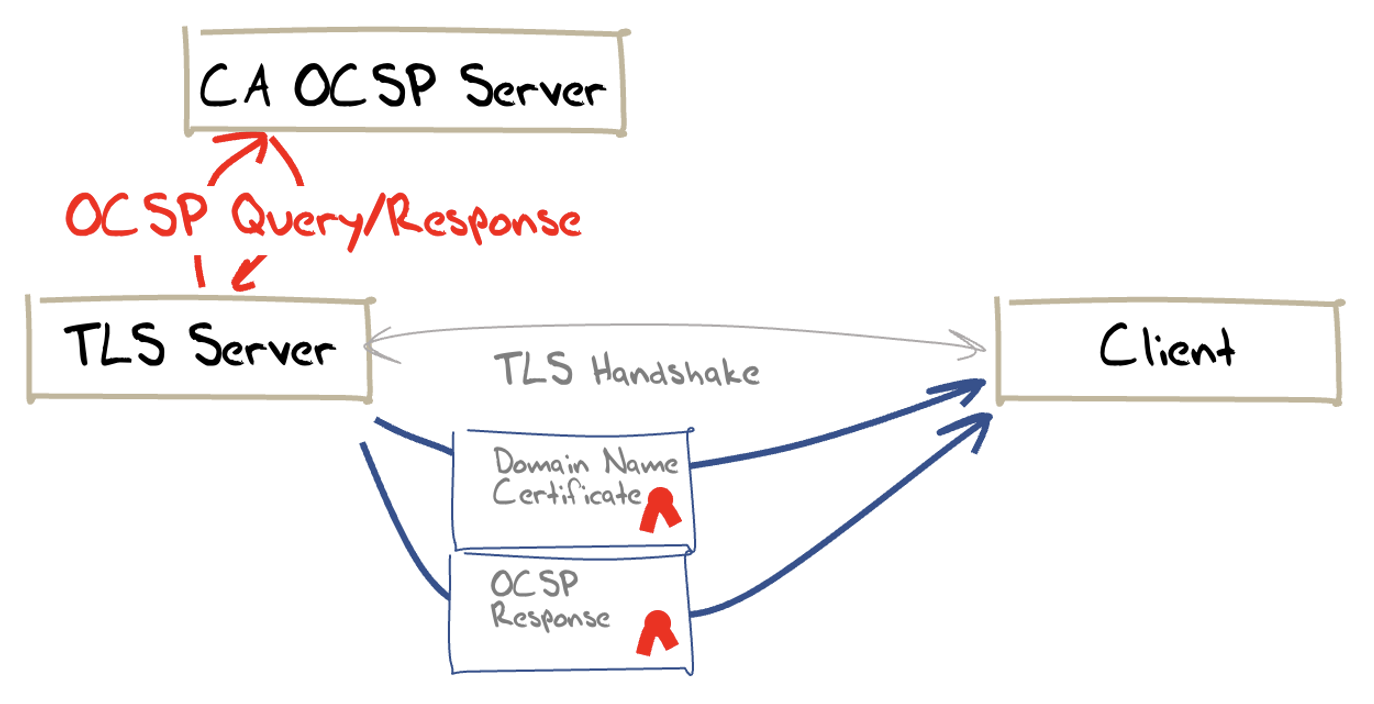
One response to these concerns related to on-demand certificate status checking is to package the OCSP response with the certificate, in a framework called Stapled OCSP (described in RFC 6066 and RFC 6961).
As the OCSP response is already signed and dated by the CA, and the server knows which certificate it has passed to the client, it also knows what OCSP requests the client will make to the CA to confirm that the certificate has not been revoked by the CA. The server uses TLS stapling to attach the OCSP response to the TLS material used in the handshake. It can do this for the OCSP response of other CA certificates in the validation chain used by the client to validate the certificate.
If we want a scalable solution to the revocation problem then it’s probably going to come in the form of short-lived certificates or something like OCSP Must Staple. Recall that the original problem stems from the fact that certificates are valid for years. If they were only valid for days then revocation would take care of itself.
Adam Langley
What stapled OCSP responses are trying to achieve is to offload the OCSP check from the client to the server. This is shown in Figure 2.
Let’s compare the OCSP scorecard against this stapled OCSP approach.
The stapled OCSP scorecard
✅️ Speed: It’s faster than performing a full CRL retrieval and lookup
✅️ Speed: It’s faster than OCSP, as there is no additional query and response delay for the client
✅️ Performance: It reduces the OCSP query load on the CA, as the OCSP response can be used for the entire OCSP validity time, rather than having each client query the CA upon every use of this certificate
✅️ Privacy: The CA gains no knowledge of the identity of the client or the times of use of this certificate
✅️ Failure modes: Persistent unavailability of the CA’s OCSP server can cause the server to hard fail as it has no current OCSP response to staple to the TLS material
We can also perform the same tests on a range of commonly used platforms and browsers to see if they will correctly detect the attempt to use a revoked certificate to set up a TLS session. This is shown in Table 3.
| Browser | Stapled OCSP |
| Chrome | No |
| Safari | Yes |
| Firefox | Yes |
Chrome and revocation
What’s going on with Chrome? Almost a decade ago, Chrome signalled that it was going to use a different form of revocation checks. The approach, termed ‘CRLsets’, involves Chrome using Googlebots to crawl across CRLs and collect a set of current revocations. Details are a little sparse, but many reports claim that the list of revoked certificates is then trimmed, and ‘unimportant’ revocations are stripped out. The resultant list is sent to instances of the Chrome browser.
The article that described this approach also included the comment: “For the curious, there is a tool for fetching and parsing Chrome’s list of revoked certificates”. After retrieving and running this tool, I was surprised to see a total of 1,081 revoked certificate serial numbers in this list. This seems oddly low. The CA Let’s Encrypt lists 1,062 revoked certificates, and it’s by no means the only CA out there. If this tool is the same as that used within Chrome, then the trimming being carried out here is quite extensive.
I must admit that this strikes me as inconsistent on Chrome’s part. On the one hand, Chrome (and Google) have been part of the pressure to transform encryption from an expensive luxury to a freely available commodity.
Chrome complains when it is directed to sites using port 80 without channel encryption, and when a certificate is signed by a private CA, Chrome will refuse to connect based on its assumed insecurity. Yet at the same time, Chrome is saying that this enthusiasm for security and encryption does not extend to support for revocation. Revocation support, timely or otherwise, is only for some chosen few in Chrome.
Now, if Chrome had no significant market share in the Internet browser space, then Chrome’s position would be insignificant. But this browser has 80% of the market, and Chrome’s position is the de facto Internet position. Chrome is all too willing to ignore revocation for all but the ‘most important’ services.
What’s the point of stapled OCSP?
Good question!
If the certificate is not revoked at the time of the CRL generation, then, as already noted, the OCSP reported status is good, which adds nothing to the information already contained in the certificate. In this case, stapled OCSP is adding nothing.
If the OCSP reported certificate status is revoked, then the CA is saying that this certificate should not be used. If that is the case, why should the server convey the certificate and the OCSP status to the client and defer to the client on the decision not to proceed with the TLS connection? Why shouldn’t the server simply terminate the TLS connection immediately itself? In other words, why should the server pass a revoked certificate to the client? Stapled OCSP is a long way around to reach the inevitable outcome of a correctly failed TLS connection attempt.
So why bother?
Is revocation worth the effort?
Another good question!
A compromised private key should not be accepted. An attacker might use a compromised private key to impersonate a site, and this vulnerability needs to be prevented to ensure that users can trust the integrity and security of the services they use over the network. The way to stop a compromised key from being accepted is to disseminate the information that the key is no longer trustable, and this is achieved by revoking the public key certificate. Or so goes the conventional thinking on X.509 certificates and revocation.
However, we are having some problems in taking this theory and creating practical implementations of revocation.
CRLs only really work efficiently when nobody revokes certificates. Otherwise, we have a scaling problem. Clients incur the considerable overheads of very large CRLs being passed around unnecessarily when they only really wanted to query the status of a single issued certificate in any single transaction.
We can use OCSP, which avoids the scaling problem of large CRLs, but introduces privacy issues, as the CA becomes aware when clients access individual services that have been certified by this CA.
We can address this by having the server retrieve the OCSP entry and staple it into the TLS exchange, but at that point, we arrive at the obvious conclusion that if the server is aware that the certificate has been revoked by the CA, then the server should not complete the TLS exchange at all. However, with the must-staple attribute in the certificate, the potential attacker is frustrated when the certificate is presented to the user.
But there is a little more going on here.
There is the issue of currency and timeliness. If the point of this entire certificate architecture is to inform the user that the location that they have reached is, or is not, the location that they intended to reach, then why is it useful at all if it can’t inform the user that the certificate that is being used is not to be trusted right now?
If the best that CRLs, OCSP, stapled OCSP and even Chrome’s CRLsets can inform you is the trust status of a certificate ‘at some time in the past’, then why is this any different from the certificate itself? A certificate claims that the subject met the CA’s criteria to issue a certificate at some point in the past.
If the entire purpose of these revocation notification mechanisms is only to reduce the ‘trust window’ of a certificate and report on the status of a certificate at a time closer to the present, then why not just use certificates with a more constrained trust window and avoid revocation completely?
This seems to be a challenging conclusion. The problem with offering certificates that provide a highly constrained trust window of hours, or at most days, is that the current CA infrastructure was not designed to behave in this way. The certificate infrastructure that is built around assumptions that certificates with a trust window of years probably could not cope with such a dramatically reduced trust window, and the associated increased intensity of certificate issuance.
Instead, we find ourselves in a situation that has the incompatible attributes of long-lived certificates and non-functional revocation mechanisms. If certificates are incapable of informing a client in real time that they are about to be drawn into misplaced trust, then what exactly are these certificates good for anyway?
The entire objective of these certificates was to answer the simple question: ‘Is the service that I am about to connect to the service that I intended to connect to?’ It is not a question about the situation a week ago, but a question about the current status of the certificate.
If we want to use public/private key pairs to underpin security on the Internet using a conventional certification framework, are we forced to use X.509 certificates and just accept the shortcomings of no robust form of timely certificate revocation? The answer to that question is: ‘No, not necessarily’. For example, DNSSEC, which uses public/private keys, does not rely on revocation capability, yet still manages to provide timely information.
In DNSSEC, the zone administrator can sign the zone with a new key and rely on the DNS cache management directives to flush out the old key values from the various DNS caches. Yes, that’s an oversimplification of key rollover, but the underlying design is that the end clients of the DNS regularly refresh locally cached information against the original authoritative source of information. This implies that ‘stale’ information can be flushed from the DNS within the time scale of the cache retention time.
The DNS typically uses cache retention Time to Live (TTL) timers of hours or days, compared to the months, years and even multiple years in web PKI certificates. That means that the window of vulnerability in DNSSEC from a compromised key is far shorter than that of the web PKI. This is the major reason why revocation is a far bigger issue in web PKI certificates than it is in DNSSEC.
There are other issues with long-lived certificates and only partial support for revocation. It is more challenging to defend against substitution attacks that exploit compromised keys.
An attacker can use the compromised private key to generate new credentials that would permit them to recertify the compromised service with the attacker’s keys. By the time the original key compromise is detected, the attacker could be using different keys and a different certificate. The original service owner must convince the replacement-issuer CA that the replacement certificate was incorrectly issued and get that fake certificate revoked. An agile attacker could repeat this recertification process any number of times, further frustrating the efforts to remove these fraudulently obtained certificates from the PKI.
Maybe the problem with revocation is best solved by avoiding long-lived certificates in the first place. As Google’s Adam Langley pointed out:
A much better solution would be for certificates to only be valid for a few days and to forget about revocation altogether. This doesn’t mean that the private key needs to change every few days, just the certificate. And the certificate is public data, so servers could just download their refreshed certificate over HTTP periodically and automatically (like OCSP stapling). Clients wouldn’t have to perform revocation checks (which are very complex and slow), CAs wouldn’t have to pay for massive, DDoS proof serving capacity and revocation would actually work. If the CA went down for six hours, nobody cares. Only if the CA is down for days is there a problem. If you want to ‘revoke’ a certificate, just stop renewing it.
Revocation doesn’t work
Has anyone done this in the 15 years since this was written? Not to my knowledge. Are there other approaches to certificate revocation?
Mozilla has revived examination of CRL-based approaches, addressing the issue of the size of the CRL. Their approach is to use Bloom Filters to compress the effective size of the CRL, using a technique they call CRLite. With this approach, they have shown a reduction in CRL data from a list of all enrolled and unexpired certificate serial numbers from 6.7G to a filter of just 1.3 MB. Their approach is to use this technique on the larger CAs and fall back to OCSP where CRL data has not been set up as a filter. The approach attempts to strip out additional delays in on-demand OCSP and not rely on the piecemeal implementation of must-staple server-side OCSP support.
As always, whatever the problem might be, the answer is ‘just use the DNS’, and OCSP is no exception. An Internet draft (from 2017) proposes OCSP as a DNS Resource Record (RR) type. The OCSP query is encoded into the DNS query name, which itself is packaged in the certificate’s AuthorityInfoAccess (AIA) extension.
For example, a query for the OCSP RR type, with a query name 123456.ca1.example.com, would respond with the OCSP status of the certificate with the serial number 123456 issued by this CA. A prudent implementation would also require this DNS zone to be DNSSEC-signed, providing assured presence, authenticity and currency of the DNS response.
It’s an interesting idea, but it managed to get nowhere in the IETF. The concept illustrates the point that the DNS is more capable of delivering timely information in a scalable fashion, while the X.509 certificate infrastructure is simply incapable of performing at the scale, efficiency and speed that we require of it.
Let’s remind ourselves of where we are.
- CAs issue long-lived certificates, and that means that when a key pair is compromised, this vulnerability may persist for years. If the underlying key has been compromised — or any other event has occurred which requires that the certificate be annulled — then we’d like some mechanism that works at a faster speed than just waiting for the certificate’s expiry time.
- CRLs provide such a mechanism, but these lists can become large, and they pose issues in delivering this high volume of data on a just-in-case basis to clients.
- We turned to use OCSP, so we could query the revocation status of a single certificate but because of doubts as to the resilience of OCSP and the poor scaling properties, which shifted the burden to the CA’s OCSP server, the client systems turned to a fail-safe approach which allows invalid certificates to continue to be trusted, while some client applications (such as Chrome) abandoned the use of OCSP completely.
Reducing the validity period of certificates
Let’s Encrypt is the highest volume CA in today’s Internet. Whatever Let’s Encrypt does in certificate management sets the momentum for the entire certificate framework. When Let’s Encrypt announced that it was reducing the certificate lifetimes of the certificates that it issued from 90 days to 45 days, it was not an isolated action. As Let’s Encrypt noted in their announcement in December 2025:
“This change is being made along with the rest of the industry, as required by the CA/Browser Forum Baseline Requirements, which set the technical requirements that we must follow. All publicly-trusted Certificate Authorities like Let’s Encrypt will be making similar changes. Reducing how long certificates are valid for helps improve the security of the internet, by limiting the scope of compromise, and making certificate revocation technologies more efficient.”
Decreasing Certificate Lifetimes to 45 Days
I must admit I find the rationale for this claim that a reduced certificate lifetime improves the security of the Internet somewhat hard to follow. These days, compromise incidents are executed in a matter of minutes, not months, so dropping a certificate’s lifetime from three months to one and a half months appears to be an inadequate response. If the goal is to reduce the window of opportunity of exploitation to something that would impact hostile exploitation, then 45 days is pretty much the equivalent of 90 days, and 7 days is probably equivalent to 45 days. Is there a ‘right’ period of certificate lifetime?
For more than a decade, the certificate landscape has been highly fragmented. Safari and Firefox browsers supported OCSP and Stapled OCSP, while Chrome only supported Stapled OCSP. The CA picture was similarly fragmented, where some CAs supported only OCSP (including Let’s Encrypt) while others supported only CRLs. What a mess! No wonder the claim that ‘revocation is broken’ has been a widely accepted truism about this certificate infrastructure
These days, it seems that OCSP is heading into disuse. As Let’s Encrypt has pointed out, the burden for supporting OCSP is pushed back to the CA, not the client, and for large CAs (such as Let’s Encrypt), the demands of maintaining a fast and accurate OCSP responder can be forbidding, even in an age of abundant computing, storage and communications.
But that’s not all.
If you look at the date fields in the example OCSP response above, you will see a validity period spanning seven days. So, there is still a significant window between notifying a CA that a certificate should be revoked and other relying parties having their previously cached good OCSP responses expire. Even with OCSP, there is a lag in the system between the act of revocation and the time that other parties are informed that the certificate is revoked.
We’ve already mentioned the horrendous privacy leak where every client is informing the CA’s OCSP server of their identity and their certificate use history, and the OCSP servers are a point of potential vulnerability in service delivery.
The direction that the CAB forum is evidently taking is to revert to CRLs and use a shorter certificate lifetime. It is attempting to push the revocation checking workload back to the browser by working on CRLsets and CRLlite. The thinking is that with a better implementation of CRL storage and lookup in the browsers, and with reduced certificate lifetimes, we can make CRL lookup great again!
Will this address the inherent lag between revocation and the updating of a browser’s CRLset? Not really. With all this effort, certificate revocation remains a case of same-week service in a nanosecond world.
The DNS, DNSSEC and DANE
There is no easy fix here, and every approach to certificate revocation represents some level of compromise.
We can live with long-lived certificates with high enrolment costs, but only if we can support a robust and fast revocation mechanism, which has been an elusive goal. CRLs and OCSP are not instant responses, but they can drastically reduce the timeframe of vulnerability arising from a compromised private key, even though there are some clear issues with the robustness of both CRLs and various flavours of OCSP.
We can head down the path forged by Let’s Encrypt, and only use short-lived certificates generated by highly automated processes (where ‘short’ is still a somewhat lengthy 45 days!). Given their short lifetime, revocation is not as big an issue, and it’s possible to contemplate even shorter certificate lifetimes. If revocation lists are refreshed at one-week intervals, then a one-week certificate could simply be allowed to expire, as revocation would not substantially alter the situation for relying parties.
But if we head down this path of short-lived certificates, then why do we need to bother with the X.509 wrapper at all? Why don’t we take the approach of packaging OCSP responses in the DNS one step further and dispense with the X.509 packaging completely and place the entire public key infrastructure into the DNS?
In the DNS, all data items provided by the authoritative server have a TTL, which governs the elapsed time that the data item can be locally stored and (re)used before it should be discarded and a new copy of the data retrieved from the authoritative server.
There is no implication that the DNS data has necessarily changed in this TTL interval, and for a lot of the DNS, nothing has changed at all, but it governs the maximum time that an item of information can exist in a local cache without re-syncing this information with that published by the authoritative server.
The analogous attribute of a certificate is the notAfter field that limits the period of validity of the key pair that is being described in this certificate. If you changed the semantic definition of this notAfter field to be the time when this instance of the certificate is no longer to be used, and the client should request a new copy of the certificate from the CA’s publication point, then you have defined a certificate use behaviour that is functionally equivalent to a DNS TTL.
At this point, why not just use DANE (RFC 6698), store the public keys in the DNS, rely on DNSSEC to provide the necessary authenticity, and use DNS TTL settings to control the cached lifetime of the public key? With a combination of DNSSEC Chain Extensions and DNSSEC stapling, it is possible to perform a security association handshake by having the server provide the client with:
- The server’s public key response
- A DNSSEC signature
- The associated DNSSEC validation responses
This can be done without performing any query in the DNS at all. So, just like OCSP stapling, it’s possible to use DANE and DNSSEC Chain stapling in TLS.
The advantage of a DANE approach is to support a far shorter timeframe of local credential autonomy. Anyone who holds a local copy of these public key credentials is limited by the DNS TTL and is required to refresh the data within the TTL interval. The layered intermediary model of DNS resolution already interposes one or more resolvers between the client and the authoritative publisher of the information, so the privacy issues are not as impactful, and if clients are sensitive about this topic, DNS privacy measures can provide levels of protection.
Increasingly, it appears that the resistance to improving the infrastructure of security on the Internet is based on the entrenched position of the incumbent certification infrastructure operators, and these days has nothing to do with any desire to improve the obvious pitfalls in the current certificate-based measures.
Are we done here? Not at all!
I’d like to think that this story is by no means over. We are seeing faster hostile attacks that perform the entire process of infiltration, deception, and data exfiltration in just a few hours rather than days or weeks. The responses we rely on today, including certificate transparency logs and the piecemeal use of OCSP, introduce time lags of days and weeks rather than a preferred timescale of seconds or even faster.
The situation points to the uncomfortable conclusion that, as far as the security of the Internet is concerned, we are still placing undue reliance on a security framework that lags the demands of today’s world by a generation or two!
Afterword
In the preparation for this article, I asked Let’s Encrypt to issue a certificate for the DNS name revoked.potaroo.net. This is that certificate:
$ openssl x509 -in cert.pem -noout -text
Certificate:
    Data:
        Version: 3 (0x2)
        Serial Number:
            05:05:c3:14:d6:91:f6:81:9d:35:5b:9d:8f:f9:88:50:42:ee
        Signature Algorithm: ecdsa-with-SHA384
        Issuer: C = US, O = Let's Encrypt, CN = E8
        Validity
            Not Before: Apr 21 03:56:19 2026 GMT
            Not After : Jul 20 03:56:18 2026 GMT
        Subject: CN = revoked.potaroo.net
        Subject Public Key Info:
            Public Key Algorithm: id-ecPublicKey
                Public-Key: (256 bit)
                pub:
                    04:c7:4f:a7:70:1d:3a:9c:38:16:df:7c:82:8c:dd:
                    20:f6:69:7a:21:4f:8a:67:ba:f8:14:85:96:fd:7c:
                    9a:77:40:76:26:c2:42:1f:c9:cc:e7:ff:81:6e:b0:
                    b1:68:c6:af:86:f0:a1:00:95:ca:8c:fe:a3:2a:23:
                    0c:f9:51:10:80
                ASN1 OID: prime256v1
                NIST CURVE: P-256
        X509v3 extensions:
            X509v3 Key Usage: critical
                Digital Signature
            X509v3 Extended Key Usage:
                TLS Web Server Authentication
            X509v3 Basic Constraints: critical
                CA:FALSE
            X509v3 Subject Key Identifier:
                5D:A4:4D:1F:C5:C8:39:29:2E:36:A5:BD:34:AE:1B:1E:B3:E9:B8:3E
            X509v3 Authority Key Identifier:
                8F:0D:13:A2:F6:2E:7E:D1:50:6C:33:18:38:5D:59:8E:23:72:91:CA
            Authority Information Access:
                CA Issuers - URI:http://e8.i.lencr.org/
            X509v3 Subject Alternative Name:
                DNS:*.revoked.potaroo.net, DNS:revoked.potaroo.net
            X509v3 Certificate Policies:
                Policy: 2.23.140.1.2.1
            X509v3 CRL Distribution Points:
                Full Name:
                  URI:http://e8.c.lencr.org/111.crl
            CT Precertificate SCTs:
                Signed Certificate Timestamp:
                    Version   : v1 (0x0)
                    Log ID    : CB:38:F7:15:89:7C:84:A1:44:5F:5B:C1:DD:FB:C9:6E:
                                F2:9A:59:CD:47:0A:69:05:85:B0:CB:14:C3:14:58:E7
                    Timestamp : Apr 21 04:54:49.553 2026 GMT
                    Extensions: none
                    Signature : ecdsa-with-SHA256
                                30:44:02:20:1E:DF:43:40:A2:19:E8:52:69:71:14:8C:
                                2B:DA:87:01:33:43:7A:DA:B5:89:FC:BF:4F:64:DF:E9:
                                39:AF:12:AF:02:20:5C:53:93:CD:8C:BC:12:DF:56:CC:
                                C1:34:7C:A9:53:28:00:06:E5:1B:32:98:8C:87:91:EE:
                                24:B7:22:3A:EA:E0
                Signed Certificate Timestamp:
                    Version   : v1 (0x0)
                    Log ID    : A8:26:CB:E3:0A:C6:35:12:46:53:3F:E0:65:F1:4F:19:
                                D9:6E:19:08:13:C4:1D:D9:6D:79:00:B3:12:3C:55:27
                    Timestamp : Apr 21 04:54:50.497 2026 GMT
                    Extensions: 00:00:05:00:07:B2:57:08
                    Signature : ecdsa-with-SHA256
                                30:45:02:21:00:BD:58:5C:62:B8:EF:7D:E1:31:60:51:
                                58:F9:02:77:FF:75:B8:53:88:DA:3B:A6:03:FF:FE:DD:
                                B6:7F:33:F5:90:02:20:5D:38:A9:58:80:25:CD:95:8D:
                                A2:3E:2F:10:0D:06:62:FA:30:3E:3D:65:04:AA:62:A4:
                                8A:99:C6:FC:72:6D:57
    Signature Algorithm: ecdsa-with-SHA384
    Signature Value:
        30:65:02:30:35:51:53:68:2d:f8:9a:ed:46:e5:05:d7:14:23:
        14:77:be:92:be:7e:94:14:a6:cd:d9:ce:c7:4c:ee:3f:4b:37:
        4b:1e:0d:eb:ff:63:62:e0:3c:36:2b:47:cb:2e:99:ec:02:31:
        00:f8:3c:b7:cb:2b:2a:1c:c7:f1:0e:16:0d:a0:06:95:4f:36:
        68:b4:bf:71:0c:a3:8e:ac:17:00:0b:c6:39:34:73:86:c4:18:
        2f:20:c0:67:50:65:58:c1:fb:71:f5:c4:4e
I then revoked this certificate with certbot. To confirm this, I retrieved the current CRL from Let’s Encrypt and confirmed the presence in the CRL:
$ curl http://e8.c.lencr.org/111.crl --output 111.crl
$ head -16 111.crl
Certificate Revocation List (CRL):
    Version 2 (0x1)
    Signature Algorithm: ecdsa-with-SHA384
    Issuer: C=US, O=Let's Encrypt, CN=E8
    Last Update: Apr 23 05:04:36 2026 GMT
    Next Update: May  2 05:04:35 2026 GMT
    CRL extensions:
        X509v3 Authority Key Identifier:
            8F:0D:13:A2:F6:2E:7E:D1:50:6C:33:18:38:5D:59:8E:23:72:91:CA
        X509v3 CRL Number:
            1776920676311319801
        X509v3 Issuing Distribution Point: critical
            Full Name:
              URI:http://e8.c.lencr.org/111.crl
            Only User Certificates
$ openssl crl -inform DER -text -noout -in 111.crl | grep -i -A 1 \ "0505c314d691f6819d355b9d8ff9885042ee"
    Serial Number: 0505C314D691F6819D355B9D8FF9885042EE
        Revocation Date: Apr 21 07:28:20 2026 GMT
So, the certificate was revoked on 21 April 2026. Don’t forget, this is a Let’s Encrypt certificate, so the CA does not support OCSP. I waited for 48 hours and then used Firefox v148.0.2 to access the URL.
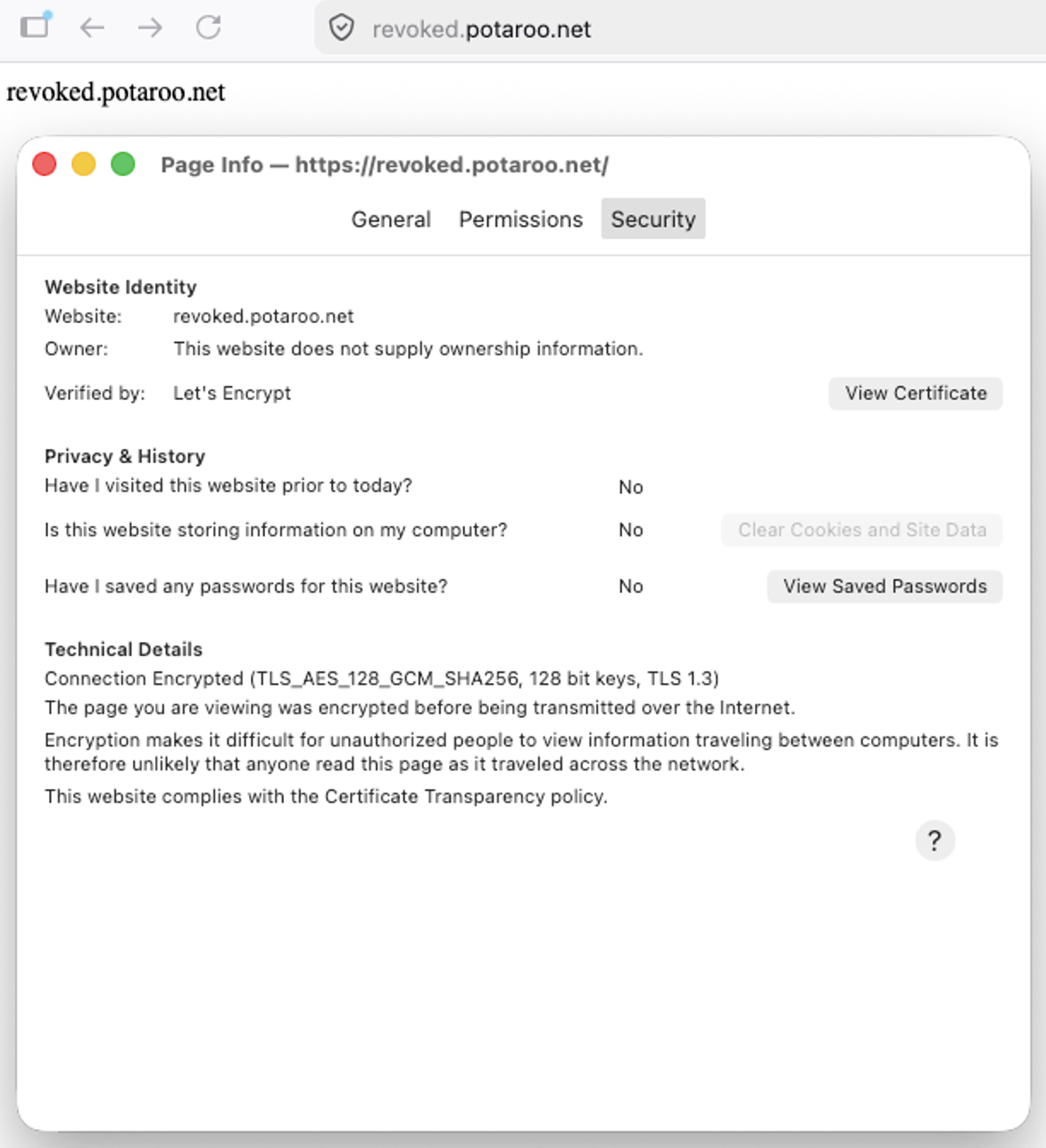
Unfortunately, Firefox has not detected the fact that the certificate used to secure the connection has been revoked. What about Chrome v147.0.7727.117?
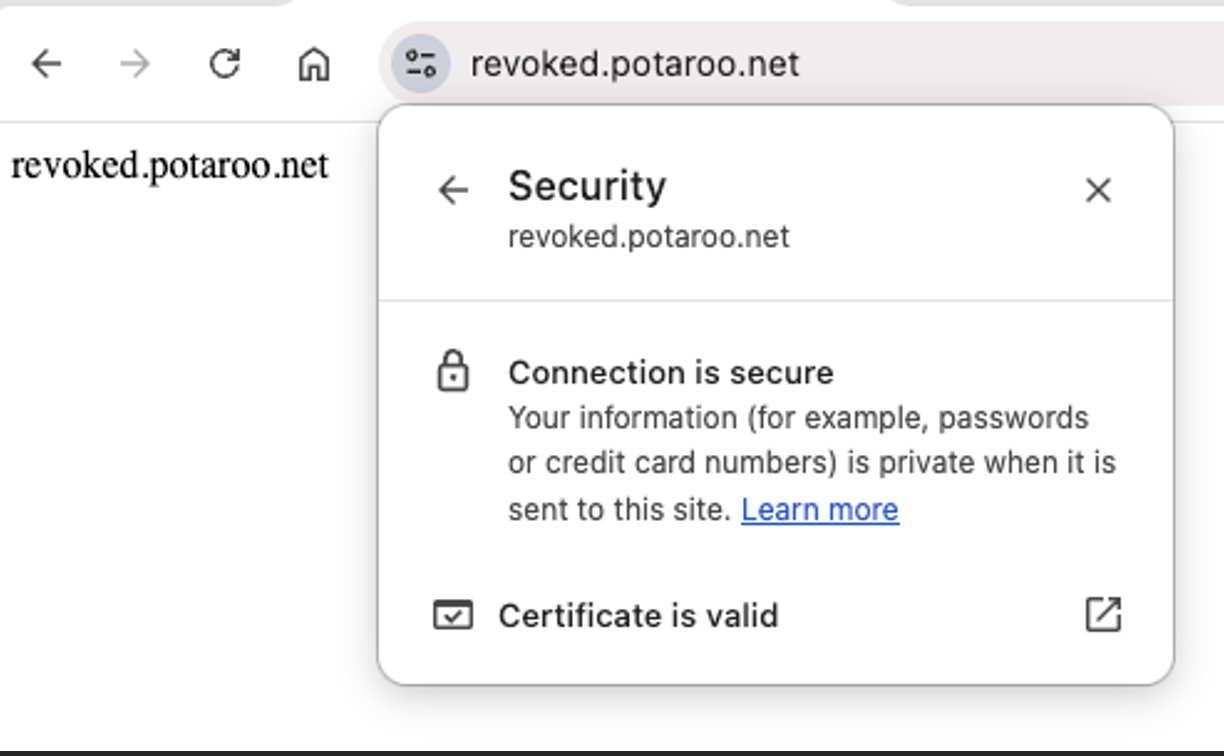
And Safari v25.4 performs the same way.
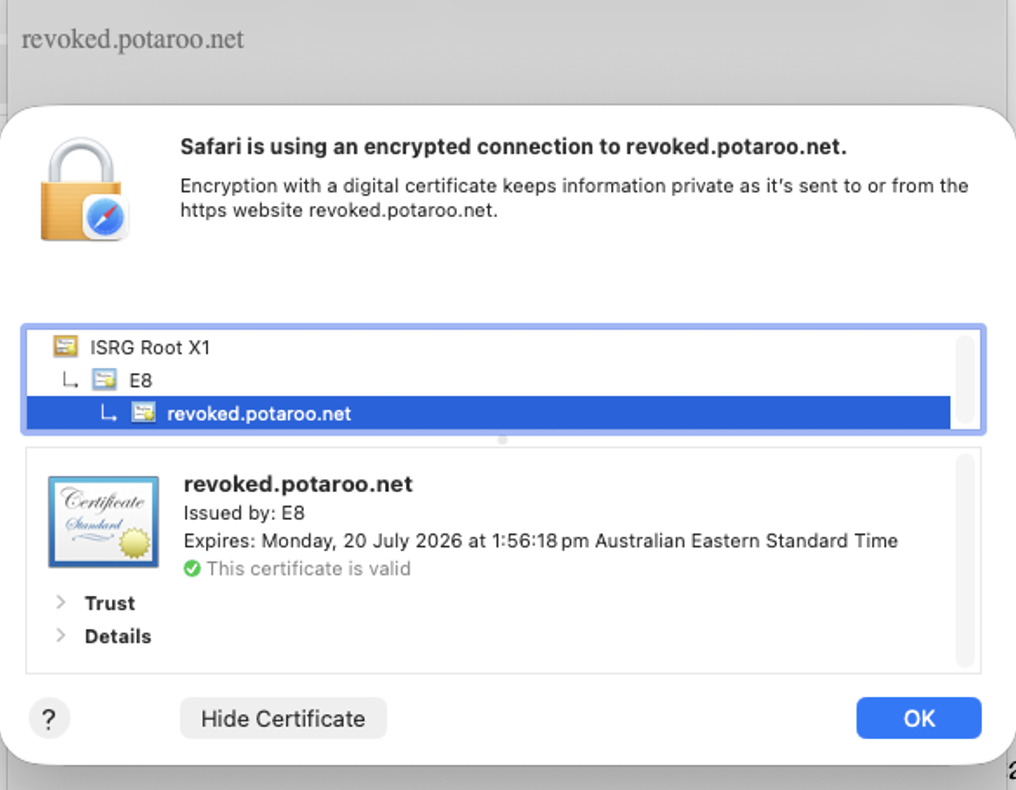
These days, browsers have a very selective view of what they store in their local CRLsets, and it’s completely unclear to me what I need to do to have the revoked state of this certificate loaded into these browsers. Indeed, revocation is a failure!
Discuss on Hacker NewsThe views expressed by the authors of this blog are their own and do not necessarily reflect the views of APNIC. Please note a Code of Conduct applies to this blog.
Thanks Geoff — really enjoyed this. Two notes from recent measurements:
On the “OCSP-via-DNS got nowhere” point — we revisited that design space in a SIGCOMM ’25 paper (https://taejoong.github.io/files/publications/bhowmick-2025-ocsp.pdf). ODIN and DCSP both stumbled on putting a DNS record per certificate. Our angle: publish only revoked serials as DNSSEC-signed TXT, and lean on NSEC + aggressive negative caching for everything else. Resolvers answer ~99.8% of checks from cache without bothering the CA, and Let’s Encrypt’s 612M active certs fit in a ~345 MB signed zone. It’s the same DANE/DNSSEC instinct you gesture at toward the end — just scoped to revocation.
The other measurement that surprised us: a small handful of CDNs now serve the majority of OCSP traffic, with ~70% of certificates having their revocation data fronted by just five providers. So even before Let’s Encrypt’s announcement, OCSP had quietly been re-centralized into a few CDN edges. What’s worth naming, I think, is that the framing of “OCSP is broken” obscures that what’s actually broken is the decentralized version of it.
Thanks Tijay, the centralisation of both CAs and CDN providers was certainly evident, and the OCSP query load cited by Let’s Encrypt (140K queries per second) is a forbidding problem which appears to have motivated in part their decision to step back from OCSP. Given that the Chrome/Android ecosystem did not perform OCSP checking, perhaps this decision would’ve been reached some years back if it had, given its far larger size relative to the Apple and Firefox platforms!
I’m of the view that revocation is indeed broken. The X.509 view of certificates is that they can be freely used and treated as valid right up to the NotAfter time, and the only check on this relatively unconstrained use of certificates is that the relying party should regularly check on the CA’s current revocation list, without any form of clear specification as to what “regularly” actually means.
The DNS adopted a different view, namely that local copies of authoritative information can only be used for a specified period of time before a new copy should be obtained from an Authoritative Server. The DNS does not revoke information per se – it simply replaces it with new information, and the clear expectation is that entities that have a locally cached copy should refresh their cached copy within the specified Time to Live.
I seem to recall that WTLS certs in the late 90s were intended to have very short validities because CRLs were infeasible on feature phones. I think VeriSign had 48 hour validities intended to be renewed on a 24 hourly basis.
There is an unfortunate ambiguity in X.509 certificates regarding the precise semantics of the NotAfter time.
One interpretation refers to the subject of the certificate, and it indicates that CA is unwilling to attest to the validity of the subject’s public key after a certain time, which is a signal to the subject to generate a new key pair and request a new public key certificate before that time.
Another interpretation refers to the relying party (or end user) where the copy of the certificate being used should not be used after this date, and the certificate should be retrieved once more from the CA’s publication point.
If you want to avoid CRLs, then it makes sense to limit the lifetime of a copy of the certificate, essentially forcing the relaying parties who are using the certificate to re-check with the CA on a regular basis without necessarily also requiring the subject
to get a new certificate issued via a new Certificate Signing Request (CSR).
But where we’ve ended up is the first interpretation of the NotAfter time, forcing the subject to get involved with a new CSR all because we wanted relaying parties to check in more frequently with the CA.
Yes, DNSSEC+DANE is the way to go in the future.
CA’s would no longer be a part of the critical domain name authenticity chain and they will probably play a different role. I have a vision for what role they could play, but that’s not really relevant for this reply. (You can ask if you’re interested.)
My main concern is DNS. It was never meant for this and our usage is straining it at it’s concepts. Where we used to only request a single A record, we now request A, AAAA and HTTPS records, records for underscore subdomains, indirectly TXT records that are used for all sorts of technologies, possibly tens or hundreds of records and everything on top of this has their own RRSIG record along with other DNSSEC records. It’s getting too crazy out there!
Our never-ending “it’s always DNS” jokes actually highlight that there’s a problem that is slowly getting worse. Maybe it’s time for DNS to get an update or be improved upon. Or perhaps consider a full redesign that matches current and possibly future use-cases?
(What would be a good place to discuss a DNS 2.0?)