

Outlined in the 2026 Activity Plan, the APNIC Blog is featuring an ongoing series of posts highlighting economies across the Asia Pacific region. These articles, available via the Economy Report tag, will explore each economy’s Internet infrastructure, along with its challenges and achievements in capacity development, security, resilience, and community building.
Across the Pacific, connectivity continues to advance through a combination of major submarine cable investments, accelerating satellite adoption, and steady improvements in operational capability. At the same time, structural constraints, such as small markets, geographic distribution, skills scarcity, and exposure to natural disasters, continue to shape how quickly and evenly these gains can be realized.
APNIC is holding its first Sub‑Regional Forum in conjunction with the PITA 30th Annual General Meeting, Business Forum and Expo, held from 13 to 17 April 2026 in the Cook Islands, to engage Members more closely through locally-delivered technical and policy discussions. Learn more here.
Economies such as the Cook Islands, Fiji, Samoa, Tonga, Papua New Guinea (PNG), the Solomon Islands, Vanuatu, French Polynesia, New Caledonia, Tuvalu, Kiribati, and Niue show both progress being made and persistent challenges. While infrastructure capacity is improving at the international edge, last-mile affordability, domestic distribution, and operational resilience remain core concerns. Across the region, collaboration, through operator communities, Computer Emergency Response Teams (CERTs), and donor-backed programs, remains the strongest driver of sustained progress.
Connectivity and infrastructure
IXPs and local interconnection
Local Internet Exchange Points (IXPs) continue to develop incrementally across the Pacific. Recent upgrades to infrastructure and capacity at the Vanuatu IX and Samoa IX, supported by the APNIC Development team, have improved local peering environments in those economies.
At the regional level, plans for a Pacific IXP, first proposed in 2018, moved forward with the establishment of the Pacific IX committee in 2024. Progress has been deliberate rather than rapid, reflecting the complexity of coordinating across multiple small markets with limited traffic volumes.
The absence of carrier-neutral data centres remains a structural constraint. In many Pacific economies, the business case for privately operated, noncarrier or nongovernment-backed facilities is weak due to small populations and limited demand. This complicates IXP and Content Delivery Network (CDN) deployment, as competition between carriers can discourage the development of shared facilities, while government-led initiatives often struggle to attract sustained commercial participation.
Submarine cables and international diversity
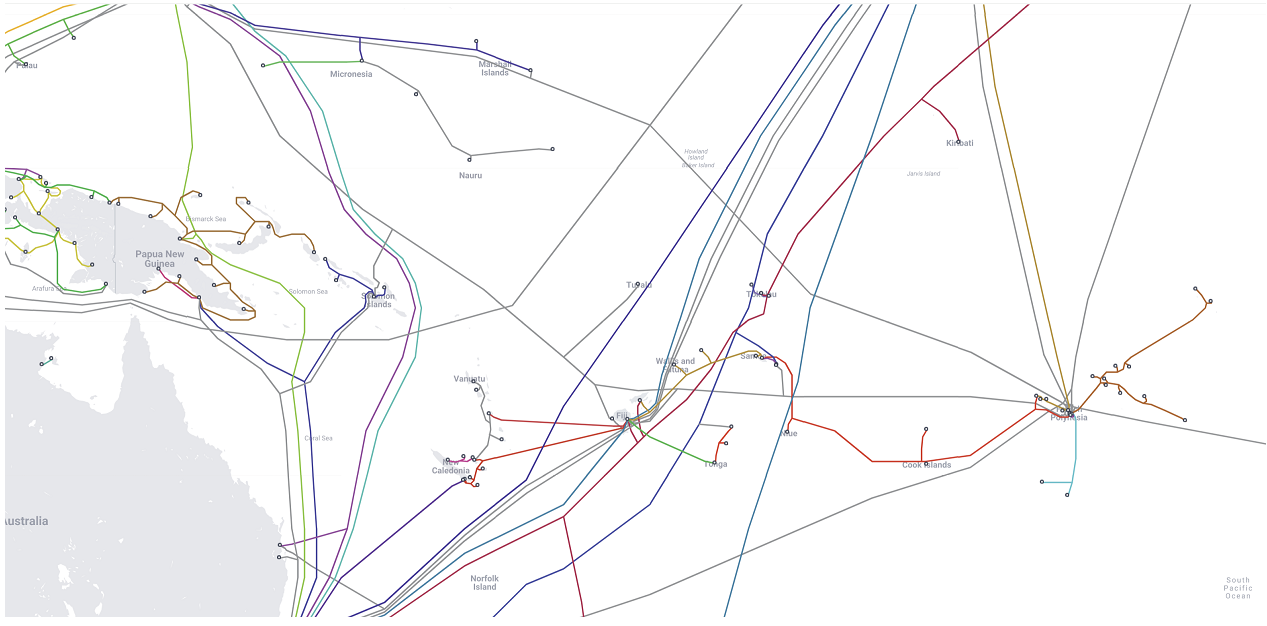
Submarine cable investment continues to reshape the Pacific’s connectivity landscape. In 2025, new systems from Google, Bulikula, Honomoana, and Tabua, are adding long‑needed geographic diversity, particularly for Fiji, and extending reach through branching units into additional markets.
For Tuvalu, the VAKA Cable will deliver the economy’s first submarine cable connection via a branching unit on Bulikula. PNG has approved a new program under the Pukpuk Connectivity Initiative to strengthen national subsea infrastructure, while the East Micronesia Cable System (EMCS) will, for the first time, connect previously underserved parts of the region.
Further ahead, the pipeline remains active. By around 2027, Hawaiki Nui 1 is expected to add a third cable path into PNG and a second into the Solomon Islands. The Adamasia Cable System 1 will provide additional redundancy for the Solomon Islands through a Bulikula branching unit. At the same time, TAMTAM will improve resilience for Vanuatu and major islands via the Loyalty Islands in New Caledonia.
Disaster exposure and the satellite response
Natural disasters, cyclones, volcanic activity, and earthquakes remain a defining risk factor for Pacific networks. These events continue to highlight the importance of diverse international paths, robust power systems, and pre‑positioned spares.
As a result, disaster-resilient communications have become a priority, driving increased uptake of satellite services. Low Earth Orbit (LEO) systems are now widely used both as a rapid failover during outages and as primary connectivity for remote islands where terrestrial backhaul remains uneconomic.
IPv6 adoption
As Internet usage across the Pacific increases, depletion of the available IPv4 pool is becoming more visible. In most economies, mobile networks, rather than fixed broadband, are the primary driver of IPv6 adoption, reflecting both limited fixed-line availability outside major population centres and the high cost of wired services.
Larger mobile operators have deployed IPv6, but widespread default enablement remains challenging. Limited access to vendor support, variations in handset capability (particularly at lower price points), and operational experience gaps continue to constrain mass adoption.
Recent surges in IPv6 capability observed across Oceania (Figure 2) are largely attributable to Starlink deployments. Exceptions include economies such as PNG, Fiji, and New Caledonia, where at least one local operator has deployed sufficient IPv6 to materially affect national statistics.
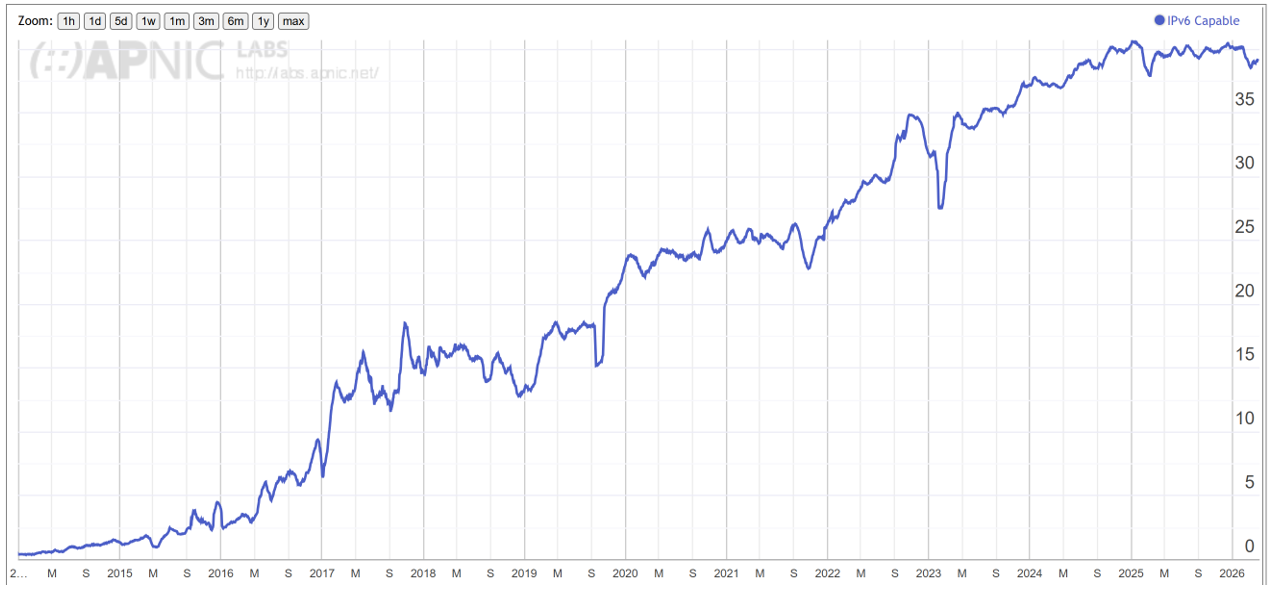
Incumbent operators have generally been slower to move, often because early market entry allowed them to acquire ample IPv4 address space, reducing immediate incentives. In contrast, challenger operators, including Vodafone entities such as ATH and Digitec, have tended to adopt IPv6 more rapidly to remain competitive without incurring high IPv4 address acquisition costs.
| CC | Economy | IPv6 capable |
| TV | Tuvalu | 73.98% |
| KI | Kiribati | 55.08% |
| NR | Nauru | 46.37% |
| CK | Cook Islands | 46.10% |
| FJ | Fiji | 37.83% |
| TO | Tonga | 27.96% |
| MH | Marshall Islands | 25.42% |
| PG | Papua New Guinea | 19.71% |
| VU | Vanuatu | 14.91% |
| SB | Solomon Islands | 12.99% |
| FM | Micronesia | 9.61% |
| WS | Samoa | 3.60% |
| PW | Palau | 0.13% |
| NU | Niue | 0 |
Routing security
RPKI and ROAs
Across the Pacific Islands, Route Origin Authorization (ROA) coverage for IPv4 address space is generally good (Table 2), and the number of invalid announcements remains low. Where gaps exist, they are typically straightforward to rectify. Engagement campaigns, trust-building through operator communities, and regular interaction at events such as the Pacific Network Operators Group (PacNOG) have supported this progress.
IPv6 ROA coverage, however, lags (Table 2). In many economies, this reflects limited IPv6 deployment, but it also points to lower perceived risk or simple oversight in operational processes.
| CC | IPv4 % valid | IPv6 % valid |
| CK | 94.30% | 0.00% |
| FJ | 98.60% | 100.00% |
| FM | 91.70% | 0.00% |
| KI | 61.90% | 0.00% |
| MH | 87.30% | 11.10% |
| NR | 97.50% | 100.00% |
| NU | 100.00% | 0.00% |
| PG | 67.50% | 100.00% |
| PW | 92.30% | 100.00% |
| SB | 86.20% | 50.00% |
| TO | 97.60% | 100.00% |
| TV | 51.40% | 100.00% |
| VU | 93.00% | 0.00% |
| WS | 89.00% | 100.00% |
Route Origin Validation
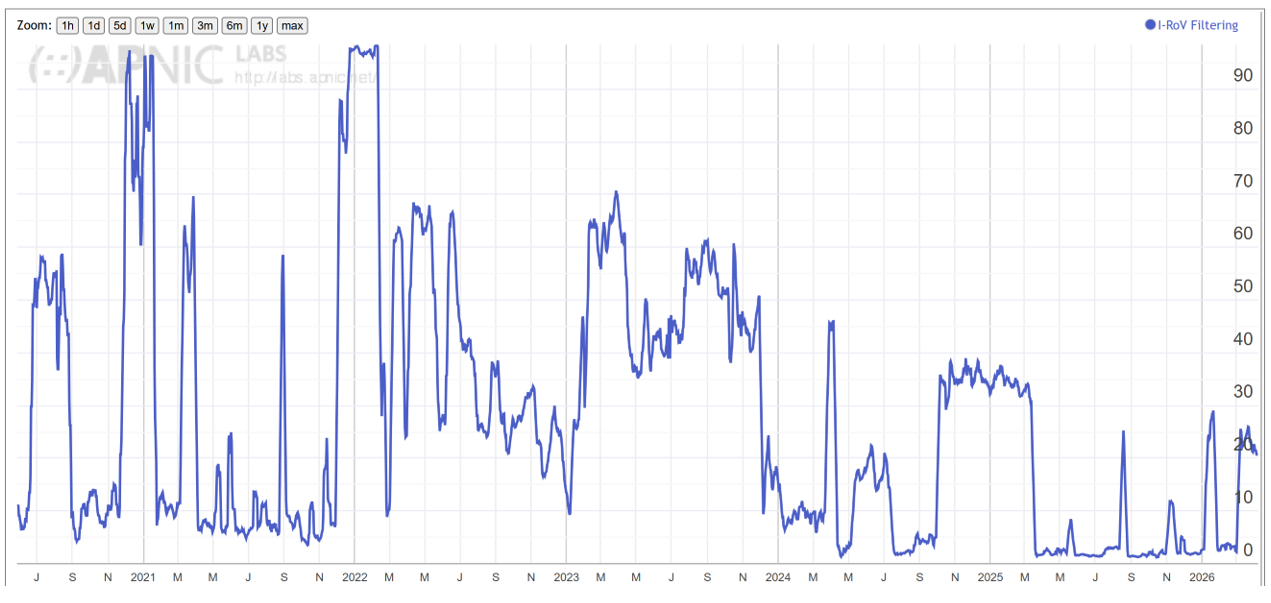
Actual deployment of Route Origin Validation (ROV) in the Pacific is difficult to observe directly. Anecdotally, there has been limited discussion among operators about deliberate ROV implementation. In many cases, observed validation effects are likely inherited from upstream providers, as many Pacific networks remain single‑homed.
This becomes visible in economies such as PNG (Figure 3), where changes in upstream routing, whether for traffic management or due to cable outages, can cause noticeable shifts in effective ROV capability.
International capacity and access
New and planned subsea systems continue to lift baseline resilience and available bandwidth across multiple economies, reducing historic reliance on single points of failure. For the Cook Islands, international capacity investments and supportive government policy have translated into more stable services and improved retail offerings.
However, domestic distribution, particularly to outer islands, remains constrained by geography and cost. This pattern is repeated across much of the Pacific, where LEO satellite services are increasingly used to extend coverage quickly, either as backup or primary connectivity.
Policy settings around licensing, universal service obligations, and wholesale access play a significant role in determining whether satellite services complement or compete with existing networks. Meanwhile, several economies are reporting incremental expansion of FTTH and 4G/5G coverage in major centres.
Where IXPs are present, local peering has reduced latency and transit costs for domestic traffic. In smaller markets, low traffic volumes can still limit IXP viability, keeping reliance on upstream transit services high.
Operations, skills, and community
Capacity building and skills scarcity
Demand for hands-on operational training in routing, IPv6, security, DNS, and incident response remains strong. PacNOG and national NOG forums continue to be central platforms for peer learning and mentorship.
Skills scarcity remains a challenge, particularly for advanced network engineering and security operations. Many economies depend heavily on a small number of specialists or external vendors. Ongoing talent drain further complicates skills development, as organizations balance investment in staff against the likelihood of retention.
Despite these challenges, regional cooperation remains a standout strength. Community and regional forums such as PacNOG, Pacific Islands Chapter of the Internet Society (PICISOC), Pacific Internet Governance Forum (PacIGF), and Pacific Islands Telecommunications Association (PITA) continue to strengthen dialogue and coordination across technical, policy, and operational domains. APNIC has supported this ecosystem through training delivery, content development, and event hosting, including the co-location of PacIGF 2024 with APNIC 58.
The security community in the Pacific also shows sustained momentum, with CERTs and cybersecurity operators collaborating to build skills, share threat intelligence, and promote best practices. The Cook Islands remains actively engaged through regional programs and targeted workshops, with a pragmatic focus on resilience and cost management.
Security, resilience, and incident response
Operators continue to report volumetric Distributed Denial-of-Service (DDoS) attacks and common abuse issues, including compromised Internet of Things (IoT) and Customer Premises Equipment (CPE) devices, phishing infrastructure, and open resolvers. Economic scale often limits investment in always-on mitigation, making upstream coordination and shared response frameworks essential.
Fraud and scam activity targeting end users is an increasing concern. CERTs, Law Enforcement Agencies, governments, and civil society are expanding awareness campaigns, but investigative capacity remains limited, highlighting the need for additional support.
CERT maturity varies across the region. Some economies operate national CERTs at early or intermediate stages, while others rely on trusted regional partners. Staffing, tooling, event availability, and sustainable funding models remain ongoing challenges. Encouragingly, newer CERTs are receiving support from international communities such as FIRST, APCERT, and PACSON. Looking ahead, expanding incident response capability beyond national CERTs into enterprises will require more training and regional engagement.
Policy, markets, and investment dynamics
Policy environments across the Pacific range from liberalized multi-operator markets to monopolies or tightly controlled duopolies, directly influencing pricing, service innovation, and adoption rates. Universal service mechanisms and donor-backed infrastructure programs remain critical for extending connectivity to outer islands.
To maximize impact, close coordination between regulators, operators, and development partners is essential, both to accelerate delivery and to avoid duplication. In some economies, open access wholesale models are under discussion as a way to improve competition and the use of high-cost backbone assets.
The Cook Islands in context
Within this broader regional picture, the Cook Islands reflect a steady, incremental trajectory. International subsea connectivity has improved service performance and stability, while access and affordability continue to advance more quickly in main centres than in outer islands.
Operationally, local operators remain engaged through regional training and peer networks, with targeted support in routing security and incident response continuing to add value. Hybrid approaches combining submarine cables with satellite services are increasingly viewed as pragmatic for continuity during outages and maintenance windows.
Outlook: The year ahead
Over the next 6 to 12 months, the Pacific is likely to see continued incremental improvements rather than rapid transformation. Blended architectures combining subsea and LEO satellite services will become more common, alongside gradual hardening of power systems, backhaul, and IXP infrastructure.
Routing security adoption is expected to continue its slow upward trend, supported by growing awareness and managed security options for smaller operators. NOG activities and targeted workshops will remain central to capacity building, while policy discussions will continue to focus on affordability, fair wholesale access, and targeted subsidies for remote communities.
For the Cook Islands, the outlook is one of steady progress, leveraging regional investments and cooperation, with ongoing opportunities to improve last-mile economics, operational resilience, and routing hygiene.
The views expressed by the authors of this blog are their own and do not necessarily reflect the views of APNIC. Please note a Code of Conduct applies to this blog.