

This post was co-authored by John Souter.
Over the past twenty years working in the Internet Exchange Point (IXP) ecosystem, I have seen many cycles of optimism, worry, expansion, and reinvention. In recent months, I’ve heard a familiar narrative resurfacing: That peering is slowing down, that IXPs are losing relevance, and that more traffic is being exchanged ‘outside’ the traditional fabrics.
In John Souter’s and my paper Peering Market at a Glance, we examined whether these claims hold up against global data and through the lens of operators who manage IXPs day in and day out.
Surface-level metrics no longer tell the full story
In some mature markets, we did see slight dips in Autonomous System Number (ASN) counts or slower growth in deployed capacity, but these are not signs of decline. Instead, they reflect a natural market evolution: Traffic consolidating into fewer, larger networks, the widespread use of Private Network Interconnects (PNIs), the migration of caches and compute deeper into access networks, and the plateau that naturally occurs as a market reaches maturity.
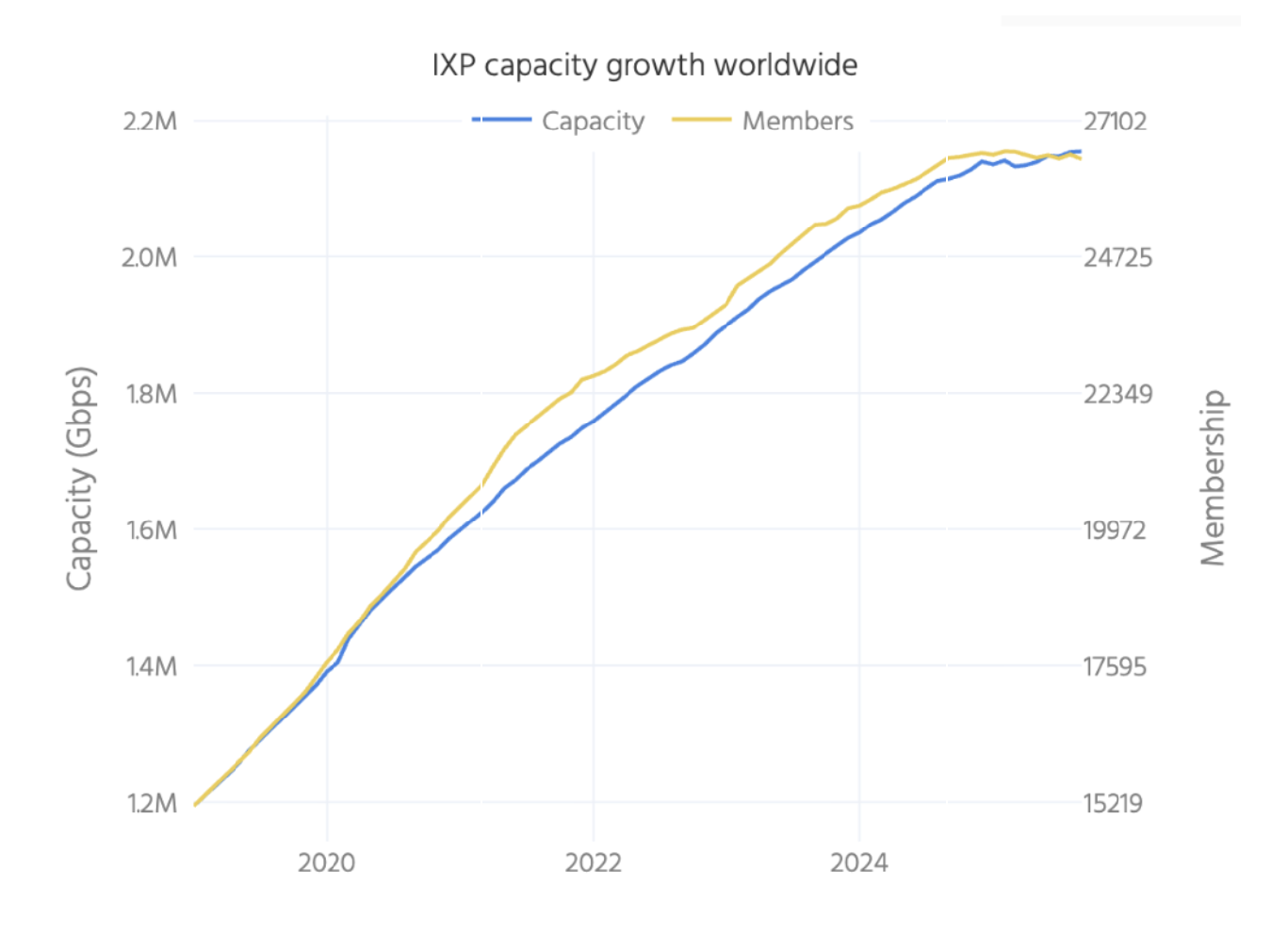
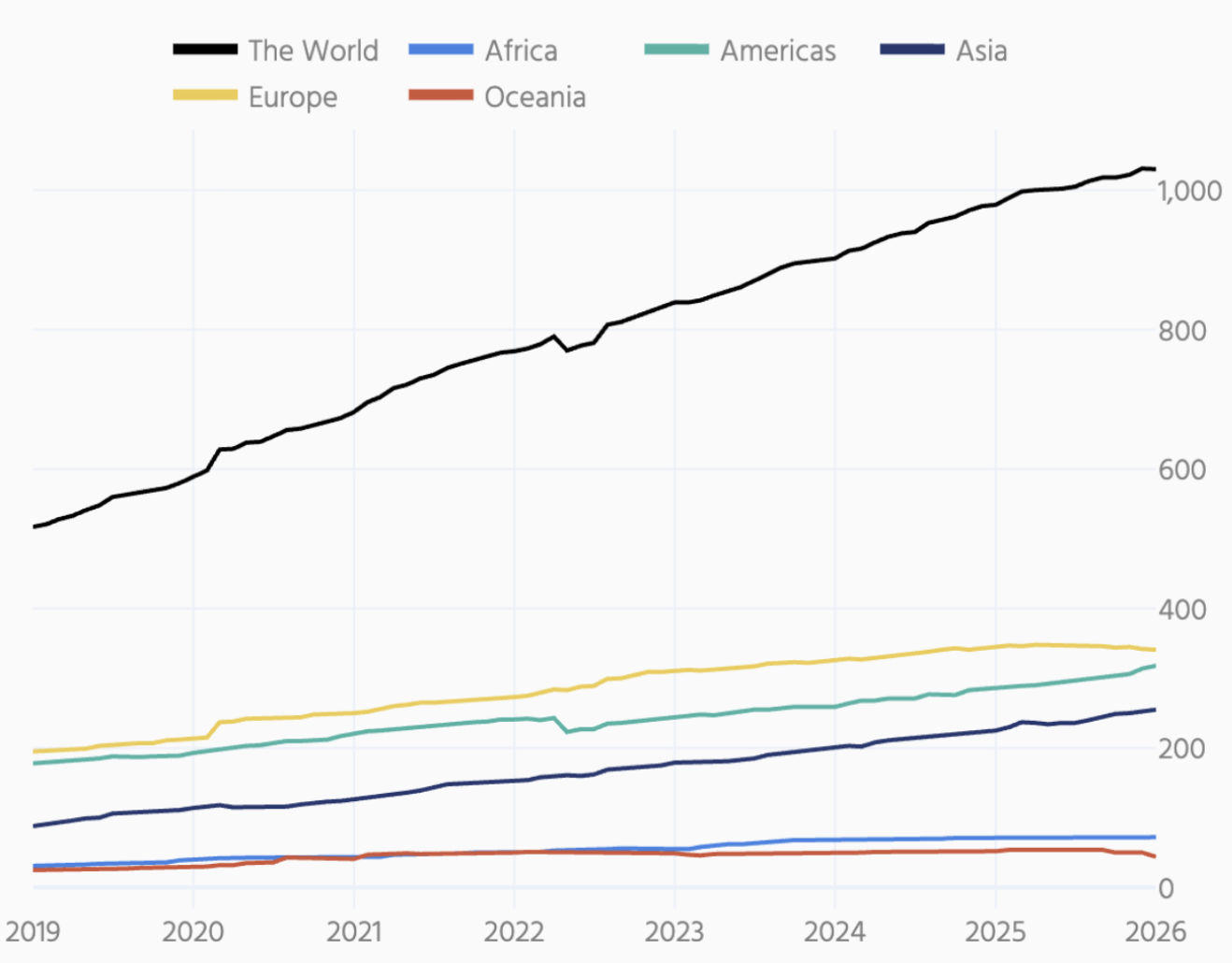
Looking at global data from PeeringDB and the Internet Society’s Pulse IXP Tracker, we saw that IXP capacity continues to grow, though at varying rates depending on regional maturity. In many regions, membership is also rising, particularly where domestic markets are opening, infrastructure is expanding, and demand for local content delivery is strong.
IXPs no longer ‘just’ peering points
One of the most striking findings of this analysis is that the peering ecosystem cannot be understood through the lens of a few major hubs. Each region has its own dynamics shaped by policy, geography, language, market liberalization, and population.
There is much more detail in the full paper, but at a glance, we see distinct trends across regions:
- Latin America — Established hubs like Argentina and Chile grow steadily. Brazil’s IX.br remains a standout, and emerging exchanges in Mexico, Bolivia, Colombia, and Peru expand rapidly with new infrastructure and increased competitiveness.
- Europe — Major hubs are stabilizing as international marketplaces, while Southern Europe, particularly Italy, experiences traffic surges driven by streaming.
- Africa — Open markets thrive, but growth is limited where monopolies persist.
- Asia Pacific — Japan shows steady progress, and Indonesia and the Philippines make rapid gains, though some markets face policy and neutrality challenges.
- North America — The US ecosystem is large but fragmented, Canada benefits from community-led IXPs, and Mexico is slowly emerging from regulatory constraints.
Across all regions studied, one pattern is clear: IXPs are expanding their role rather than shrinking. Their value increasingly comes from keeping domestic traffic local, improving resilience during surges and outages, supporting critical national services, enabling ultra-low-latency applications, enhancing data sovereignty, and hosting new types of participants, from banks to public administrations.
The traditional traffic‑exchange model is evolving into a more diversified interconnection platform, often including PNIs, edge sites, and specialized value-added services.
Who IXPs serve is changing
As hyperscalers move their caches and interconnection deeper into access networks, IXPs are returning to a role that is, in many ways, closer to their origins — serving Tier‑2 and Tier‑3 networks, supporting local resilience, and strengthening national connectivity.
This does not diminish their importance. On the contrary, in a world facing growing geopolitical instability and increasing dependence on external cloud services, strong domestic IXPs are becoming critically important. They help ensure that economies can continue to function even when international connectivity is disrupted.
A market in transformation, not decline
Looking at the global picture, our conclusion is clear: The peering market isn’t shrinking, it’s evolving. Traffic keeps growing, interconnection strategies are becoming more sophisticated, and IXPs are transforming into far more complex and strategically critical hubs than mere traffic exchange points.
The interconnection ecosystem is becoming more complex, more diverse, and more critical to the resilience of the Internet. The task for IXPs now is to adapt to this transformation — to serve new types of participants, support edge-driven architectures, and continue enabling a decentralized and robust Internet.
For those who want to explore the detailed dataset, regional charts, and more detailed conclusions, I invite you to read the full paper.
Flavio Luciani is Chief Technology Officer at Namex (Roma IXP) and co-author of the book ‘BGP: from theory to practice‘.
John Souter is an Advisor at Namex and former CEO of the London Internet Exchange (LINX).
The views expressed by the authors of this blog are their own and do not necessarily reflect the views of APNIC. Please note a Code of Conduct applies to this blog.