

The Domain Name System (DNS) infrastructure is infamous for facilitating reflective amplification attacks. Countermeasures such as server shielding, access control, rate limiting, and protocol restrictions have been implemented to improve the situation. Still, DNS-based reflective amplification attacks remain.
In this article, we focus on the threat vector introduced by transparent DNS forwarders. Our research shows that transparent forwarders enable access to shielded recursive resolvers and scale better in terms of potential attack volume.
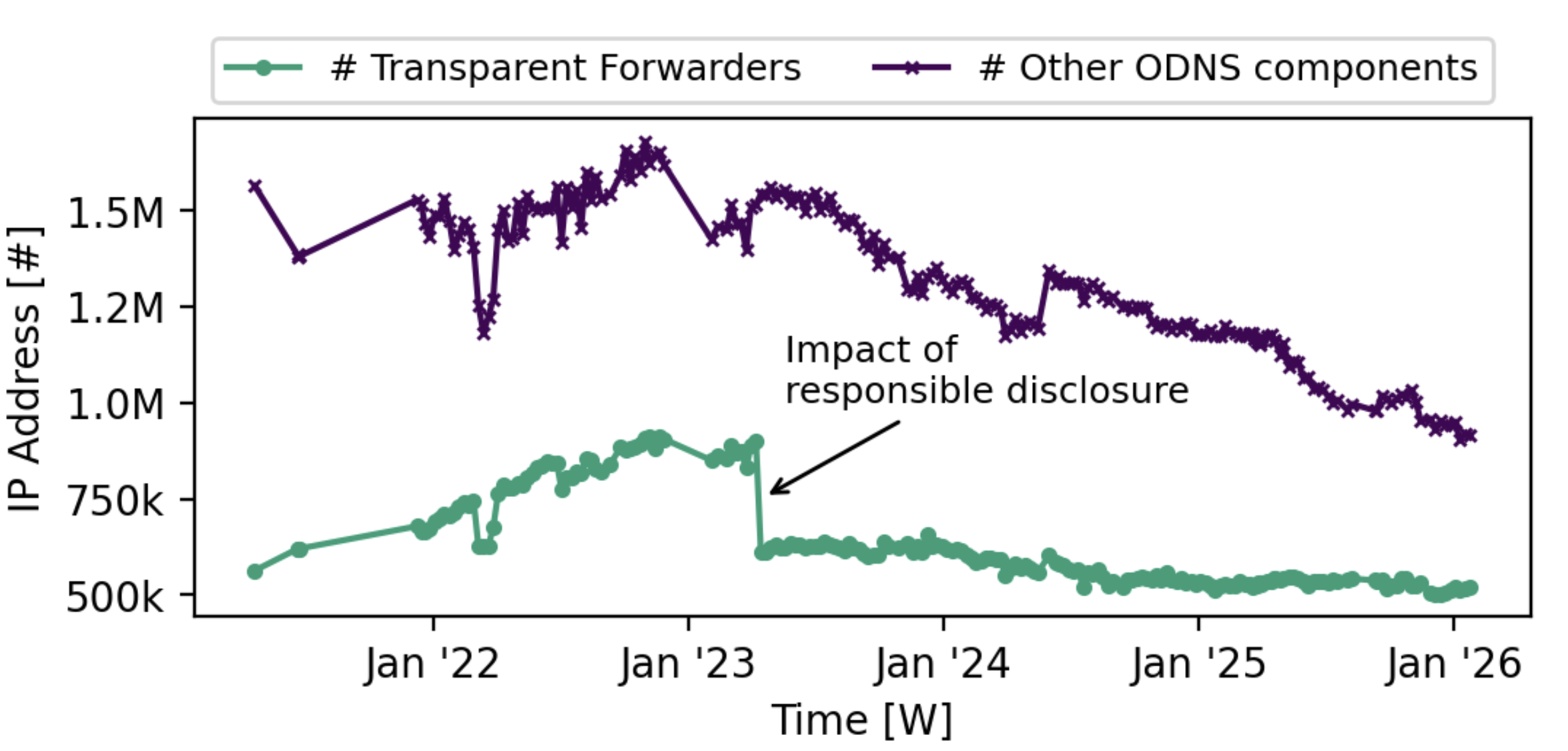
Over the past decade, the total number of open DNS devices has decreased from over 25M in 2014 down to 1.4M in 2026. These devices are often targets of attackers, misusing them as reflectors for DNS requests with spoofed source IP addresses. Over the past five years, we conducted weekly Internet-wide scans to monitor the open DNS infrastructure.
Our analysis shows that the number of recursive DNS resolvers and forwarders (aggregated under ‘Other ODNS components’) constantly decreases while the number of transparent forwarders remains at the same level. Our responsible disclosure removed more than 250k devices from the threat landscape.
Transparent DNS forwarders
An often unnoticed threat derives specifically from so-called transparent DNS forwarders — a widely deployed, incompletely functional set of DNS components.
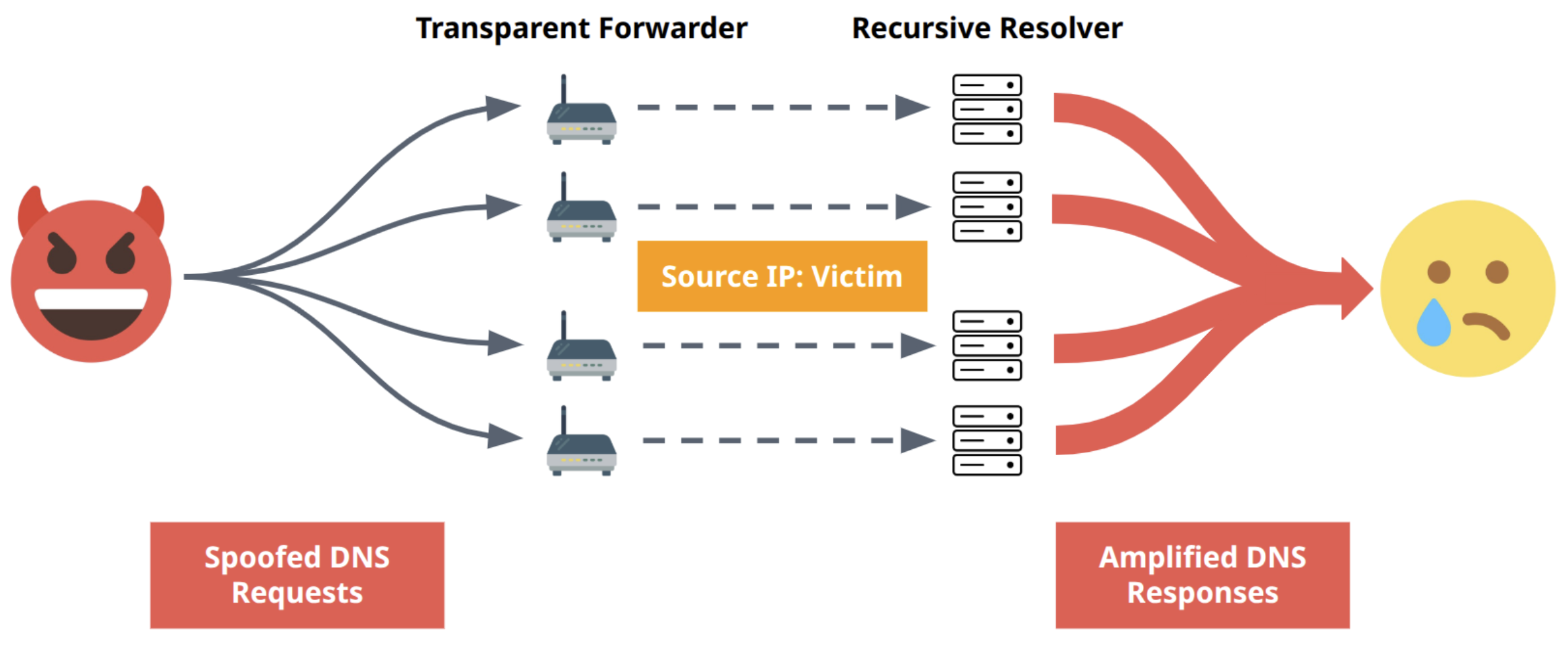
Transparent DNS forwarders transfer DNS requests without rebuilding packets. The source IP address included in the query forwarded to other DNS components (for example, recursive resolvers) remains the IP address of the original resolver.
Transparent forwarders raise severe threats to the Internet infrastructure:
- They feed DNS requests into (mainly powerful and anycasted) open recursive resolvers, which thereby can be misused to participate unwillingly in distributed reflective amplification attacks.
- They easily circumvent rate limiting and achieve an additional, scalable impact via the DNS anycast infrastructure.
- They can also assist in bypassing firewall rules that protect recursive resolvers, making these shielded infrastructure entities part of the global DNS attack surface.
- They do not need to handle the (potentially amplified) response, enhancing the effectiveness of an attack. This is in contrast to recursive forwarders.
Distribution of transparent forwarder deployment
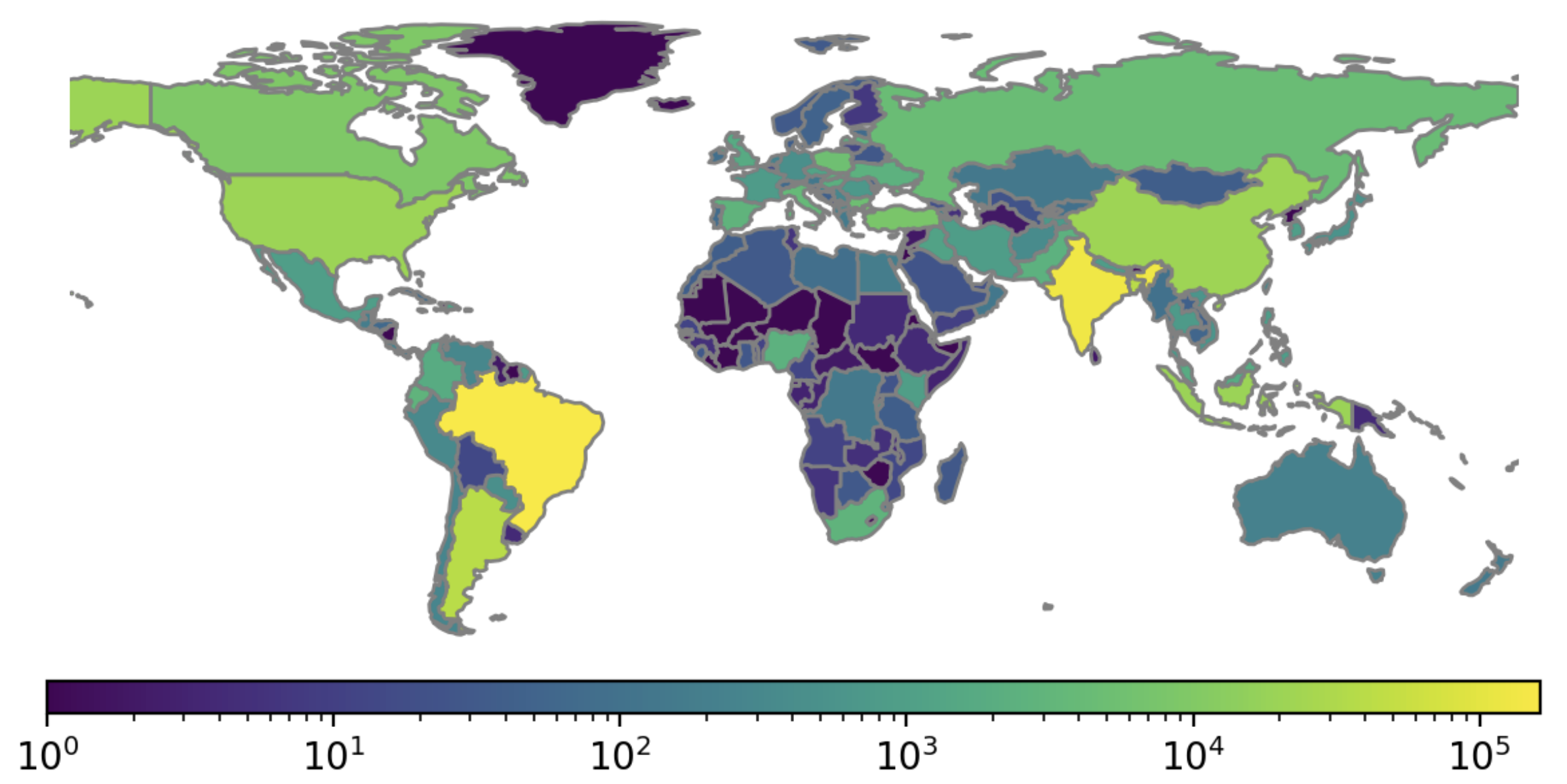
Transparent DNS forwarders are publicly accessible via the global Internet in 175 economies, with a strong bias towards Brazil (31%) and India (24%).
Our observations imply that attackers have access to a widely distributed infrastructure. Forty five percent of transparent forwarders are located in 173 economies, with most of the remainder being in two economies. The concentration of the second group makes it possible to efficiently approach a smaller subset of operators to reduce the threat landscape.
Public DNS resolvers used by transparent forwarders
Transparent forwarders redirect the resource-intensive recursive workload of DNS resolution to recursive resolvers that belong to a powerful infrastructure.
Our measurements show that a recursive resolver belonging to either Google or Cloudflare is configured on 76% of all transparent forwarders. An attacker that simply bases its attacks on recursive resolvers in general may prefer to target less powerful resolvers (for example, customer-premises equipment, or CPE).
| Public resolver | Transparent forwarders using public resolvers | ||
| IP Address | Provider | Number | Percentage |
| 8.8.8.8 | 341,447 | 64.25 | |
| 1.1.1.1 | Cloudflare | 48,313 | 9.09 |
| 208.67.222.222 | OpenDNS | 14,464 | 2.72 |
| 8.8.4.4 | 14,115 | 2.66 | |
| 223.29.207.110 | Meghbela | 11,789 | 2.22 |
| 83.220.169.155 | Comss.one DNS | 2,047 | 0.39 |
| 178.233.140.109 | Turksat | 1,790 | 0.34 |
| 203.147.91.2 | Meghbela | 1,634 | 0.31 |
| 1.0.0.1 | Cloudflare | 1,196 | 0.23 |
| 103.88.88.88 | DNS Bersama | 1007 | 0.19 |
Broad range of affected vendors
We use a set of common fingerprinting techniques (like banner grabbing, and Simple Network Management Protocol (SNMP) scanning) and tools (ZGrab, SNMP scanner, and Selenium).
We are able to fingerprint 13,072 (2.5%) of ~530k transparent forwarders. Even though this number is much lower than the overall number of transparent forwarders, global applicability still holds because we learn more details about this global subset, enough to derive performance properties of the potential attack infrastructure.
The majority of the identified devices are MikroTik routers (76%). Those MikroTik devices can be divided into core routers, which are powerful devices such as CCR2116-12G-4S+ or CCR1036-8G-2S+, and CPE devices such as RB750Gr3 or RB760iGS.
We observe routers as the major type of transparent forwarders, however, we also discover network video recorders such as HikVision or UNV IP-cameras.
While we are only able to map 2.5% of the transparent forwarder landscape to a vendor and device type, it is clear that transparent DNS forwarder behaviour is not limited to MikroTik. Although the fingerprinting is limited to a small sample, the identified devices are distributed in 1,544 Autonomous System Numbers (ASNs) across over 103 economies, therefore indicating a global trend.
Furthermore, transparent forwarders cover a broad range of devices, from constrained CPE up to powerful core routers. We summarize the results in Table 2.
| Device type | Vendor | Number of devices |
| Router | MikroTik (Core) | 5,569 |
| MikroTik (CPE) | 4,362 | |
| TP-Link | 728 | |
| Ubiquiti | 663 | |
| Fortinet | 252 | |
| ZTE | 200 | |
| Cisco | 104 | |
| Zyxel | 102 | |
| Huawei | 58 | |
| D-Link | 24 | |
| Other | 114 | |
| Network Video Recorder | HikVision | 871 |
| UNV | 25 |
Transparent forwarders allow access to the shielded DNS infrastructure
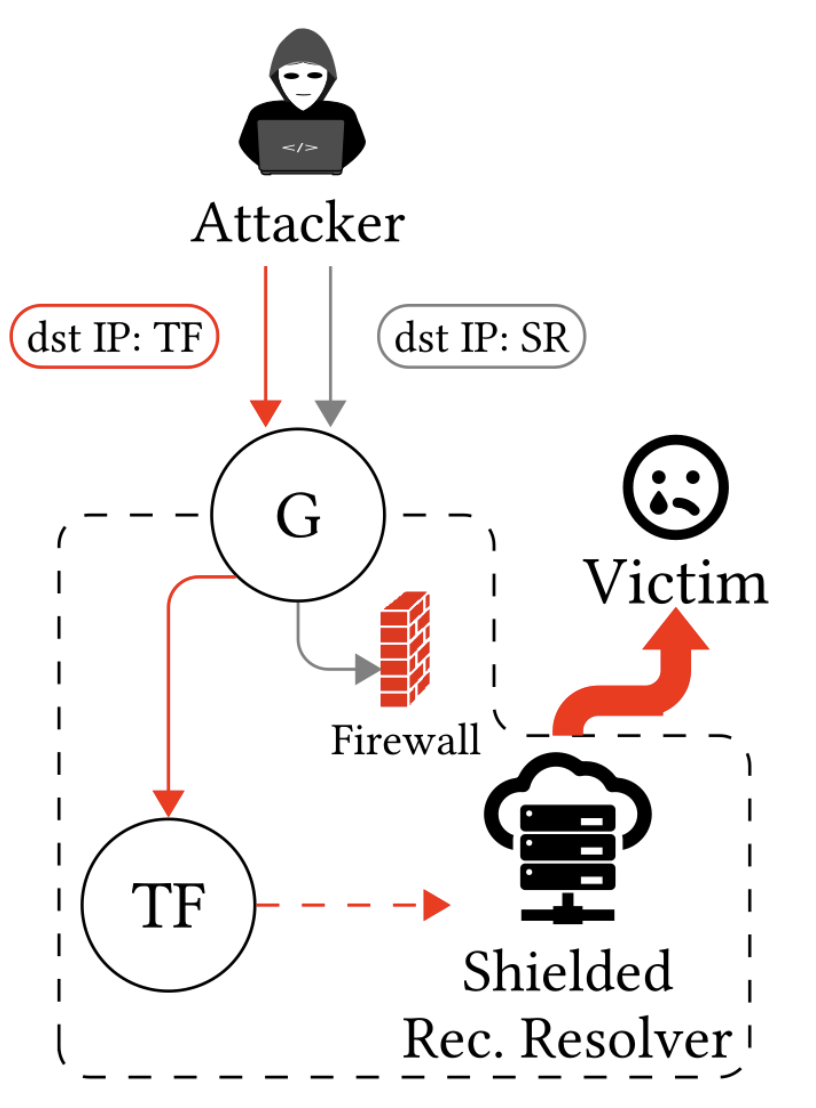
An attacker can take advantage of insufficient firewall rules to access shielded resolvers by using recursive resolvers that are protected by a firewall. While the network borders block traffic directly targeting these resolvers, the firewall of the DNS resolver does not validate the source IP address. Hence, an attacker can trigger responses from this (not so well) protected entity.
Transparent forwarders are not the only open DNS components that can bypass firewalls. Shielded resolvers can also be accessed indirectly through recursive forwarders. In contrast to recursive forwarders, however, transparent forwarders are less likely to be affected by rate limiting of DNS queries, because transparent forwarders aim to minimize states and assume any query to be legitimate.
Transparent forwarders exceed the constraints of recursive forwarders in attacks.
Both transparent forwarders and recursive forwarders can be used to bypass firewalls that protect shielded resolvers. Transparent forwarders, however, pose the unique security risk that they do not need to handle the amplified reply, which increases the scalability of the threat landscape.
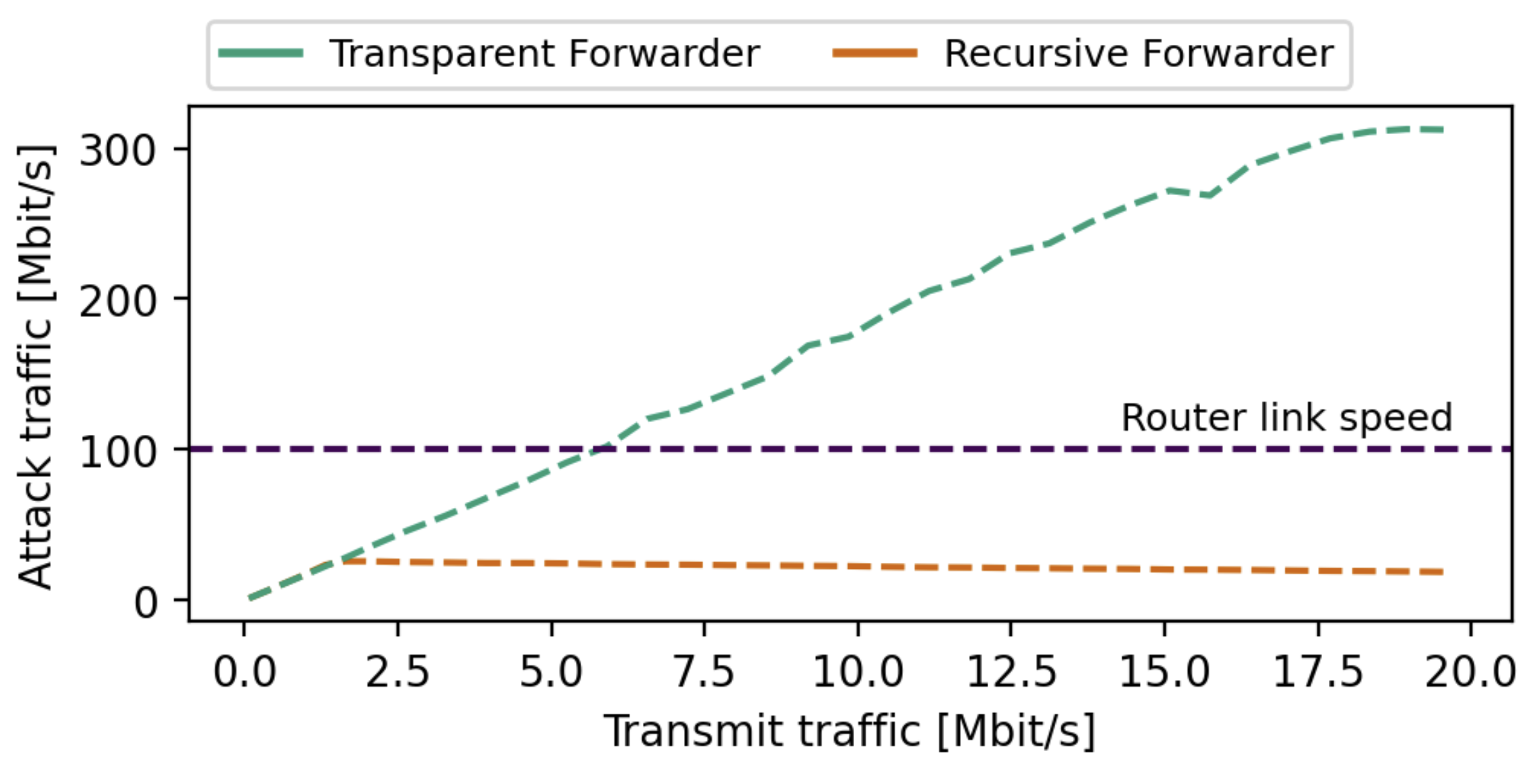
Comparing the limits of both types of DNS forwarders based on an Internet-wide measurement study would conflict with ethical concerns and is therefore not in the scope of this work. Instead, we gather empirical data in a lab experiment using the MikroTik router model RB750Gr3, which we also observe in the real world to reflect structural properties.
We previously assumed that a recursive forwarder would be limited by its link speed. Our testbed shows that the tested router already runs into resource limitations at 1.5Mbit/s of query traffic, resulting in ~50MBit/s attack traffic at the victim.
In contrast, when configured as a transparent forwarder, we reach up to 320MBit/s at the victim without running into bandwidth limitations on the transparent forwarder side. This highlights the increased threat potential of transparent forwarders over recursive forwarders in Distributed Denial-of-Service (DDoS) amplification attacks.
In a nutshell
Transparent DNS forwarders significantly extend the attack surface of the open DNS infrastructure and scale up reflective amplification attacks.
They scale better in terms of potential attack volume and enable access to shielded recursive resolvers, exposing a further attack surface of the global DNS infrastructure. Networks with transparent forwarders do not implement network ingress filtering nor reverse path forwarding checks, as transparent forwarders spoof the source IP address of their clients. The majority of transparent forwarders show consolidation in geographical diversity as well as configured recursive resolvers.
Mitigation advice for network operators
- Check your firewall rules and router configuration, as the network border can be bypassed for direct access to entities in your network. Always secure your infrastructure independently of the network firewall.
- Implement network ingress filtering or reverse path forwarding checks to prevent spoofing in your network.
- Configure rate limiting on your resolver infrastructure: it is often not necessary to allow thousands of requests per second coming from the same source IP address.
- Check if your networks or devices are affected: We publish our measurement results once a week — use our API to check your network!
More details are available in our publication ‘Forward to Hell? On the Potentials of Misusing Transparent DNS Forwarders in Reflective Amplification Attacks’, which we presented at the Proceedings of the 2025 ACM SIGSAC Conference on Computer and Communications Security.
Maynard Koch is a PhD student and research associate at the Chair of Distributed and Networked Systems at TU Dresden, supervised by Prof. Dr Matthias Wählisch. Before joining TU Dresden, he graduated with a BSc and MSc in Computer Science from Freie Universität Berlin. His research focuses on Internet measurements to improve network security. He is particularly interested in DNS and scalable IPv6 scanning.
The views expressed by the authors of this blog are their own and do not necessarily reflect the views of APNIC. Please note a Code of Conduct applies to this blog.