
The APNIC IPv6 Deployment session at APRICOT 2026 highlighted how and where IPv6 is being deployed in our region, the innovations driving deployment, and the challenges holding it back.
Project IPv6-first: A case study in achieving an 80% native IPv6 SOHO network
Presenter: Terry Sweester
Terry is a familiar face in the APNIC community, as a long-time technical trainer and current chair of the Routing Security SIG. His presentation was about his experiments on his home network to answer what seemed like a simple question: “Is a near-native IPv6-first environment achievable today”?
To answer this question, Terry used some common equipment and open source tools. RouterOS on his Mikrotek rb5009 home router (from a manufacturer with a large deployment base in our region) produces NetFlow data, which he imported into Akvorado to produce Sankay charts.
As it turned out, 67.7% of his network traffic was IPv6 native; a solid baseline! But Terry suspected he could get that ratio even higher. To do so, he iterated on a ‘find-and-fix loop’ to identify sources of residual IPv4 traffic and intervene to force IPv6.
Some of the culprits might be surprising: BitTorrent has good IPv6 support, but the default configuration accepts connections on any interface. After Terry changed his Debian ISO downloads to require IPv6, the ratio of IPv6 traffic on his network jumped to above 80%.
He also reported improvements from optimizing his local DNS to give IPv6 a 250ms head start in the Happy Eyeballs race, allowing him to reach over 90% IPv6 traffic.
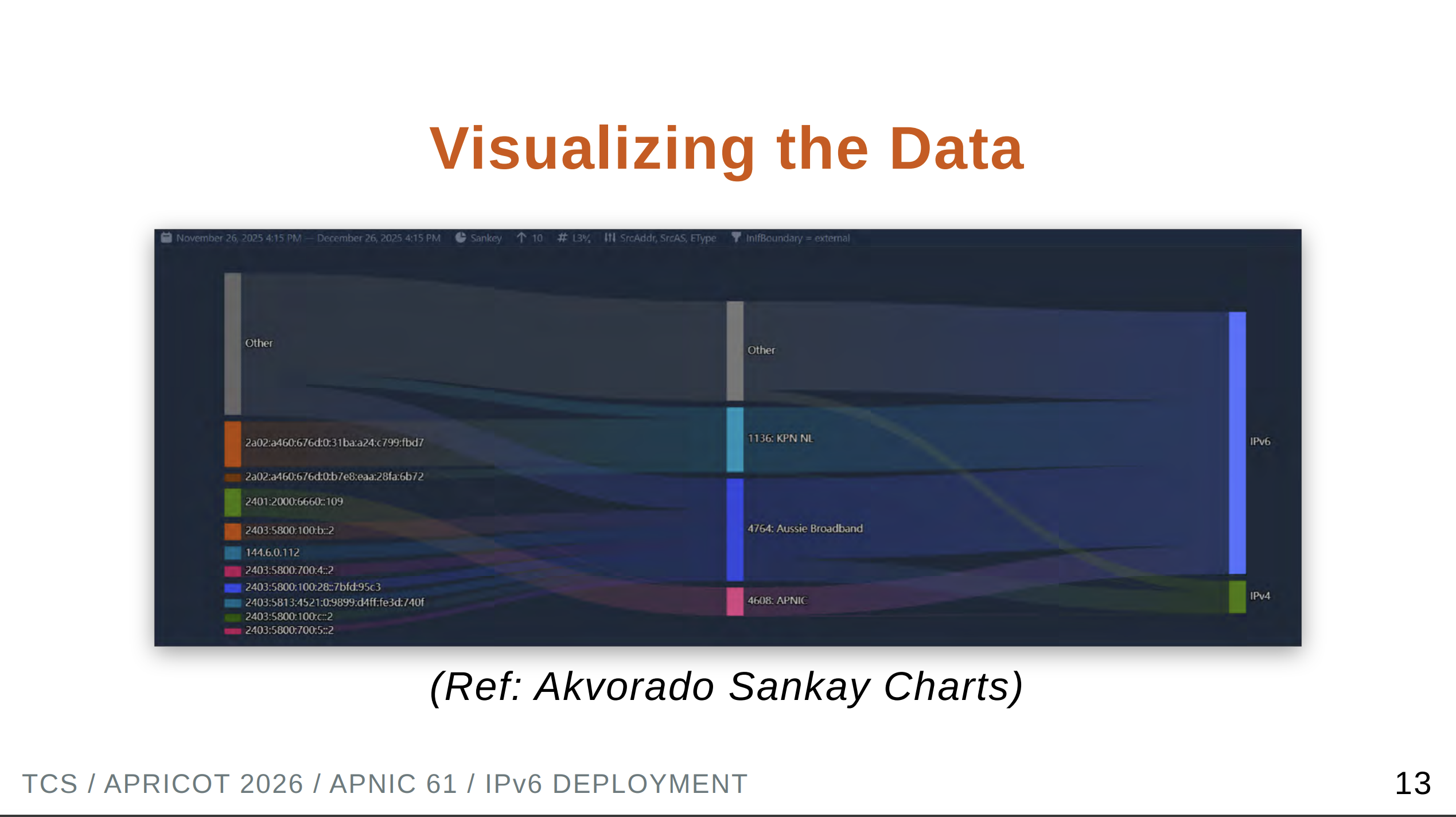
The remaining 10% of IPv4 traffic was driven by IoT devices (Ring cameras) and legacy web services (Amazon retail and GitHub).
Terry closed by proposing a dynamic extension to RFC 7757 to allow IPv4 devices to connect directly to IPv6 APIs, and by asking the audience to join him in advocating for 464XLAT on more platforms.
Slides: Project IPv6-first: A case study in achieving an 80% native IPv6 SOHO network
Advances in IPv6 aliased prefix detection and a new aliased prefix detection approach for IPv6 scanning
Presenter: Dr Ren Gang
Dr Ren Gang is an academic with Tsinghua University in Beijing, China. Dr Ren Gang won the First Prize of the China National Science and Technology Progress Award in 2023, and teaches the course ‘Next Generation Internet and Its Security’.
Dr Ren Gang noted that IPv6 scanning is the cornerstone of next-generation cyberspace mapping and cybersecurity situational awareness. He said that IPv6 scanning has three steps:
- Target generation with a Target Generation Algorithm (TGA)
- Probe and scan
- Aliased prefixed detection
An aliased prefix is when an entire IPv6 prefix maps to a single network interface. Scanning aliased prefixes wastes significant resources and can poison scan results. Improvements to aliased prefix detection are essential to more accurate and efficient IPv6 scanning.
Common aliased prefix detection techniques fall into two main categories:
- Density-based, or Multilevel Aliased Prefix Detection (MAPD): Probe a small number of random addresses within a given prefix. If the number of responses exceeds a certain threshold, the prefix is flagged as aliased.
- Fingerprint-based, or Fingerprint-based Aliased Prefix Detection (FAPD): Used as a more precise follow-up to validate the candidate aliased prefixes identified by density-based methods. Instead of just counting probing responses, they analyse fingerprints.
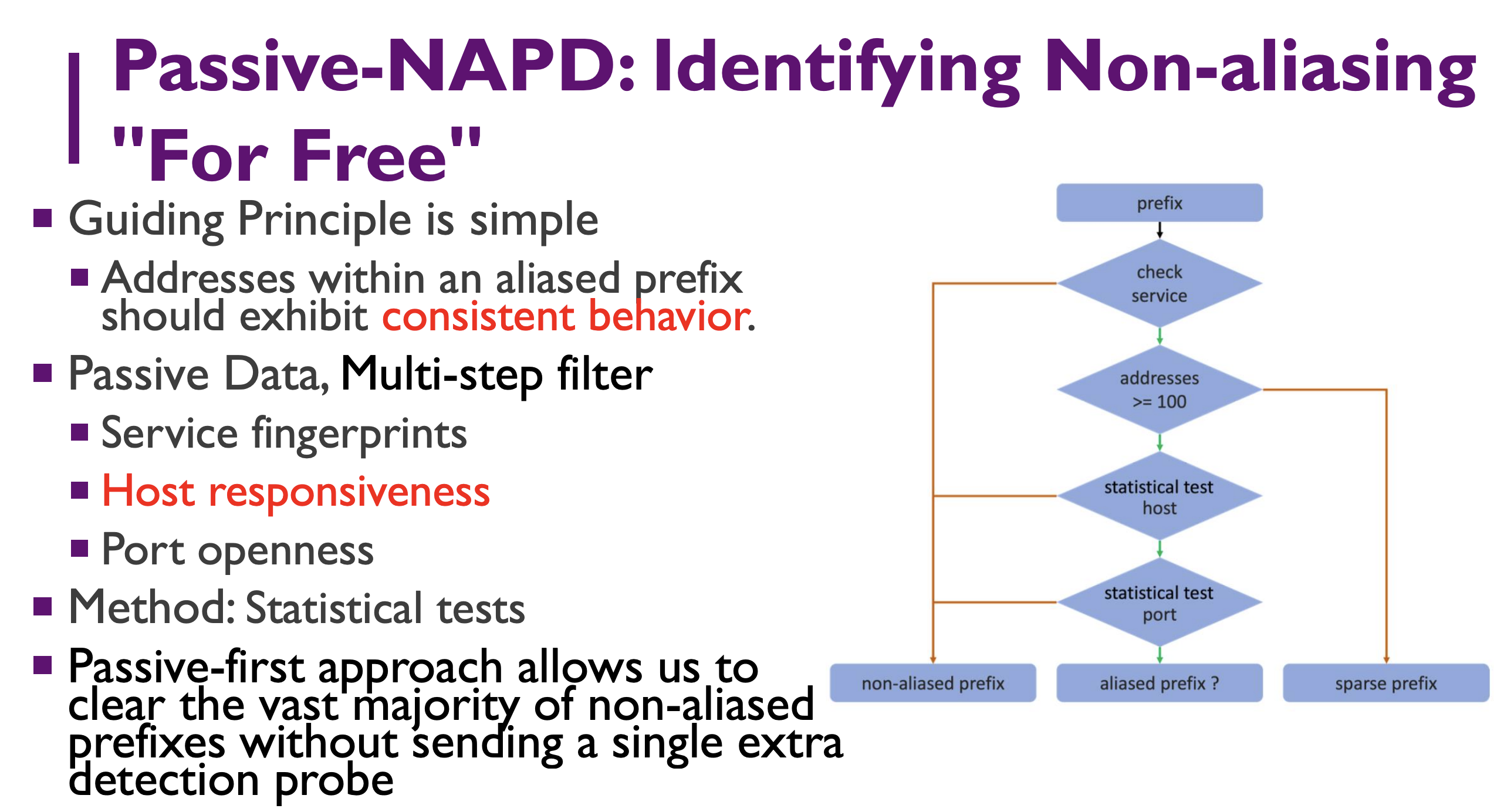
These techniques may be flexible, argues Dr Ren Gang, but suffer from limited accuracy or high overheads. Passive-enhanced Multi-level Aliased Prefix Detection (PMAPD), he says, can deliver higher accuracy with lower overheads by integrating passive analysis with active probing for real-time detection within the IPv6 scanning loop. The passive component allows the vast majority of non-aliased prefixes to be cleared without more probes.
Relative to MPAD, PMAPD-based scans showed increased scanning efficiency, massive improvements in the quality and reliability of the scan data, with less detection overhead.
Going forward, Dr Ren Gang says he plans to enhance passive analysis with richer fingerprints and to develop ‘aliasing-aware’ TGAs.
A day in the life of IPv6 scanning
Presenter: Yoshinobu Matsuzaki
Yoshinobu Matsuzaki, well known in the community as ‘Maz’, is a regular speaker at Internet events in our region and beyond. His contributions to the community are deep and broad, ranging from SIG leadership to RFC authorship to policy discussions.
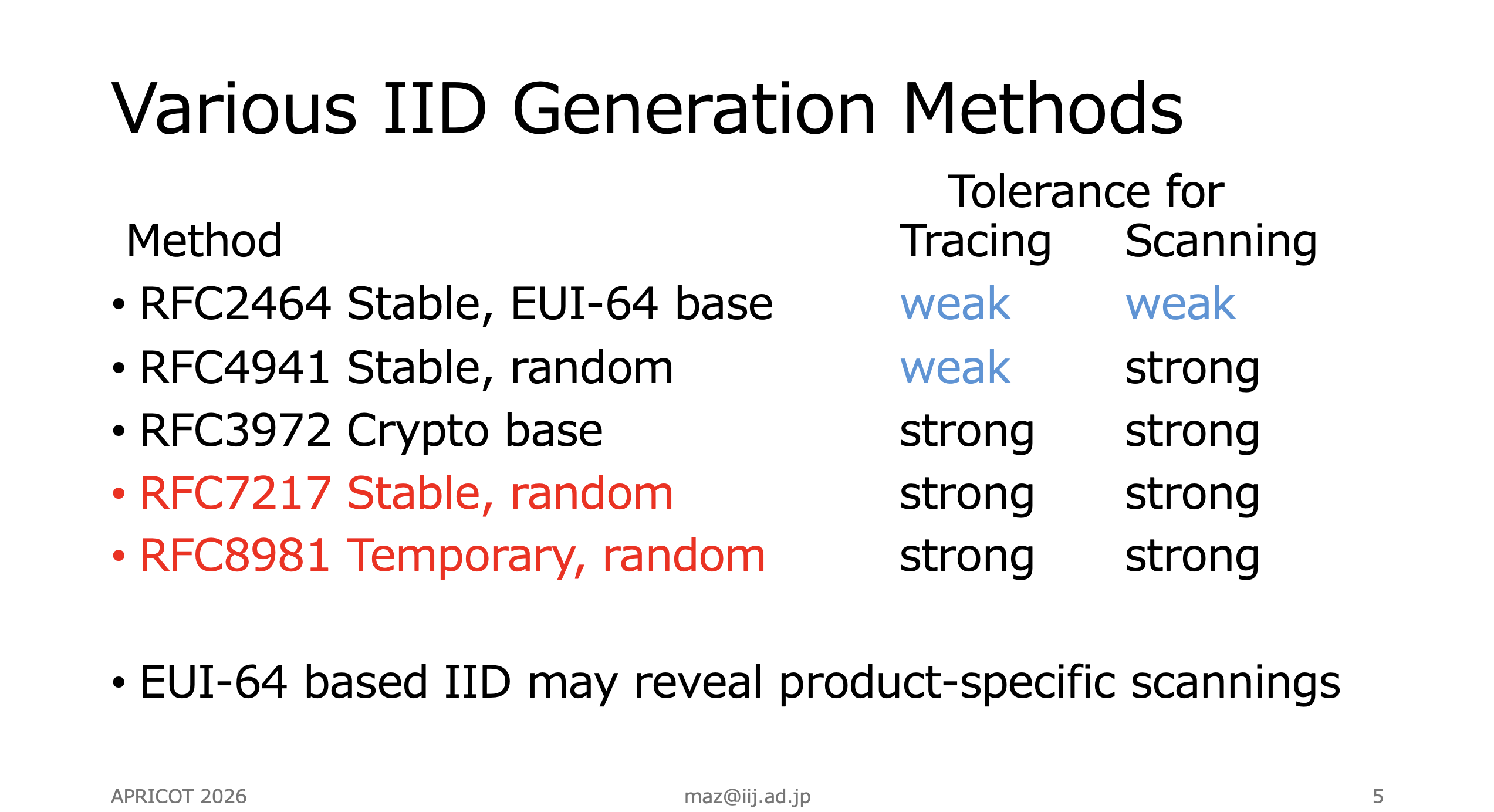
Maz began by discussing IPv6 autoconfiguration and IPv6 Interface Identifier (IID) generation methods, before moving on to the impact those methods have on tracing and scanning. He used himself as an example of how the use of MAC address (EUI-64) based IID may reveal information that some may prefer to keep private, like his trip from Japan to Indonesia.
The sheer size of the IPv6 address space (18 quintillion prefixes, 18 quintillion IIDs) means that scanners cannot scan blindly and rely on some hints to help them get started. As examples of the types of hints scanners used, Maz gave the IPv6 hit list (currently listing 3.6 billion addresses), DNS and TLS records, and RIPE Atlas probes.
To get a better understanding of the behaviour of scanners from the perspective of his hobby network, Maz uses two open source tools — pf for layer three segments, and a device running nfptables for layer two end segments. nfptables can monitor packets to existing hosts, and pf can monitor all incoming packets.
Maz identified some port trends, namely that IPv6 scanners are targeting ports in broadly the same way IPv4 scanners do. Scans for tunnels like Generic Routing Encapsulation (GRE) also seem to be common. Security companies, researchers, and cloud service providers were the primary sources of scanning traffic to his hobby network.
If you’re trying to get noticed by IPv6 scanners, Maz gave some tips to get your network noticed and added to the IPv6 hit list. Make your /64 appear in use through TLS certificates and AAAA records. Use EUI-64-based IIDs, as they follow more scannable patterns.
To avoid scanners, you must avoid the hit list. Do not respond to probing, says Maz, and use self-signed or wildcard certificates.
Slides: A day in the life of IPv6 scanning
Generative AI for IPv6 renumbering
Presenter: Mukhammad Andri Setiawan
Mukhammad Andri Setiawan is currently the Chief Information Officer at Universitas Islam Indonesia, as well as being an associate professor there. He has a long history of involvement with IDNIC, APRICOT 2026 host APJII, and has been known to step up with a keynote presentation in a pinch.
His presentation focused on research he has been conducting to see whether generative AI can ease the transition from IPv4 networks to dual-stack networks, as a stepping stone to IPv6.
In particular, he has been seeking answers to three questions:
- Does generative AI reduce the cognitive workload experienced by network engineers during the complex IPv6 renumbering process?
- How does AI-assisted configuration compare to traditional manual methods in terms of error rates and time-on-task efficiency?
- Do technical improvements from AI tools directly translate into organizational readiness for broader IPv6 adoption?
To answer these questions, his research used some source code, in the form of Net AI Copilot, experiments, and a survey.
Professor Setiawan noted that, despite investments in training, psychological and organizational barriers to IPv6 adoption remain. He says that some of those barriers stem from a perceived business model risk. As an example, he shared conversations with network operators at an enterprise that relied on advertising as a source of revenue. Even knowing the improvements of IPv6 over IPv4, there were concerns that adoption could introduce risk to their business model.
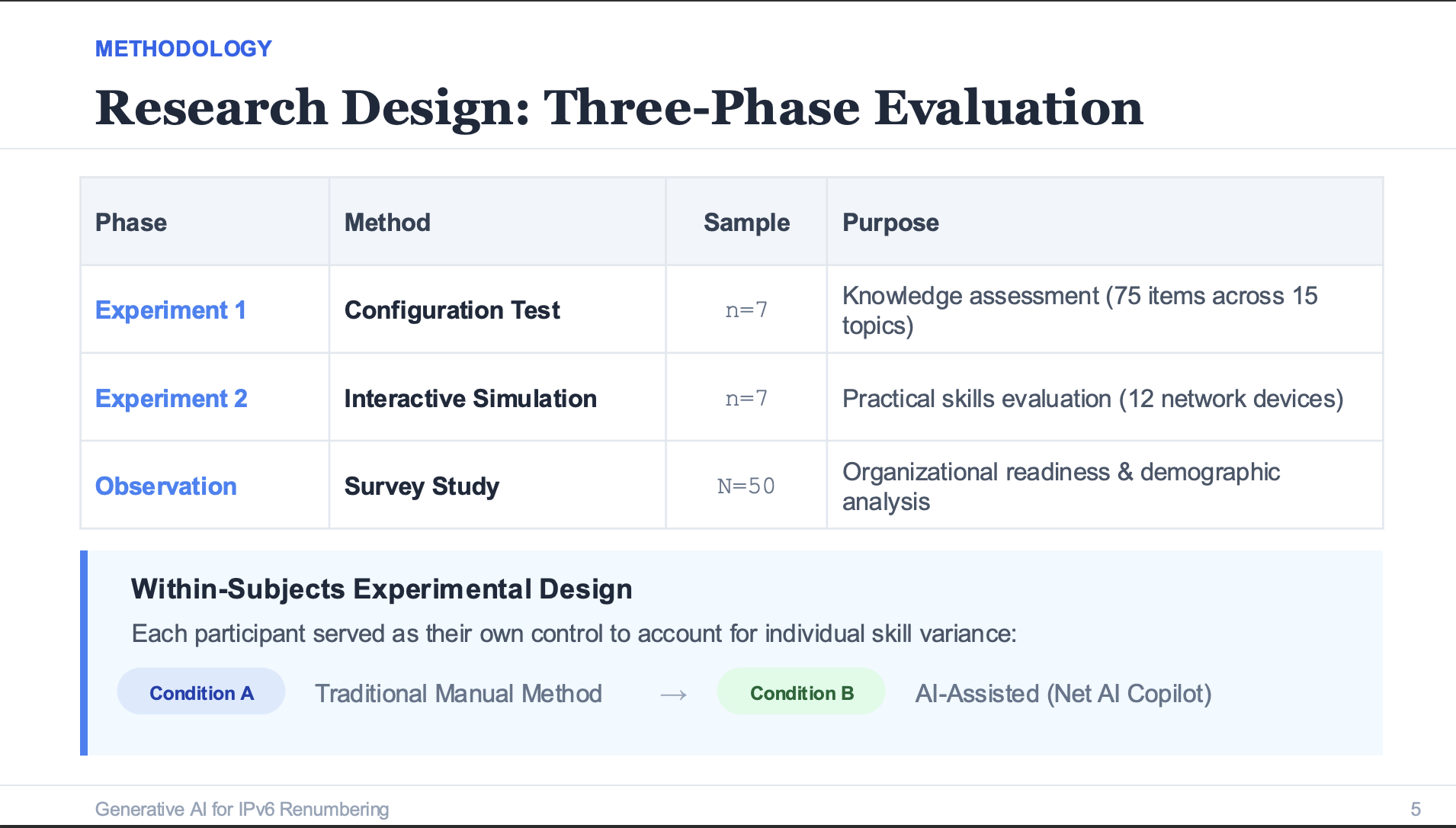
The Net AI Copilot, which his team developed, aimed to ease some of those concerns while keeping a ‘human in the loop’. Experiments with that tool, both knowledge tests and task simulations, both showed massive reductions in time to completion (96.8% and 99.7%, respectively). Relative to manual configuration, AI assistance led to a 100% task completion rate, completely eliminating frustration-driven abandonment and manual configuration errors.
Professor Setiawan said that the surveys revealed an ‘execution crisis’, a large gap between strategic intent and operational reality, that prevents technical tools like Net AI Copilot from being effectively deployed.
He argues that the dominant barrier is not political resistance or policy, but a deep-seated psychological fear of technology they don’t fully understand. Organizational readiness, he says, is the bottleneck preventing operators from using AI tools to aid in IPv6 adoption.
To widen this bottleneck, Professor Setiawan suggests investing in both tools (like generative AI) AND people (to give them the skills they need to absorb these tools, and the change they bring).
Slides: Generative AI for IPv6 renumbering
Overview of Xiong’an IPv6-only deployment
Presenter: Dr Yang Guoliang
Dr Yang Guolian is the Director of the Future Network Innovation Research Institute of Xiong’an New Area. He has published 20 papers, obtained 25 national invention patents, compiled 6 industry standards, and drafted 8 international standard drafts.
Xiong’an New Area (Xiong’an) is a Chinese city established in 2017 as a ‘pilot city’, 100 km west of Beijing. The goal for Xiong’an is to create a model for future digital cities. A large part of that model is built in IPv6-only, from the ground up.
Designated as a “comprehensive pilot city for IPv6 technological innovation and integrated application” by the Cyberspace Administration of China and other ministries, Dr Yang says Xiong’an is committed to building a pure IPv6 demonstration zone across the entire area.
Dr Yang identified the open source, distributed HarmonyOS, developed by Huawei, as an important element of the city’s core digital infrastructure, where it can play an important role in operating the planned one million Internet of Things (IoT) devices per square kilometre.
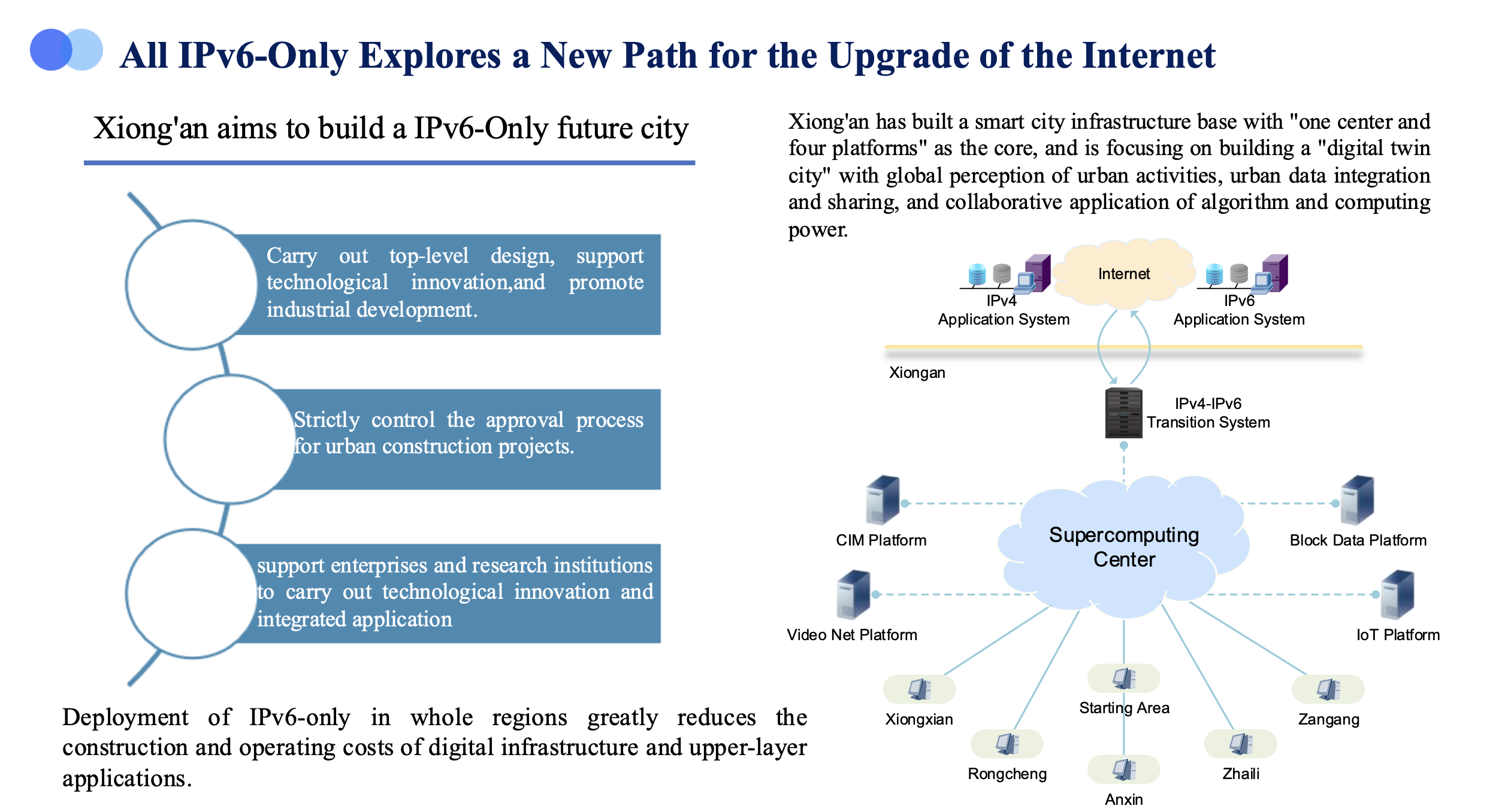
He also described the ‘one centre, four pillars’ architecture. The city has a central ‘city brain’ data centre that powers platforms for autonomous digital infrastructure, unified and twin-co-growth construction, layered smart operations, and a scenario-led replication framework.
The Future Network Innovation Research Institute of Xiong’an New Area was established in April 2025, complete with an IPv6 Exhibition Hall open to the public. Dr Yang says it brings together key elements of IPv6 innovation to provide technological innovation and integrated application services.
The IPv6 industry development model, according to Dr Yang, follows a ‘1+N+3’ strategy:
- To develop a city-level integrated IPv6 solution (one plan).
- To establish numerous innovative scenarios for converged applications leveraging IPv6 (N scenarios).
- To formulate unified standards, construct open platforms, and develop universal chips/modules (three levers).
Dr Yang hopes this approach will open up scenarios, data, and computing resources to create an optimal environment for developing new IPv6 applications and products. By building on the achievements of the new district and continuously summarizing best practices, he hopes that Xiong’an New Area will become a global hub for IPv6 innovation and entrepreneurship.
Slides: Overview of Xiong’an IPv6-only deployment
The views expressed by the authors of this blog are their own and do not necessarily reflect the views of APNIC. Please note a Code of Conduct applies to this blog.