

The Internet Engineering Task Force (IETF) ratified the specifications for the Registration Data Access Protocol (RDAP) a decade ago, in March 2015, with the clear intent of replacing the ageing whois protocol. While whois remains in widespread use, the RDAP ecosystem is rapidly maturing. Indeed, 2025 saw significant adoption and an accelerated expansion of RDAP services across the industry.
The sunset is complete: A new baseline
The most critical context for the growth occurring last year was the sunset of whois, which officially occurred on 28 January 2025. On this date, the contractual obligation for most Generic Top-Level Domain (gTLD) registry operators, and all gTLD registrars, to provide a whois service was removed.
With the requirement removed, many registries and registrars began shutting down their whois services. In February 2025, 74 gTLD registries shuttered their services, according to an internal Internet Corporation for Assigned Names and Numbers (ICANN) reachability scan. And by September, 374 gTLDs no longer offered whois, according to the TLD RDAP Monitor.
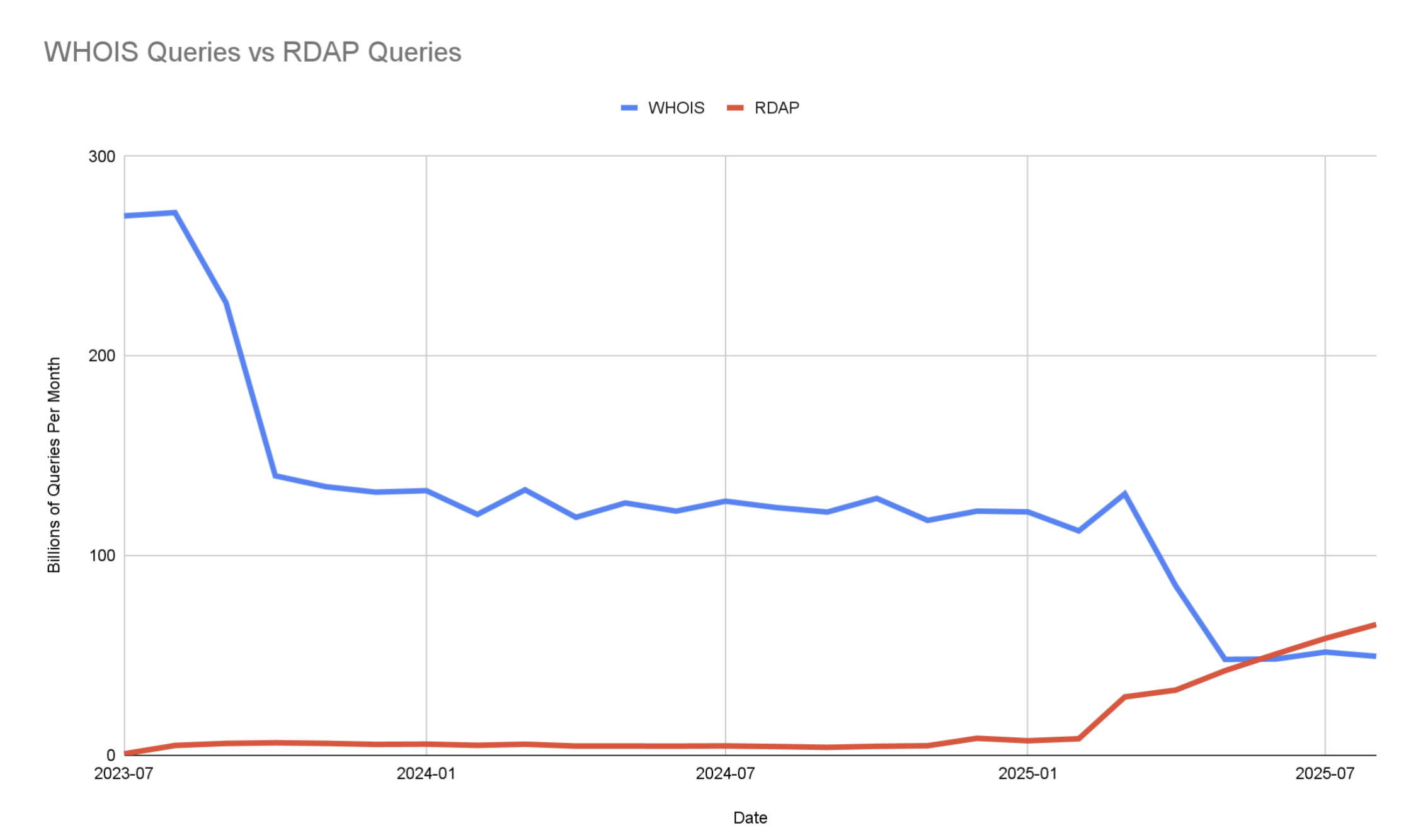
Data from the ICANN monthly registry activity reports 1 also shows a significant drop in whois queries. In January 2025, there were approximately 122 billion monthly queries, but by August 2025, that had fallen to around 49 billion, a drop of 60%.
RDAP adoption: By the numbers
Meanwhile, the queries for RDAP have shown a significant rise according to those same ICANN monthly reports. In January 2025, the gTLDs were reporting around seven billion RDAP queries per month, rising in August 2025 to 65 billion. RDAP queries had surpassed whois queries in June 2025.
Other sources of query numbers help complete the picture of RDAP adoption. The American Registry of Internet Numbers (ARIN), one of the five Regional Internet Registries (RIRs), regularly reports monthly query rates between 250 and 300 million. And rdap.org, a popular RDAP bootstrapping service, sees close to 56 million queries per month.
In addition to what RDAP servers are seeing, ICANN’s web-based RDAP client, ICANN Lookup, regularly gets around 1.5 million page views per month. This aligns with the common understanding from whois: Of the approximately 100 billion RDAP queries issued every month, most come from automation, not humans.
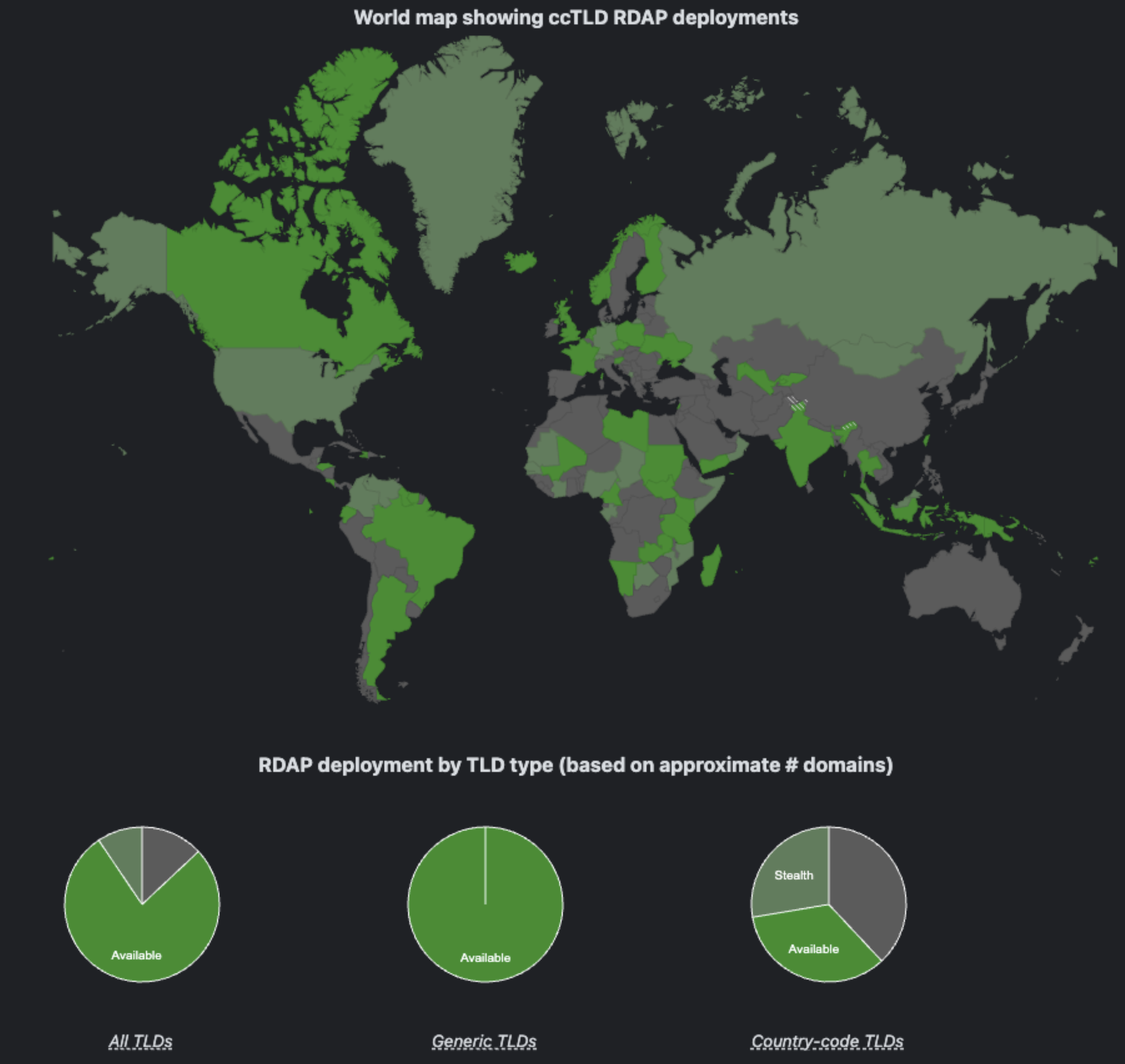
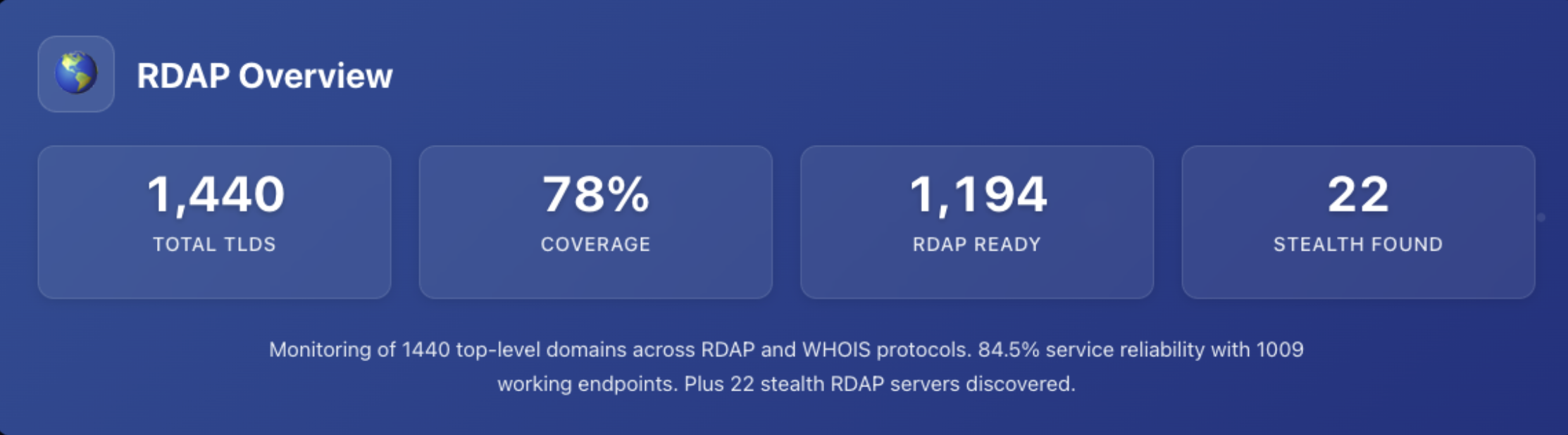
Figure 3 — Coverage of RDAP across all TLDs, according to the RDAP TLD Monitor.
The adoption of RDAP by the ccTLDs also continues to grow. Unlike gTLDs and the RIRs, ccTLDs are under no collective mandate to deploy RDAP. However, adoption by ccTLDs is robust. Including ‘stealth’ RDAP servers — those not listed in the Internet Assigned Numbers Authority (IANA) bootstrap files — approximately 60% of ccTLDs have deployed RDAP, a 12% increase since January 2025.
Finally, the amount of RDAP software known to be available, as categorized by rdap.rcode3.com, continues to help drive and improve the RDAP ecosystem.
Client software:
| Type | Quantity |
| Online web clients | 9 |
| Web client software | 4 |
| Mobile clients | 3 |
| CLI clients | 10 |
| Client libraries | 21 |
| Total | 47 |
Server software:
| Type | Quantity |
| Authoritative servers | 11 |
| Redirect servers | 6 |
| Conformance tools | 5 |
Technical evolution: Closing the gaps
Another sign of RDAP’s growth is the number of extensions being proposed for it.
1. RDAP RIR Search
The original charter for RDAP in the IETF was to provide the most common set of features, not to attempt to replicate all uses of whois in RDAP. With that accomplished, the RIRs have standardized the rest of the features necessary to fully move to RDAP for the RIRs with the new RIR Search extension.
This extension has already been given IETF consensus and has been published as RFC 9910. ARIN has already deployed it, with the other RIRs following very soon.
2. RDAP RPKI
As RDAP has become more important, so too has the Resource Public Key Infrastructure (RPKI) with regard to routing security. To help with troubleshooting of RPKI and the correlation between resource holders and RPKI data, there is now a proposal to expose some RPKI data in RDAP. This will be helpful to network operators who may have previously relied on ad hoc web services for this information.
3. Transition to JSContact
When RDAP was originally ratified, it used the jCard standard for representing contact information. jCard is a programmatic translation of the popular vCard into JSON. It was believed that jCard would be as popular as vCard, but that has not happened. Instead, jCard is considered difficult to use.
Now that the IETF’s Restful Provisioning Protocol (RPP) working group is considering the use of JSContact, a more modern representation of contact data, there is heightened interest in also adding it to RDAP.
Conclusion: The ecosystem has matured
The current state of RDAP is that the ecosystem continues to grow by query volume and adoption, spurred by the whois sunset for gTLDs. Interest in this protocol is growing, and there are many efforts to add new features and functions to it.
1 Monthly aggregate data of whois and RDAP queries sourced from the ICANN activities reports that had been previously published contained errors made during analysis, resulting in inaccurate information and showed RDAP queries to be much lower than previously stated.
Andy Newton is a principal engineer at ICANN, one of the primary authors of the RDAP specifications, and currently serves as an Applications and Real-Time Area Director for the IETF.
The views expressed by the authors of this blog are their own and do not necessarily reflect the views of APNIC. Please note a Code of Conduct applies to this blog.