

With a population exceeding 1.4 billion, China’s Internet landscape is shaped by rapid digital transformation across government, industry, and society. The ‘Digital China’ initiative serves as the economy’s long-term blueprint for digital development, implemented through successive Five-Year Plans and coordinated by key agencies, including the Cyberspace Administration of China (CAC) and the Ministry of Industry and Information Technology (MIIT).
China’s 14th Five-Year Plan (2021 – 2025) for the Information and Communications Industry emphasizes 5G rollout, next-generation network expansion, and the development of national data centres to support broad economic transformation. Looking ahead, recommendations for the 15th Five-Year Plan (2026 – 2030) include building a modern industrial system, strengthening technological self-reliance, expanding digital trade and services, and advancing the Digital China initiative to support economic modernization and international collaboration.
These coordinated efforts underpin China’s pursuit of both its ‘Digital China’ and ‘network-strong nation’ objectives.
Connectivity
China has made substantial progress in both Internet adoption and connectivity quality. By 2024, 92% of the population were Internet users, leaving only around 8% offline. Mobile coverage is nearly universal, with 4G networks reaching the entire population and 5G available to 96%. Internet speeds have also improved, with average download rates of 304 Mbps for mobile broadband and 481Mbps for fixed broadband.
Connectivity gaps between urban and rural areas are gradually narrowing. In 2023, 83.3% of urban residents and 66.5% of rural residents were online, up from 81.8% and 57% in 2021, respectively.
Affordability has also improved. In 2024, a basic mobile data and voice plan cost just 0.5% of GNI per capita — well below the Asia Pacific regional average of 1.25%. Data-only mobile broadband basket and a fixed-broadband Internet basket each cost 0.41% of GNI per capita, making Internet access increasingly accessible across China.
Internet Infrastructure
IXPs
There are 13 active Internet Exchange Points (IXPs) in China, with a combined total of 111 members as of November 2025.
Major IXPs such as CHN-IX, with locations in Beijing, Shanghai, and Guangzhou, and CNIX, present in Qianhai, Shenzhen, serve as carrier-neutral hubs enabling efficient local traffic exchange. Regional IXPs, including SHIXP in Shanghai, IXPSU in Hangzhou, ZXIX in Wuhan, and LoLi-IX in Ningbo, support specific metropolitan areas. These exchanges allow local ISPs and content providers to peer directly, reducing reliance on international links, lowering latency, and improving overall network performance. Operators like CHN-IX and CNIX facilitate these connections, helping to build a more resilient domestic infrastructure. NNIX in Hangzhou is a semi-commercial entity operating under government guidance. It aims to maintain neutrality, fairness, and openness, and functions in many respects as a public-service organization.
The growth and importance of IXPs in China are increasingly recognized by both the government and industry. By lowering interconnection costs and encouraging adoption, the Ministry of Industry and Information Technology (MIIT) has supported the expansion of these critical nodes. While historically limited in number, IXPs are now expanding, reflecting China’s broader objectives to strengthen local digital infrastructure, enhance network efficiency, and improve resilience against disruptions to international connectivity.
Data centres and CDNs
China operates 41 active data centres according to ISOC Pulse, primarily concentrated in the eastern region. To address energy intensity and environmental concerns, the ‘Eastern Data and Western Computing’ initiative is relocating data centres westward, leveraging clean energy, natural cooling, and cost-effective resources. By 2030, this initiative aims to reduce emissions from the data centre sector by 16 to 20% and generate approximately USD 53 billion in economic benefits.
China’s Content Distribution Network (CDN) market is dominated by domestic providers such as Alibaba Cloud, Tencent Cloud, and Wangsu. Regulatory requirements, including licensing, local data storage, and content monitoring, create high barriers for foreign CDNs to operate independently.
Submarine cables
China is connected to multiple major international submarine cable systems, including Asia-America Gateway (AAG), Asia-Pacific Gateway (APG), and Trans-Pacific Express (TPE), linking the economy to regional and global Internet hubs.
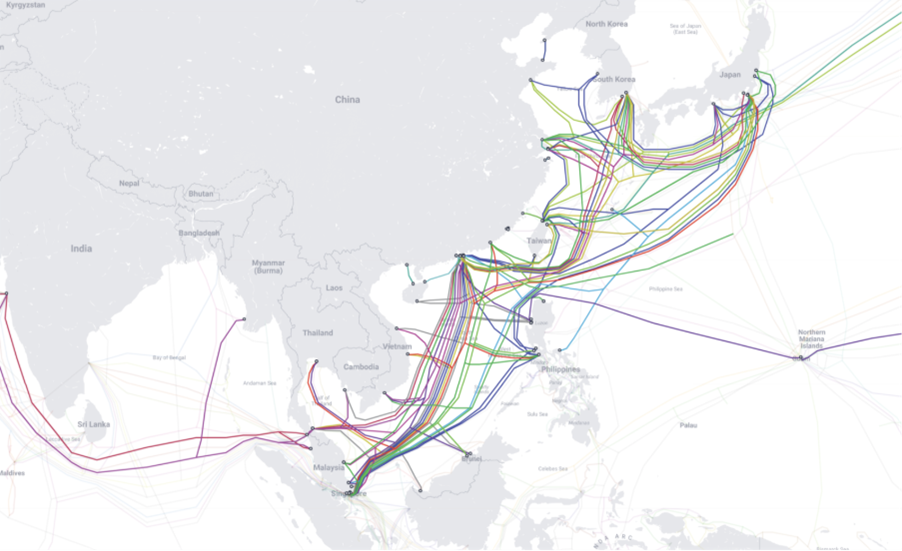
China is a major player in the global submarine cable network, building extensive domestic and international links to secure data flow and reduce reliance on foreign infrastructure. Key landing stations, including Chongming in Shanghai, Shantou, and Xiamen, connect major systems such as APCN-2, Asia-Pacific Gateway (APG), and the Trans-Pacific Express (TPE).
China’s investment strategy focuses on self-reliance and resilience, creating an independent digital infrastructure capable of withstanding external pressures. Chinese companies like HMN Tech now play a leading role in constructing and operating these underwater networks alongside global tech giants and traditional cable builders.
IPv6 deployment
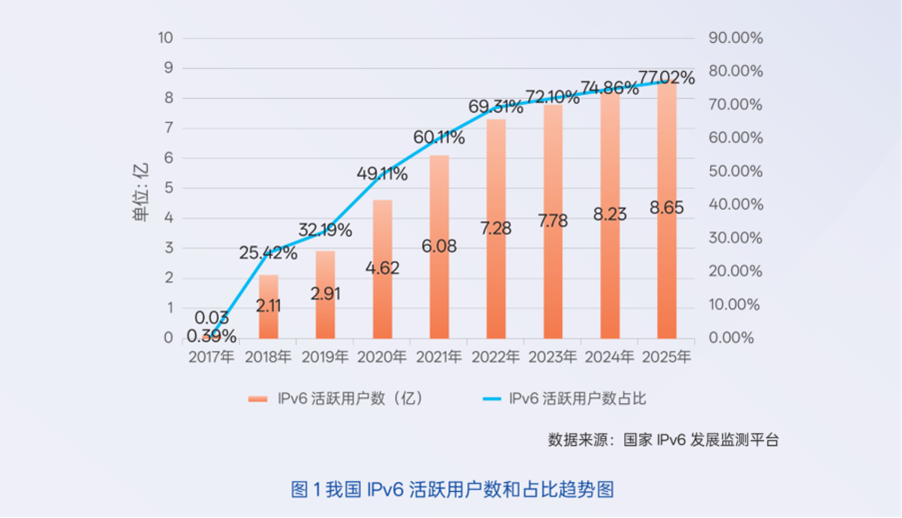
China has made significant progress in IPv6 deployment. China’s recent 2025 IPv6 Development Report showed that by September 2025, there were 865 million active IPv6 users — 77% of all Internet users. The report stated that IPv6 now carries 34% of total Internet traffic in China, with mobile networks at 69% and fixed networks at 31%.
Major operators have rolled out IPv6 across backbone, metro, mobile, and fixed networks, and new technologies like 5G and high-speed fibre are IPv6-ready by default. This upgrade supports data centres, cloud platforms, CDNs, and DNS systems, allowing more applications and services to run over IPv6. Key sectors such as government, education, finance, energy, and transport are also adopting IPv6, and popular apps and websites increasingly support it.
Pilot projects in nine cities and forty initiatives across the economy — including a program to reduce NAT44 infrastructure — are driving innovation. Over 200 IPv6 projects have emerged from community events, boosting awareness and collaboration.
Looking to 2030, China plans to expand single-stack IPv6, integrate it with AI, satellite networks, and autonomous vehicles, strengthen security, and embed it in smart cities, industrial IoT, and government systems. Coordinated long-term planning is setting the stage for a fully IPv6-enabled Internet future.
The IPv6 city
Xiong’an New Area, APNIC’s first city-level member, is a 2017 pilot city 100 km west of Beijing, designed as a model for future digital cities. Built IPv6-first, the city supports over 1 million IoT terminals per square kilometre and 198,000 sensors per square kilometre. A city-level IPv4 – IPv6 transition system enables dual-stack delivery externally while keeping internal networks IPv6-only, including optical and 5G networks using SRv6 for slicing.
The city’s computing centre provides IPv6-only cloud, edge, and supercomputing services with high energy efficiency (PUE ≤1.1), while IPsec and blockchain protect device communications. With a /28 IPv6 allocation from APNIC, Xiong’an can offer millions of routable subnets and uses centralized DHCPv6 to simplify large-scale IoT deployment, avoiding NAT and enabling scalable, future-ready connectivity.
RPKI deployment
Around 4% of China’s IPv4 address space is covered by valid Route Origin Authorizations (ROAs) (Figure 4). Compared with global adoption levels, which are around 57% for routed prefixes, China’s adoption is still emerging, offering opportunities to strengthen the security and resilience of its Internet routing infrastructure in the years ahead.
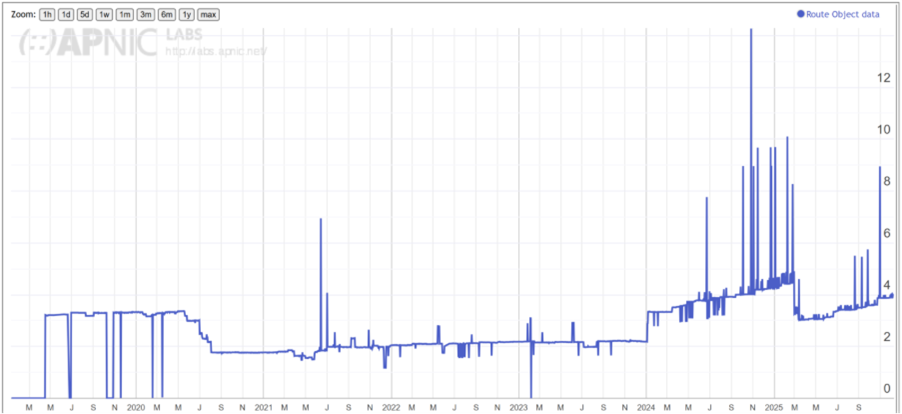
To that end, APNIC Academy training sessions related to RPKI have seen high engagement, with participants actively exploring ROA creation on both CNNIC and APNIC platforms. These efforts are expected to support longer-term RPKI adoption across China’s networks.
Internet community
China’s Internet ecosystem is supported by a diverse network of organizations that coordinate governance, security, and research. The China Internet Network Information Center (CNNIC) manages the .cn ccTLD, oversees key Internet resources, and represents China in international Internet governance forums. National cybersecurity initiatives are coordinated by CNCERT/CC, which engages with regional and global communities such as APCERT and FIRST.org to enhance resilience and response capabilities. On the academic and research side, the China Education and Research Network (CERNET) operates an IPv6-based backbone, CERNET2, connecting universities and research institutions nationwide.
The China Internet Governance Forum (IGF) provides a platform for dialogue on Internet governance, AI, and international cooperation, reflecting a broader trend of collaborative engagement across the Asia Pacific. By working with operators, researchers, policymakers, and technology partners, China and its counterparts are able to support the consistent deployment of technologies like IPv6, RPKI, and RDAP, promote shared learning, and contribute to a more secure, open, and interoperable Internet both regionally and globally.
The road ahead
China has built one of the world’s most extensive and complex Internet ecosystems, supported by sustained investment in connectivity, infrastructure, and policy coordination. Progress across access networks, IXPs, data centres, submarine cables, and IPv6 deployment reflects a long-term, system-wide approach to strengthening digital foundations.
China’s priorities continue to emphasise next-generation network development, digital economy growth, and cybersecurity. Together, these objectives provide a stable framework for expanding IPv6, improving routing security, and supporting the scale and resilience required by cloud services, smart cities, and emerging applications.
Looking ahead, continued investment in advanced networks, data infrastructure, and community capacity building will shape China’s ability to meet future economic and societal digital demands, while contributing to a more secure, scalable, and interoperable Internet at both regional and global levels.
The views expressed by the authors of this blog are their own and do not necessarily reflect the views of APNIC. Please note a Code of Conduct applies to this blog.