

Satellite mega-constellations like Starlink and OneWeb are extending the Internet’s reach to every corner of the world. However, Low Earth Orbit (LEO) network paths change frequently, challenging conventional transport congestion control designed for the terrestrial Internet.
Broadband Internet from space
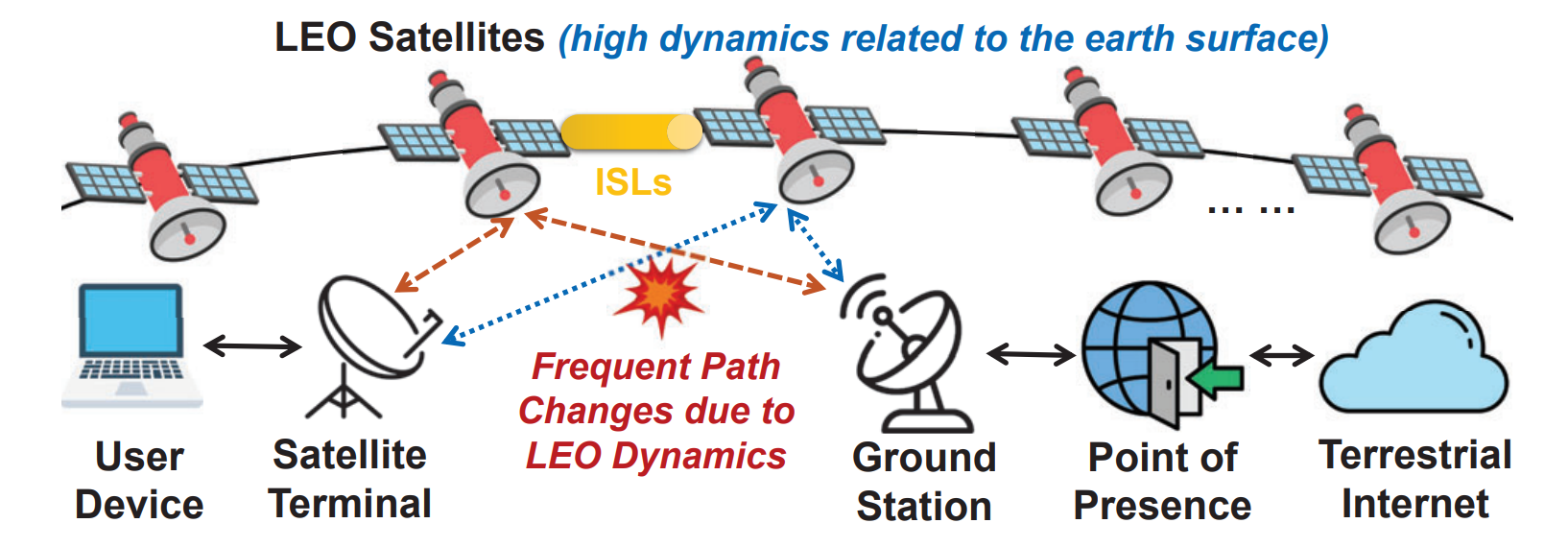
Figure 1 illustrates a typical LEO satellite network architecture. Operating at 550-2000km altitude, broadband satellites relay user data through ground stations (GSes) and Point of Presence (PoP) to the Internet, and vice versa. Some satellites can also be equipped with Inter-Satellite Laser Links (ISLs), enabling coverage in areas far from any ground station, such as aircraft or maritime users.
Misleading effects of LEO dynamics on Internet congestion control
Because LEO satellites move rapidly around Earth, the forwarding path between a user terminal and a ground station changes frequently. In practice, each path change often brings variations in bottleneck capacity, delay, and loss rate. However, end-host congestion control cannot easily tell whether these performance changes are caused by actual congestion or by LEO path changes. These unique ‘LEO dynamics’ may ‘mislead’ the transport-layer congestion avoidance logic, and pose a major challenge to today’s Internet congestion control.
Figure 2 shows the performance of several widely used and research-proposed congestion control algorithms (CCAs) in a real LEO network. The results were collected based on a Starlink terminal deployed in Europe, sending data from the terminal to a nearby cloud server with different CCAs. Here, the LEO satellite link is the bottleneck of the end-to-end connection. From the results in Figure 2, we observe three key findings.

Firstly, loss and delay increases do not always indicate congestion in LEO networks. Packet loss or delay spikes can simply result from satellite path changes rather than actual congestion. As a result, traditional loss-based or delay-based CCAs such as Cubic, Vegas, and Copa suffer from very low throughput.
Secondly, precisely modelling a time-varying LEO bottleneck is difficult. Bottleneck Bandwidth and Round-trip propagation time (BBR), a widely used model-based CCA, estimates bottleneck bandwidth using a max filter. When link capacity fluctuates rapidly, BBRv1 tends to overestimate bandwidth, leading to excessive queueing delay. Although BBRv3 adds a loss threshold to slow down under high loss rates, it still suffers from self-limiting performance over lossy LEO links.
Thirdly, learning-based rate control struggles to converge. Recent research explores ML-driven congestion control, such as VIVACE and Proteus. However, due to the highly dynamic nature of LEO networks, real-life measurements show that these learning-based methods often fail to converge to a stable sending rate, and they involve high queuing delay.
Collectively, the real-world measurements reveal that the massive network variations caused by LEO dynamics, rather than congestion, break the fundamental assumptions behind existing CCAs, preventing them from achieving the best balance between throughput and delay as they did in conventional terrestrial networks.
LeoCC: Using reconfiguration information to improve congestion control

To make Internet congestion control more robust to LEO dynamics, researchers from Tsinghua University have proposed LeoCC, a new CCA designed specifically for LEO networks. LeoCC builds on a key insight: Performance variations in LEO networks are closely tied to an important mechanism called LEO reconfiguration.
In practice, satellite operators typically employ an LEO connection reconfiguration mechanism to schedule, manage, and update connections between satellites and ground entities (for example, terminals and GSes). These reconfiguration events can be inferred from patterns in the ACK intervals observed at the sender.
Thus, LeoCC incorporates reconfiguration awareness into its congestion control logic. It maintains a dynamic bottleneck model that identifies and discards outdated samples collected before reconfiguration, preventing misleading estimates of the current network state. Figure 3 compares LeoCC with other CCAs. Experiments driven by real LEO network data show that LeoCC achieves a significantly better delay-throughput balance than existing algorithms under various replayed LEO conditions.
Learn more in our LeoCC research paper. The open-source implementation is available at GitHub.
We hope the LeoCC work will inspire further research on congestion control for LEO networks and provide practical insights for network operators and engineers working to build the next generation of satellite Internet.
Zeqi Lai is an associate professor at the Institute for Network Sciences and Cyberspace, Tsinghua University. He has long been engaged in research and education in computer networks, with a particular focus on mobile/wireless networks and satellite Internet.
The views expressed by the authors of this blog are their own and do not necessarily reflect the views of APNIC. Please note a Code of Conduct applies to this blog.